The Hard Road and Beach LIfe

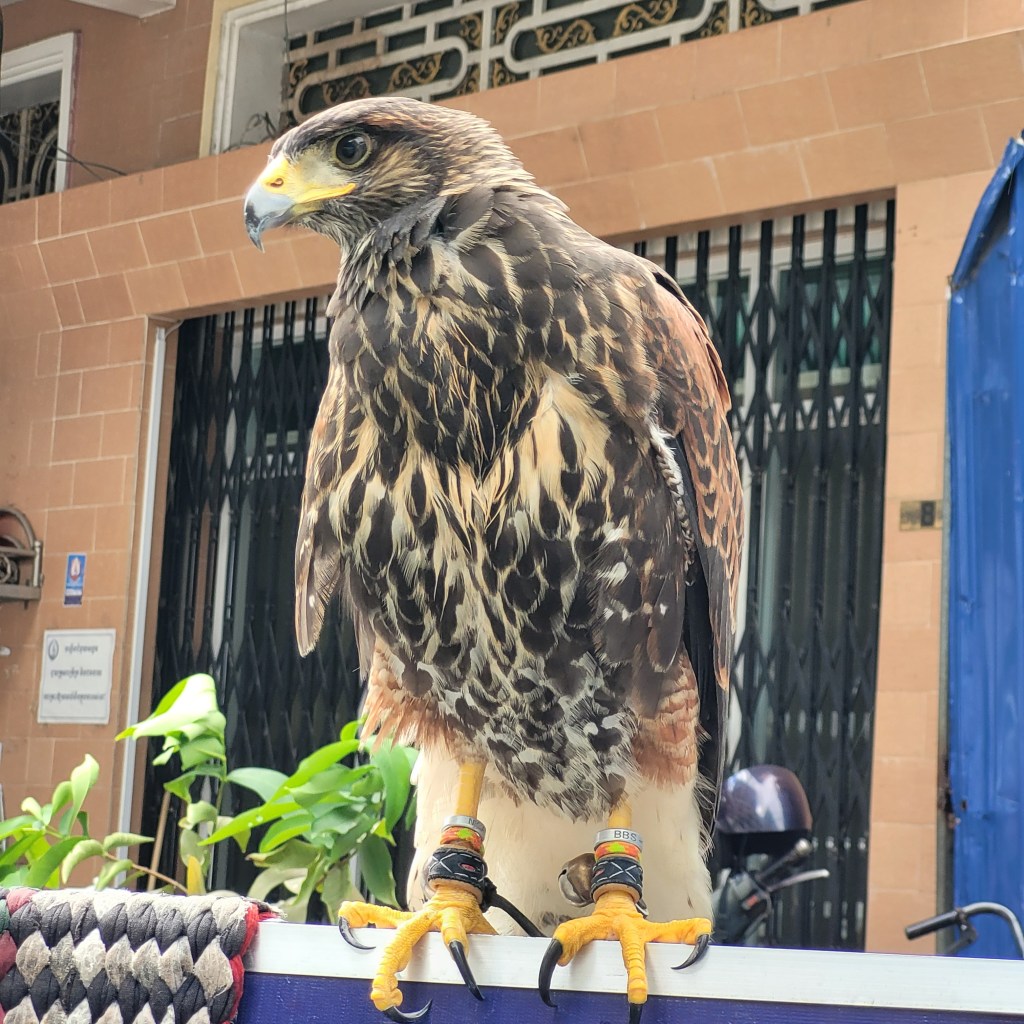
The proprietor of the hostel in Kampot barely looked up as I dropped off the key on the desk and departed. I booked my bus ticket to Sihanoukville with a smaller company running minibuses, and was happily shocked when I discovered that the staff member had an excellent feathered friend.

A Falcon? in Cambodia?

The minibus was an older model, but I tend to be more concerned with the driver than the vehicle in SE Asia. An hour out of Kampot the road becomes an unsealed mess, forcing the driver to slow to a walking pace as he negotiated a path through the worst of the potholes.

Not the best example of Cambodia infrastructure.

Sometimes due to heavy vehicle traffic, the bus was forced onto the very soft shoulder, leaving the whole bus to be on an angle, which made me rather nervous, but our driver knew how far he could push this. I noted in alarm that there were several stockpiles of blue metal on the side of the road as if the money to fix the road only lasted long enough to transport the materials on-site. Two hours and a bruised coccyx later we reached the outskirts of Sihanoukville.

Phnom Penh is ugly because by the time anyone realised they could make it beautiful it was too late. Sihanoukville is ugly out of a twisted sense of civic pride. Rampant Chinese investment has left the place a horrid monstrosity of over-development. Russian interests have led to high crime, and according to the expat I shared a beer with last time I was here, means it is easier to get a sad handjob from a Russian than any local. But I was not here for handjobs, sad or otherwise. I was only interested in getting to Koh Rong Samloen. I only had enough time to order, but not drink a latte before a lady escorted us from the bus office to the pier. Still clutching my coffee, I managed to go to the Seven-Eleven to buy some jubes and some questionable Dim Sum on a stick, then jumped on the ferry. Luckily and dispite the best efforts of the skipper, I ate and kept down the coffee, jubes and dim sum by the time we docked at Koh Rong Samleon.

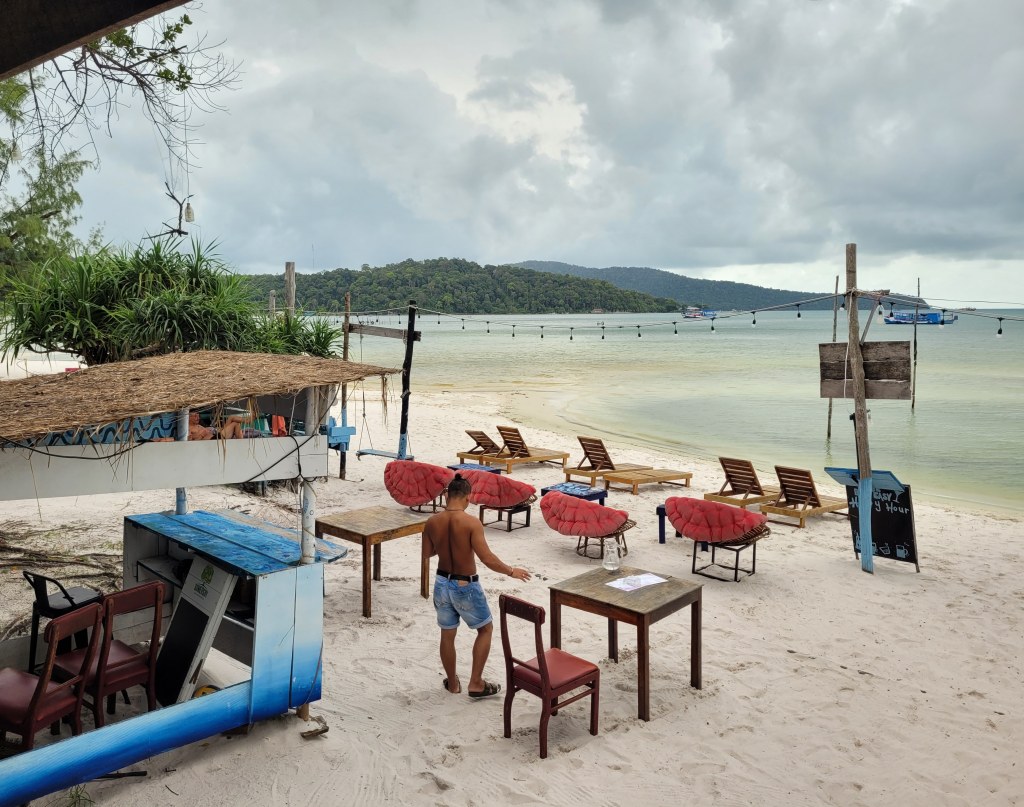
Beach, and eye candy.

Island life is slow. You wake up, eat when you want, swim when you want and shower and head to bed when ever you feel like it. I spent four nights on the island, quickly settling into the routine.

Second night in and I was safely tucked into my dorm bed with the curtain drawn when, with a very Italian arrogance, the lady in the bunk above me peeked into my space and asked if I knew how to turn off the air con. No idea I replied, in shock at this breach of etiquette. A few hours later I was being kept awake by the same Italian moaning, and whacking the rail. Next thing I know she’s again in my space, and asked me if I could sleep on my side so I don’t snore. Wordlessly I turn onto my side, while thinking how the fuck was I snoring when I was awake because of her? Nothing is said the next day, but I overhear another lady telling a friend on the phone that a friend of hers in the hostel had a kidney infection, which is, of course, a problem when it is easier to get hash brownies than antibiotics on the island. I wonder if those two things were related.

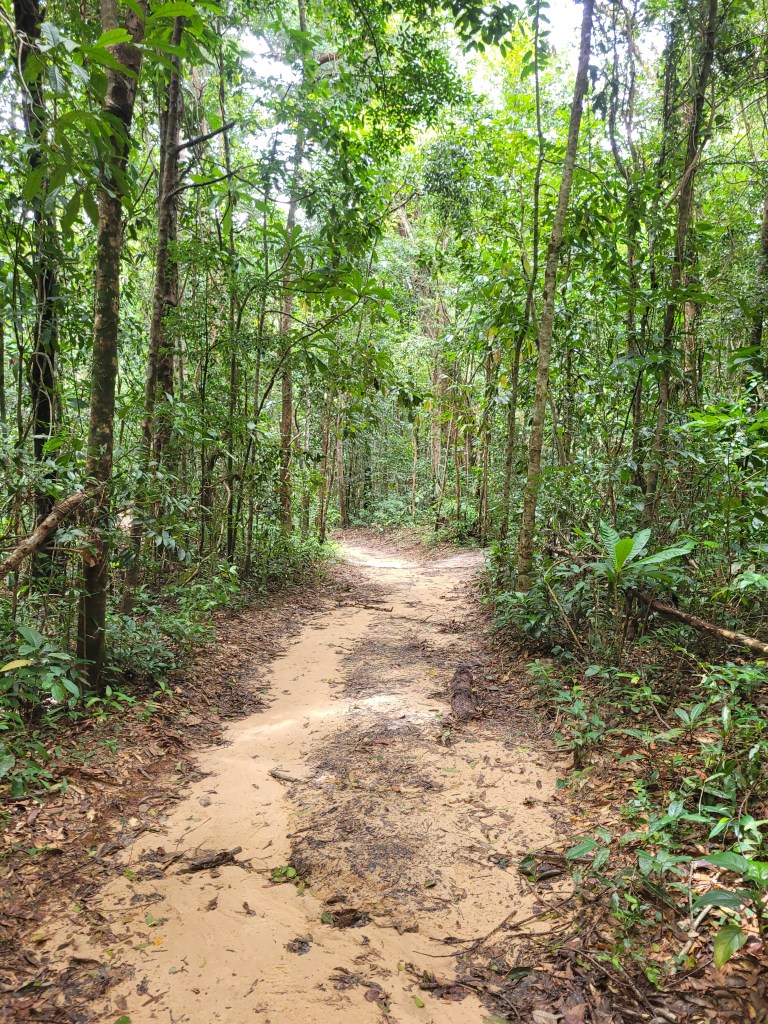
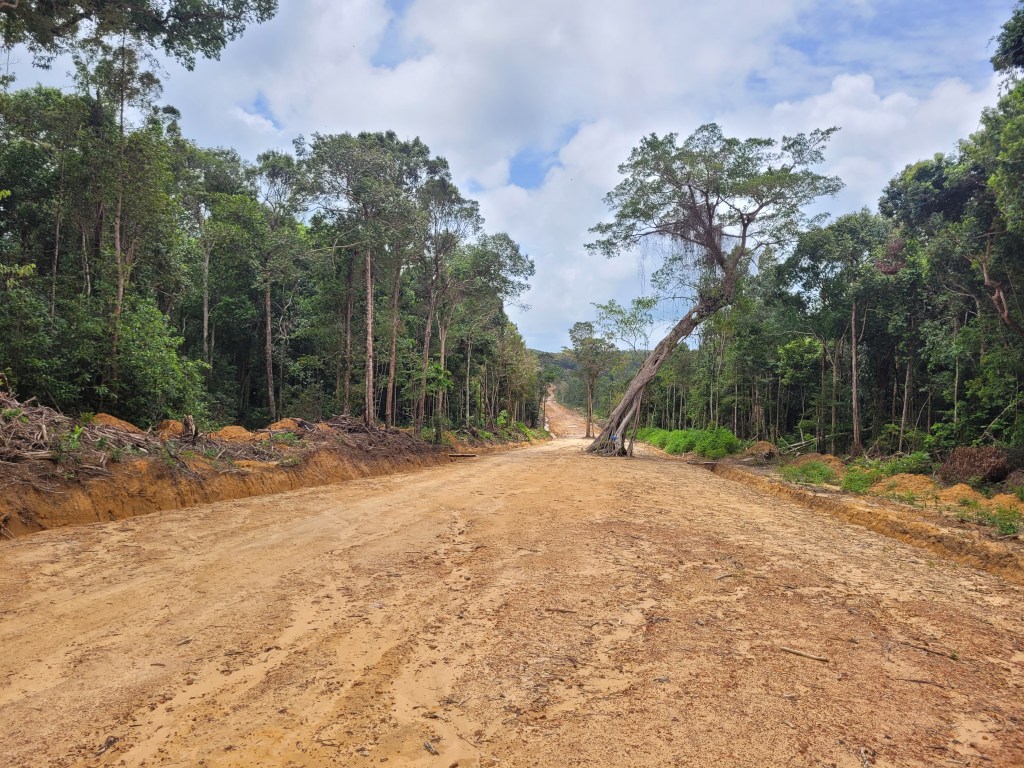
On my day on the island I decided to take a walk to the other side of the island to Lazy Beach. It starts off looking like the early stage of a highway build, and then I turn into a more standard jungle path.

If we go out in the woods today…

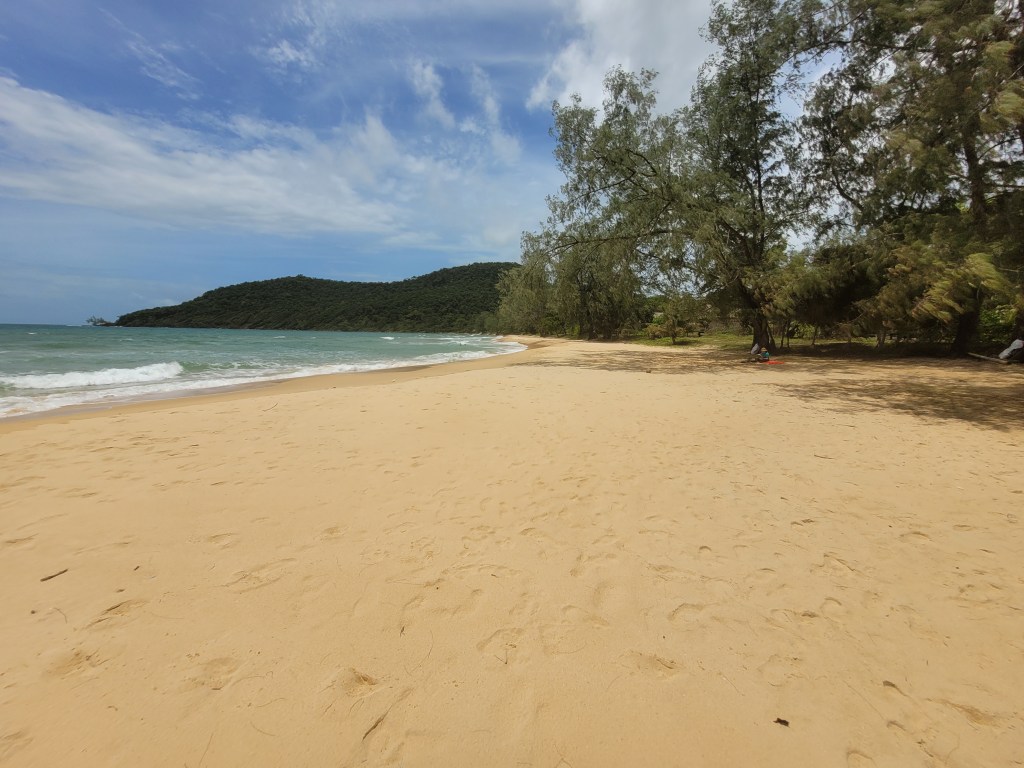
A wasp decides to attack me on the big toe, but I manage to brush it away before it does too much damage, and I keep walking. I end up at the rear of a semi-abandoned resort, and then the beach.

Not sure why the sand is limestone .

I spend a quarter of an hour swimming in the choppy surf before having a read in the shade before heading back.

Seems excessive clearling, and probably the result of machines being used to clear.

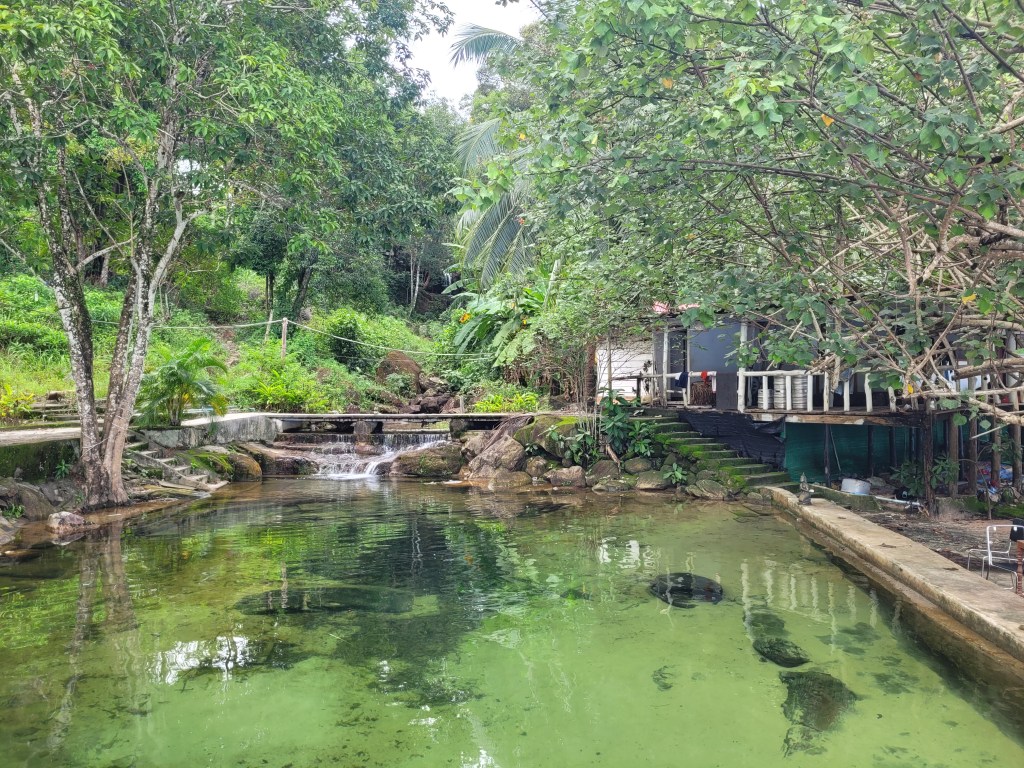
After a late lunch, I go for a lazy walk to the far end of the bay, to check out a waterfall, which turned out to be a little disappointing.

But the pool was nice.

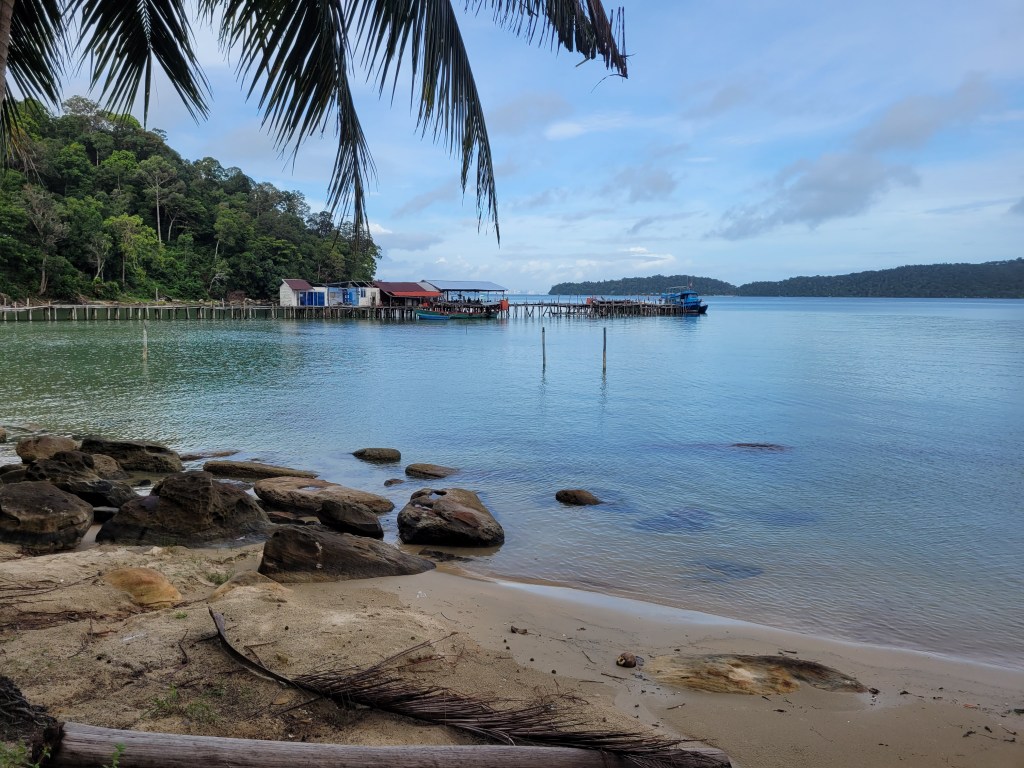
However, the walk did show me the tumultuous nature of the tourist industry on the island. I saw an empty resort with a skeleton staff feeding scraps to dogs, and abandoned villas, with overgrown gardens. Again I can’t help wonder how it would be now if COVID never happened.

Maybe they failed because of the lack of sand.

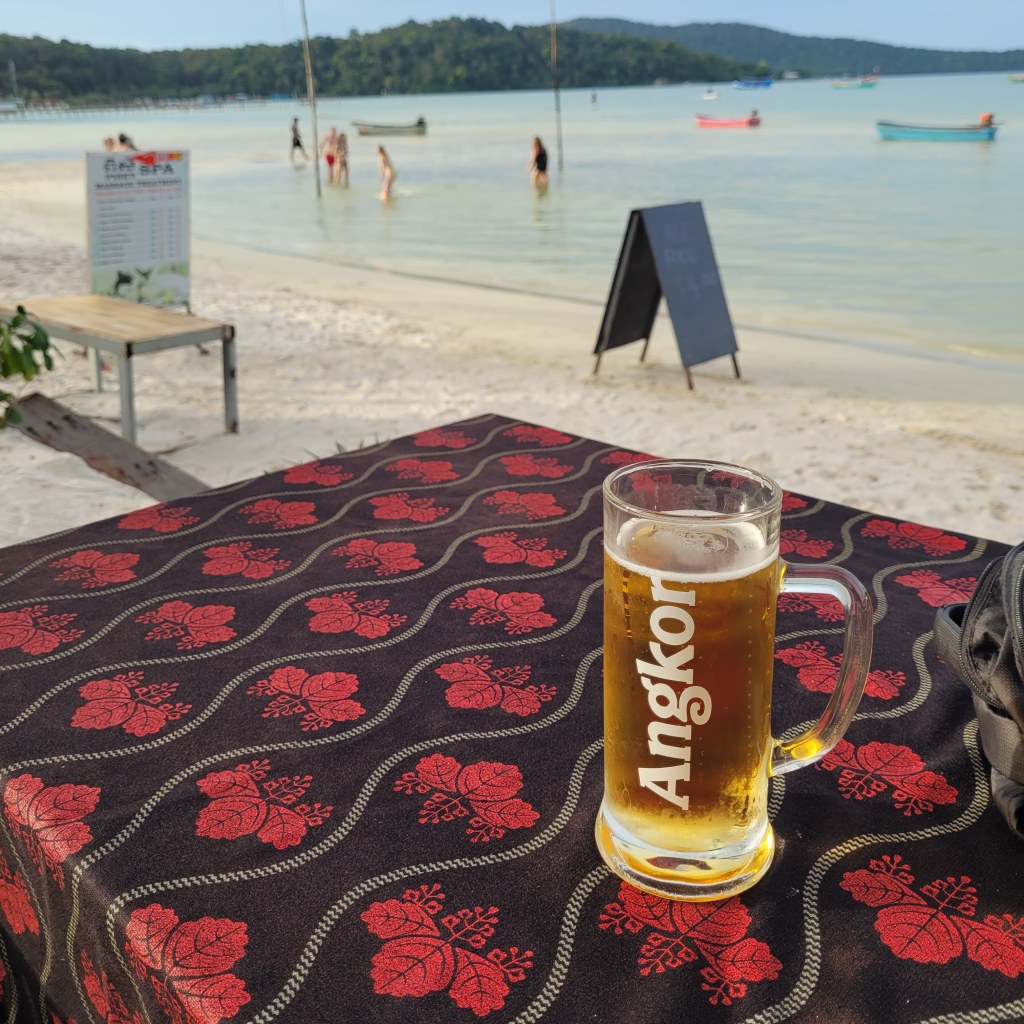
When I returned to my hostel I discovered that a tour group had been dropped off, and were busy taking advantage of the happy hour half-priced cocktails. While this no doubt made the owner happy, I felt that the number of Eurotrash babes in the shallow water taking selfies had reached critical mass, and I took my first beer for the day a few metres up the beach.

Quieter as well.

Fragments of Phnom Penh

The hotel I am staying at is owned by an Australian, and they have the TV in the bar streaming Foxtel, an Australian cable network. I keep glancing up and seeing familiar advertisements for Bunnings, Hungry Jacks and My Chemist Warehouse, in between highlights of AFL.

On my last night, I glanced up at the TV above reception and it’s playing Miss Cambodia. I don’t need this, I mutter to myself, then grab my phone to message Arum that I love her.

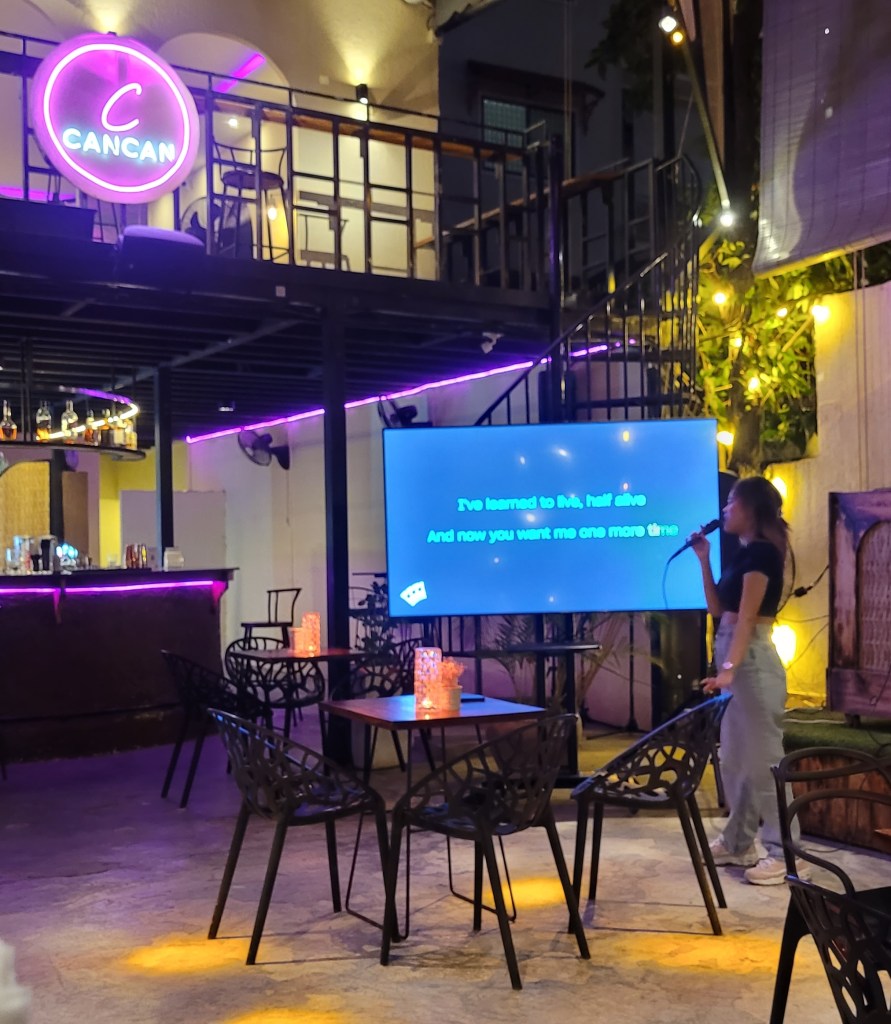
I take a Tuktuk to Bassac Street, the local nightlife “walking street” that every Cambodian has told me I must visit. I have dinner and beers, and watch some fairly entertaining Karaoke, but after Hanoi and Saigon, it’s fairly quiet and tame. The Tuktuk driver on the way back barely waits for me to sit down before roaring off, and changes gears as if the clutch slept with his wife.

Taylor Swift 😦

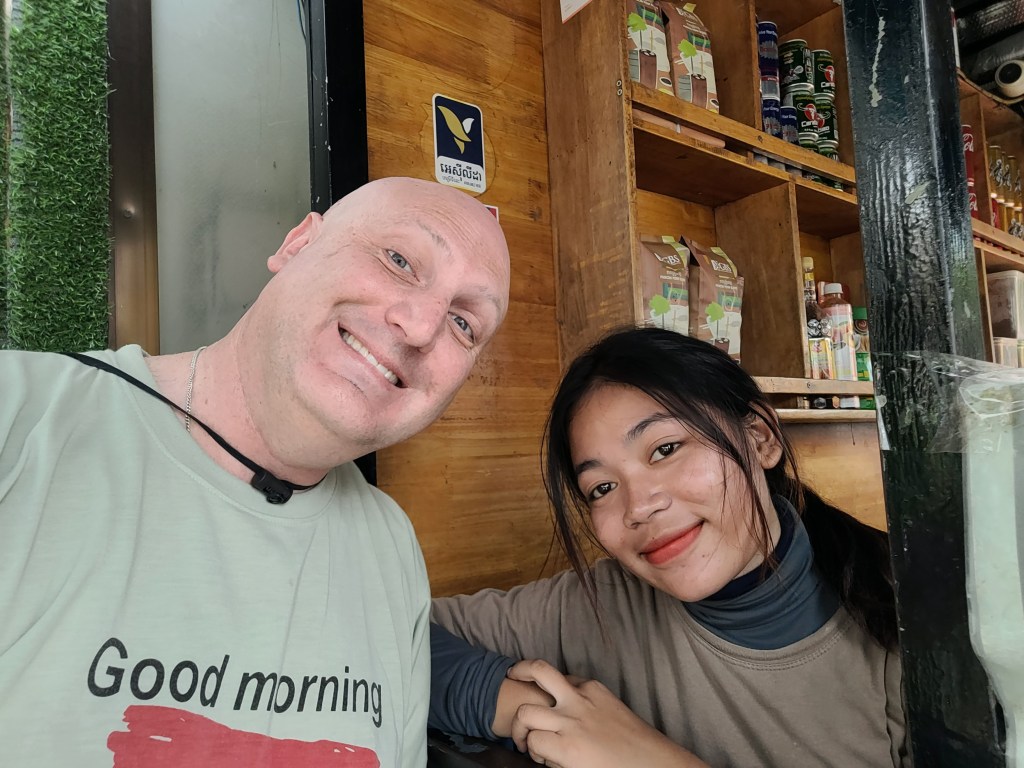
The coffee at the hotel is nothing more than instant, so I discover a small stall thirty metres away, where the lady owner, Passregsa, does a steady trade to nurses from the local hospital, parents to students at the nearby school, and many local professionals. There might not be air conditioning, but she charges a third of the price of the Starbucks around the corner.

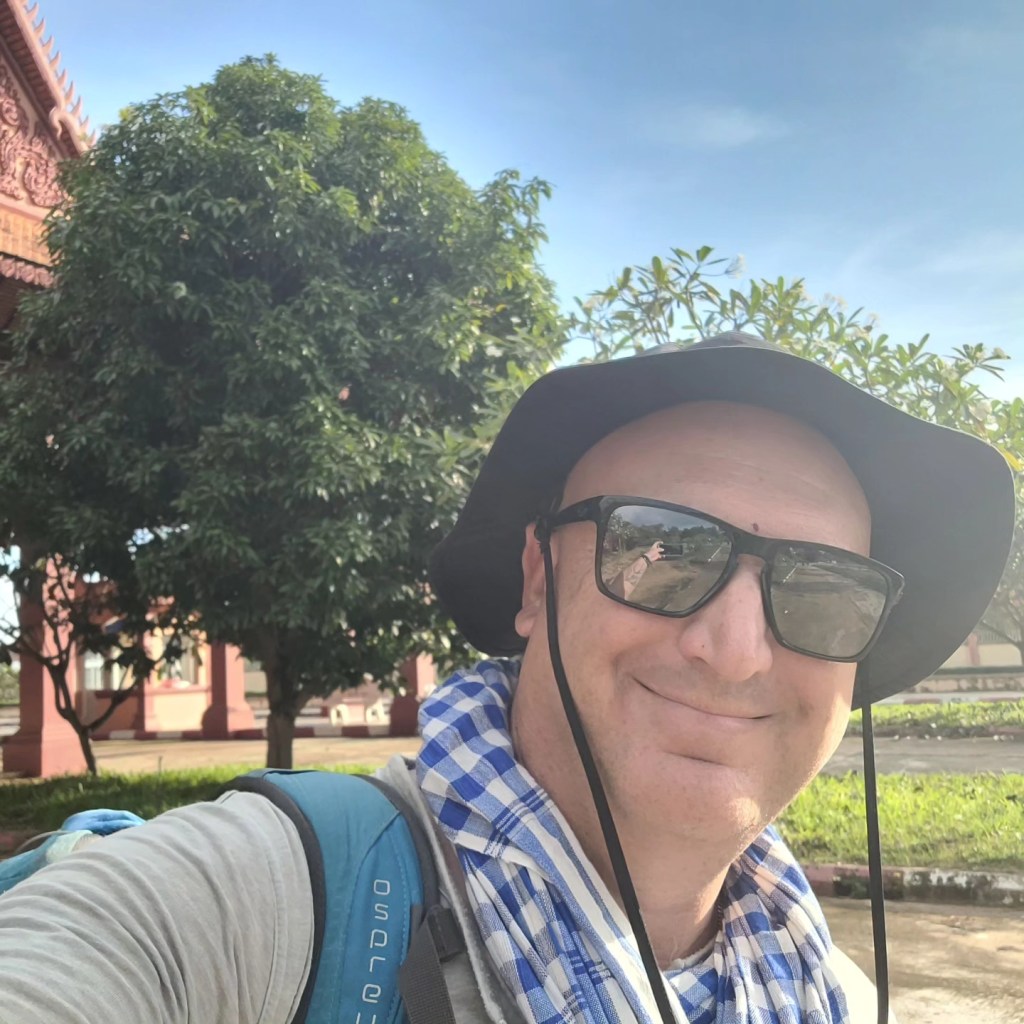
Selfie time!

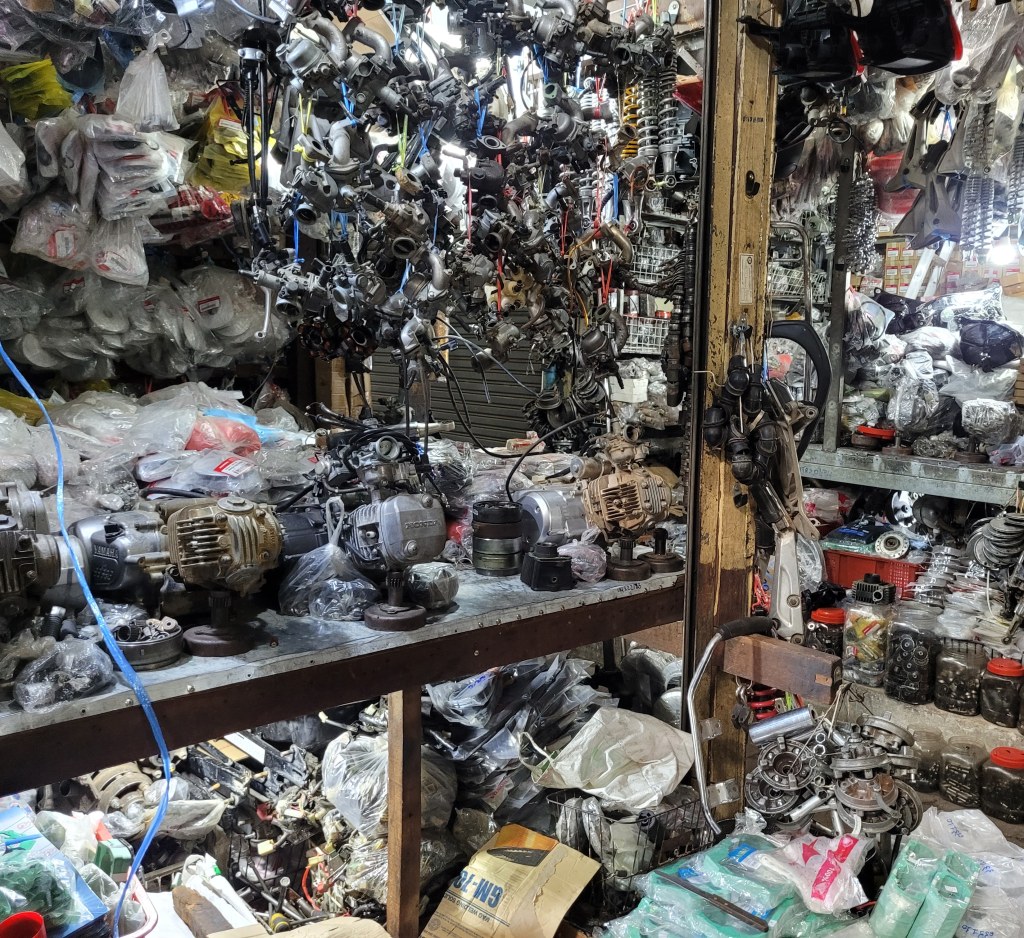
The Russian Market. The Russians have moved on but the name remains. Clothes, fragrances, homewares and trinkets, motorbike parts and just about anything you can think of is available here. Also food, which for me was Mae Pok, and as an added bonus the last of the fishball soup in the pot. The fishball soup is not to my taste but I gave it ago before pushing it to the side.

Might take you a while to find anything though.

On a whim with time to kill before my bus out of town, I decided to get a massage. The masseur was attractive, but not scantily dressed, so I assumed everything was legitimate. Then she pointed at my groin and said something I couldn’t understand. I managed to convey that I didn’t want any “extras”, but I considered myself lucky that I left with my virtue intact.

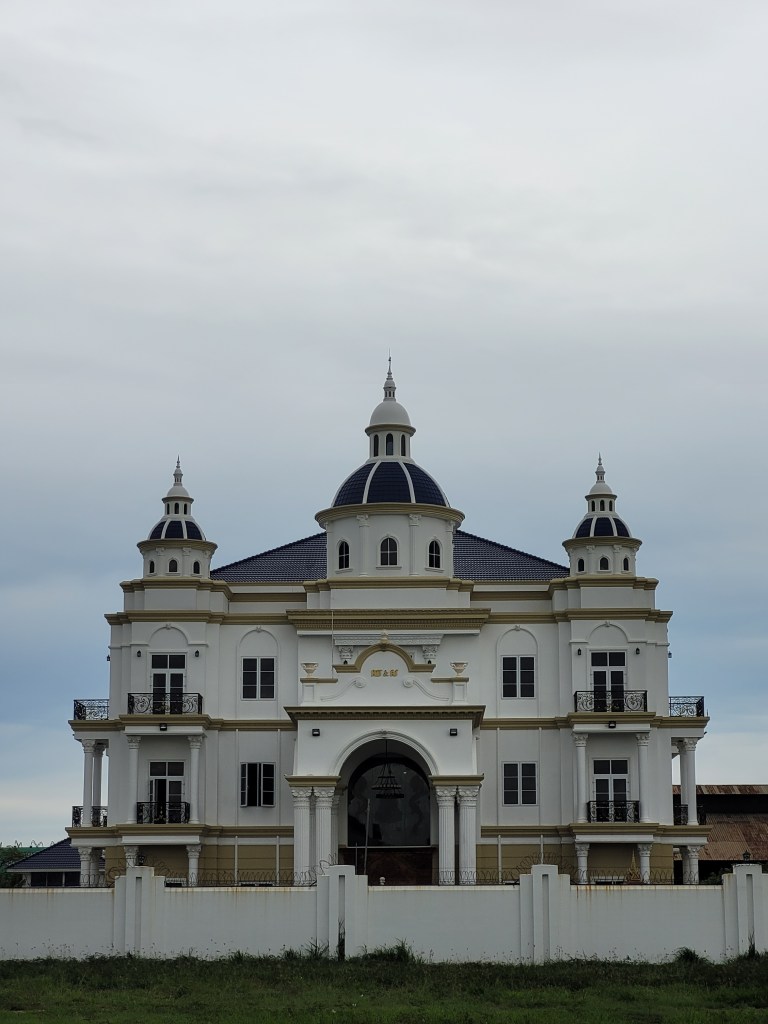
At a petrol station on the outskirts of town, our bus parked at a forty-five-degree angle from the bowsers. Next door is a villa, virtually a mansion. Over the road is a line of hovels that probably flood every time it rains.

Genocide and a Complete Lack of Puns

As soon as I realised that every bus from Saigon heading into Cambodia ended in Phnom Penh, I knew I could not avoid the graceless capital, and therefore could not avoid revisiting The Killing Fields and S21 Genocide Museum. I booked a tour through my hotel as soon as I woke up, which further cemented me to this course of action.

The next morning I was picked up in a minibus and drove downtown to pick up the other client, a Frenchman called Thomas. On our way to the Killing Fields, our guide gave us a solid background in the political realities that led to Pol Pot seizing power. I will not attempt to recount that here, but invite my gentle readers to research this themselves if they wish.

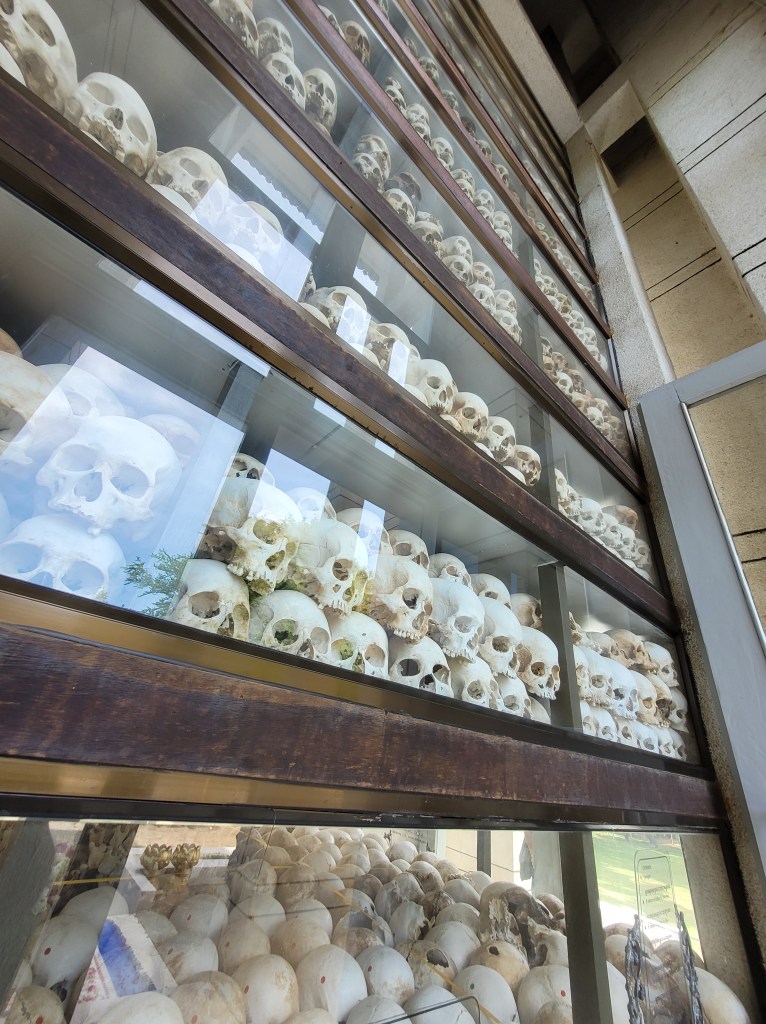
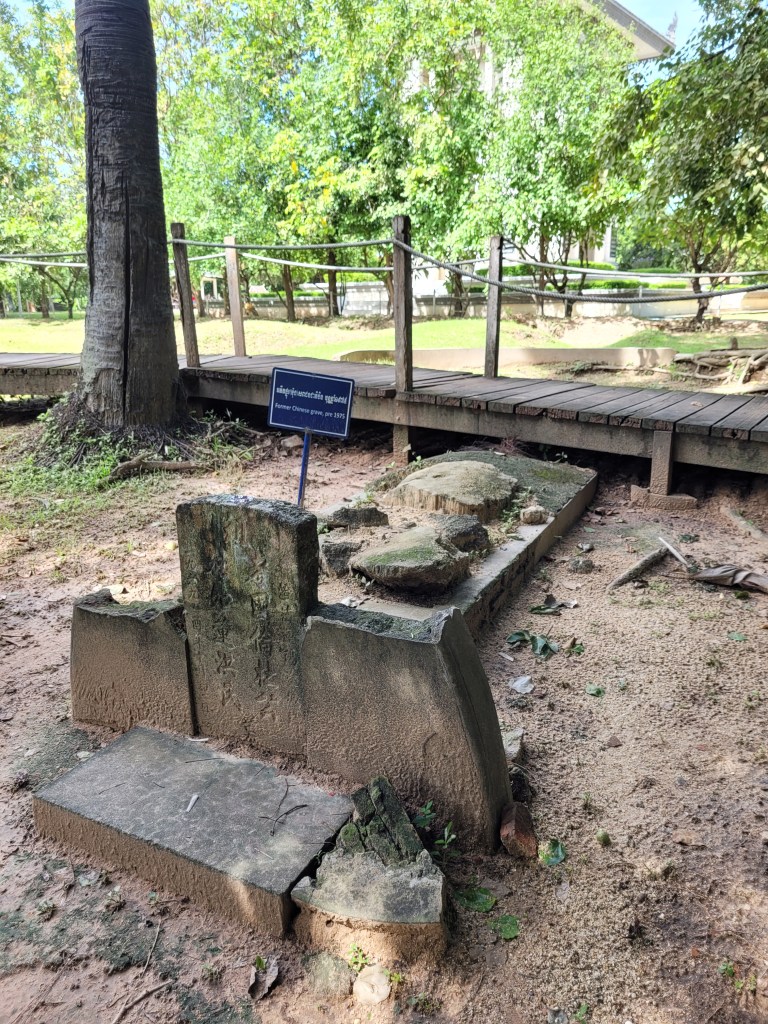
The Cheung Ek Genocidal Center is in the poorer outskirts of the city. It was before the regime, an orchard and a Chinese cemetery. Truckloads of prisoners were unloaded, and slaughtered using common agricultural tools, in addition to other improvised methods, to save using bullets that would have to be bought from China. The central point of the Killing Fields is a Stupa, containing a multistorey display case, containing over eight thousand skulls, less than half the souls who met their end here.

Maybe the least tasteful photo I have ever taken.

Many of the Chinese graves were destroyed in the process, and only a handful of the headstones still visable, all broken.

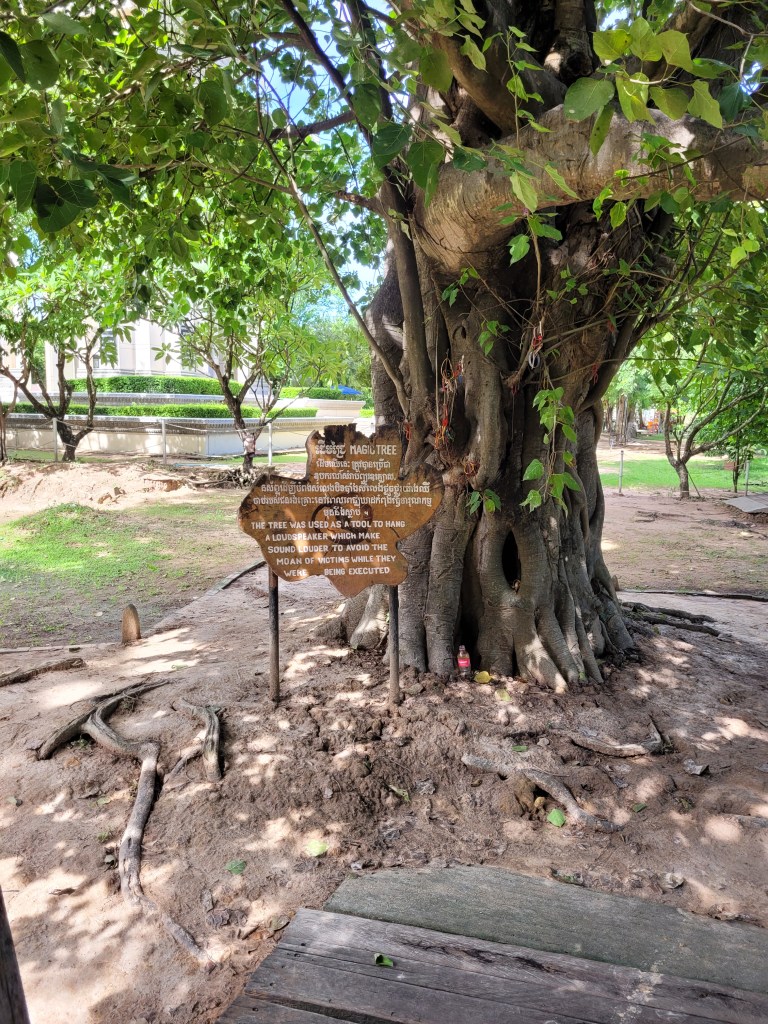
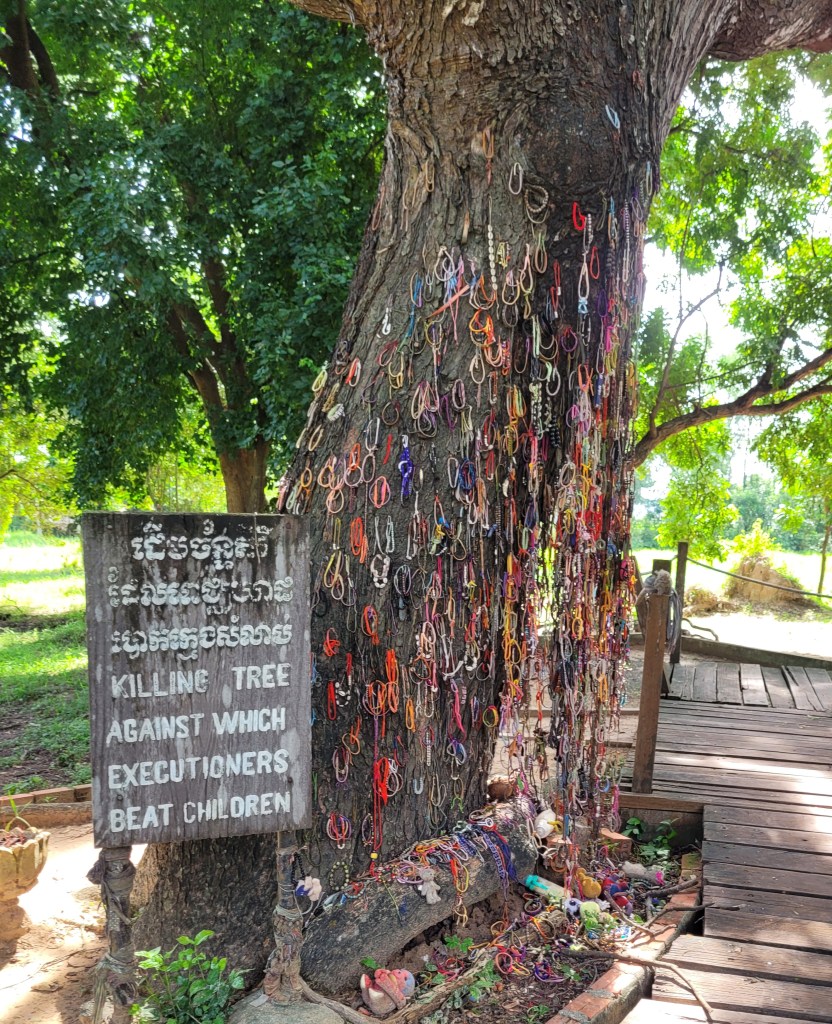
Due to the barbaric nature of the executions, the moans and screams of the victims was masked by playing audio through a speaker strung up on a tree branch, to not disturb the later victims.

“The tree was used as a tool to hang a loudspeaker which make sound louder to avoid the moan of victims while they were being excecuted”

Children, tragically, were also victims here. often killed right in front of their mothers, who were also sorely used by the soldiers. The children were killed using a method straight out of the old testament, that I cannot bring myself to type here.

Nope, not typing that out.

A modest shrine of bracelets, and baby bottles and toys has grown, unplanned on the tree. I added one of my own.

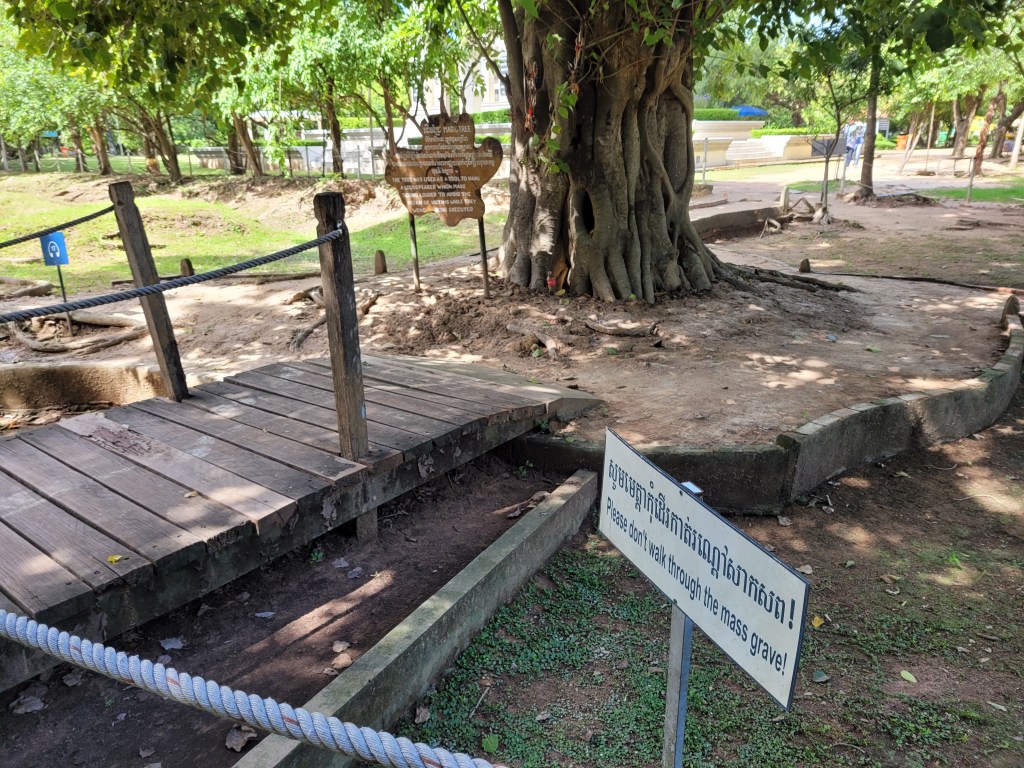
Not all of the mass graves have been excavated, and everyday clothes and bone fragments are brought to the surface in a horrifying display of erosion.

Even the supporters were not immune. one of the mass graves contained over a hundred soldiers, who having returned from Vietnam, became victims of Pol Pot’s paranoia, they were buried without their heads.

“Please don’t walk through the mass grave!”

DDT, the now universally banned herbicide, was used to speed up the decomposition of bodies and to mask the smell. I could not help but think about Holy Innocents Cemetery in Paris, how so many bodies were buried that the ground lost the ability to decompose the bodies. The the comparison is apt, but equally stomach-turning.

It might be possible to exaggerate the numbers, but not the sheer horror, and the famous Kiling Fields are only one of the sites with mass graves.

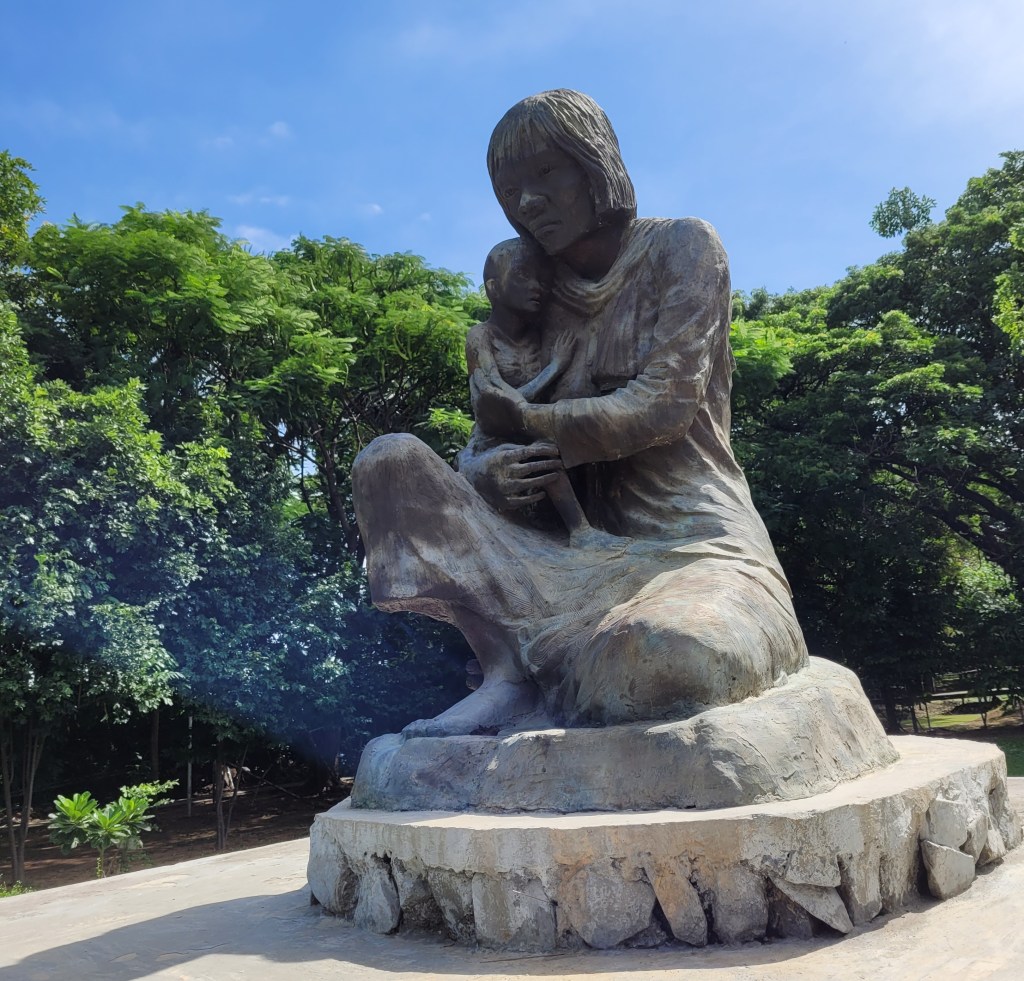
Depicting the wife of Sek Sath, former party offical, who met her end at the Killing Fields.

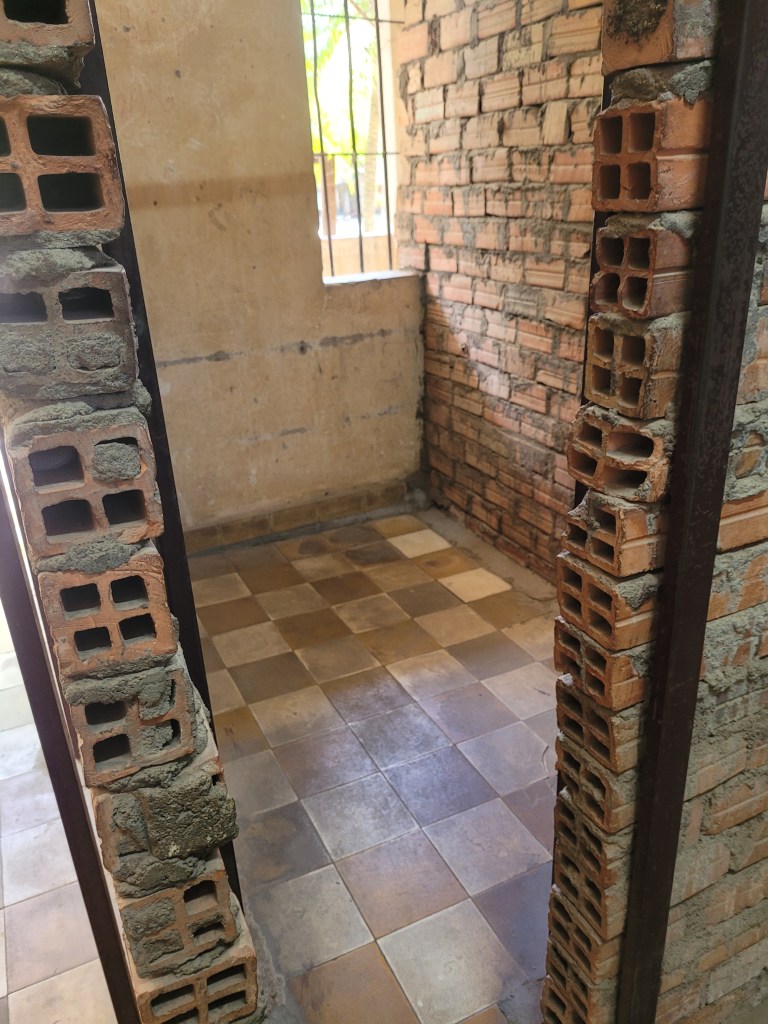
We moved on to the S21 Genocide Museum, a lesser-known, but equally heartbreaking site. A former school, it was converted into a prison for those awaiting transport elsewhere, and those awaiting interrogation. Cells varied, some for “VIPs”, the size of the original classrooms, others subdivided with rough brick walls. All prisoners were chained to the floor, with or without beds, with an old ammo box as a toilet. Rarely were prisoners bathed, by a guard holding a hose through a window.

“VIP” cell

Despite the years of cleaning and the opinion of our guide, you can still detect a hint of the horrible smell. I don’t think it will ever leave.

Cell for common prisoners.

I won’t describe the torture. Imagine the most painful, the most extreme removal of human dignity, triple it and you may come close to the realities endured, and not endured by the prisoners.

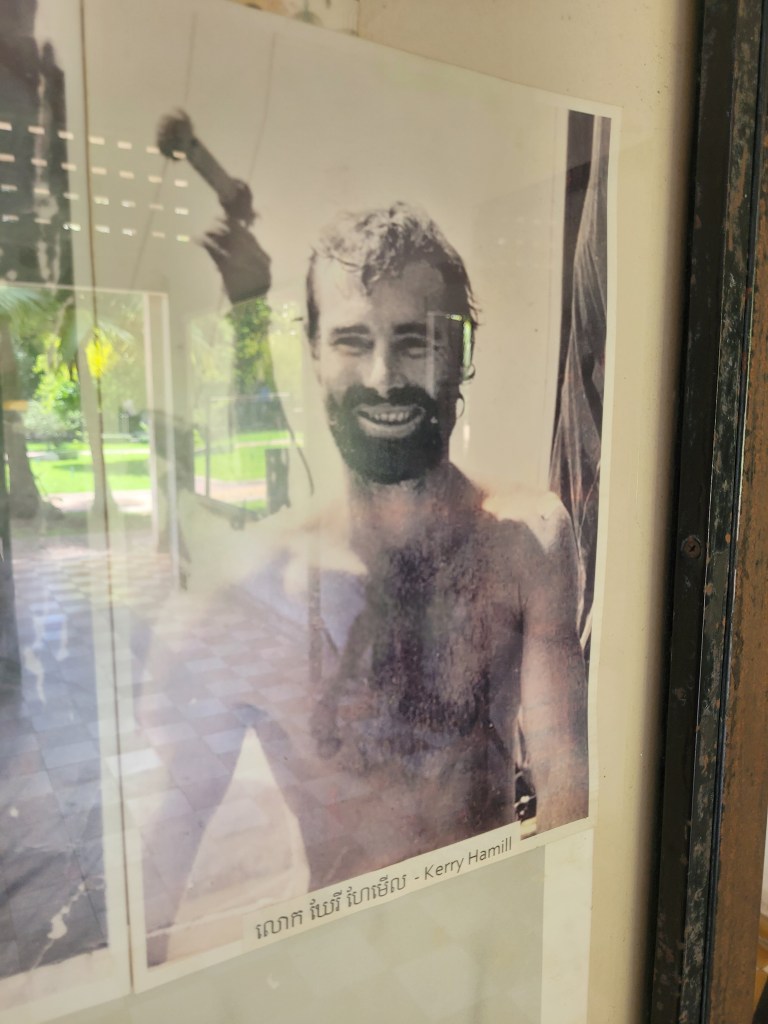
Prisoners were forced to confess to crimes, regardless of how illogical they were. A fact demonstrated somewhat gleefully by our guide, who told us the story of the New Zealander adventurer Kerry Hamill, who confessed under torture that his CIA handler was Colonial Saunders, of KFC fame. He was nothing but a tourist, but this mattered little to the regime.

Kerry Hamill

The regime kept excellent records. Every prisoner was photgraphed and measured on their entry to S21. Some of these photos are on display. The eyes stare back at us, most not angry or afraid, simply resigned to their fate.

“Everything belongs to the regime, including our lives”

I couldn’t help but think on the drive back to my hotel that quite a few Kymers make at least part of their living from these horrific sites. Gardners, cleaners, ticket sellers, maintenance workers and probably a dozen other professions unknown to me. They all show up to these nightmarish blights on Cambodian history. It must take an extraordinary level of emotional control, or severe dissonance. The lovely lady working reception at my hotel, who like me was not alive during the Kymer Rouge, said she had visited the Killing Fields once, and nothing would convince her to ever visit ever again.

Hungover Border Crossing

The next morning I barely managed to settle my bill, and get a Grab to what turned out to be the back of a warehouse, and not the bus station or office that I expected, even though it was the pickup point listed on the ticket. I sat on the steps of a nearby agricultural bank for half an hour, considering the futility of man, the nature of my self-destructive tendencies, and how the bank staff would react if I got a swag, a portaloo, and an esky full of ice and Pocari Sweat delivered right here and just smiled inanely for the next year.

Finally summoning a herculean level of willpower, I walked to the nearest intersection and hailed a taxi. The taxi driver didn’t speak a word of English, which was fine because I don’t speak a word of Vietnamese. After trying to drop me off a hundred metres up the road, I managed to convince him I wanted to go further, showing him what I hoped was the bus company office on my phone. He then tried to drop me off at a hotel a kilometre down the road, and when I refused to get out he enlisted a staff member who spoke English and we managed, somehow to get to the office.

A few minutes later I was sitting in the office, staring at the bus over the road that I was told was the bus I needed, because I had completely regressed out of object permanence. Exactly on time I boarded the bus.

I was the only Westerner on the bus, and I suspected the only non-Kymer, we were all heading over the border into Cambodia, and ultimately the capital.

Half way through our seven-hour journey we exited Vietnam and entered Cambodia. the whole procedure was done by our guide, who collected passports, got us to wait inside the checkpoint building, then back into the bus for a short trip to the Cambodian side, where the procedure was repeated. Luckily no questions were asked of me, as I doubt I could have recited my date of birth. The Cambodian border town was a graceless monstrosity given mostly over to dubious-looking casinos, and we had a meal break before continuing, and a short stop for me to go to an ATM to pay back our guide who paid my visa fee for me because the fee must be paid in USD.

Hours later, we entered Phnom Penh, passing Wat Phnom and Independance Monument, before stopping at the bus company office. Grabbing my pack, I stepped into the office and begged the WIFI password from the most stunning lady working there. I did a little dance of joy when I discovered that my hotel was a ten minute walk from the office, and I bypassed the Tuk Tuk drivers and made my way to the hotel on foot. There I managed to check in without further incident, where I showered, shaved and and slept for ten hours, the deep, untroubled sleep of children, and idiots.

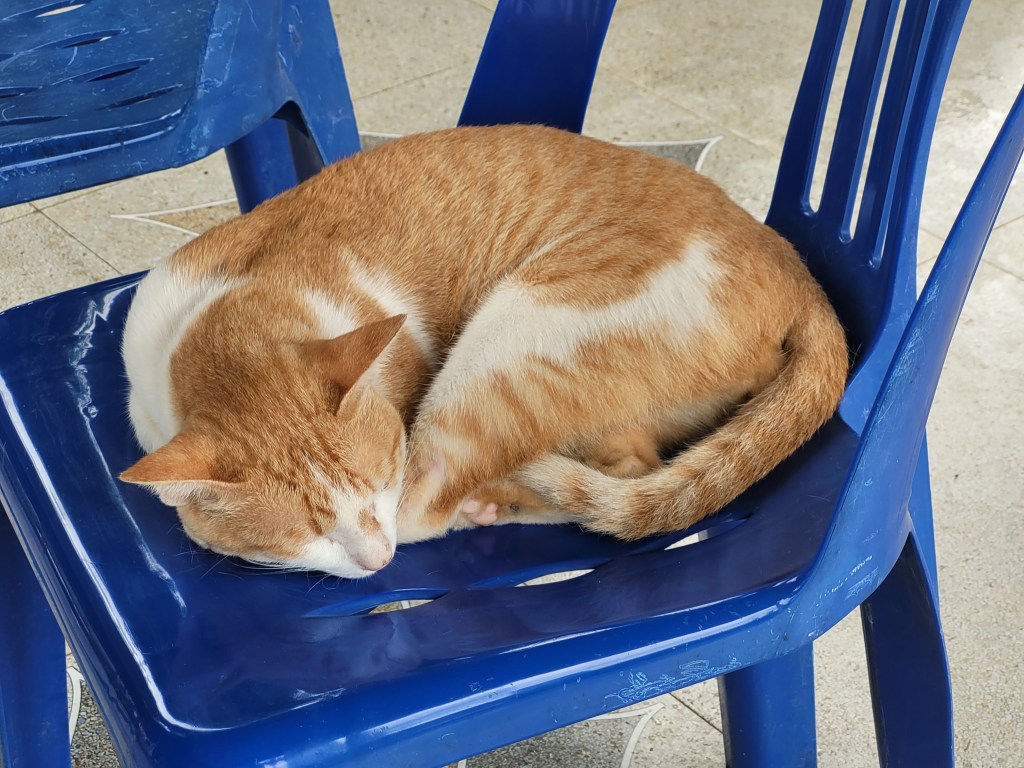
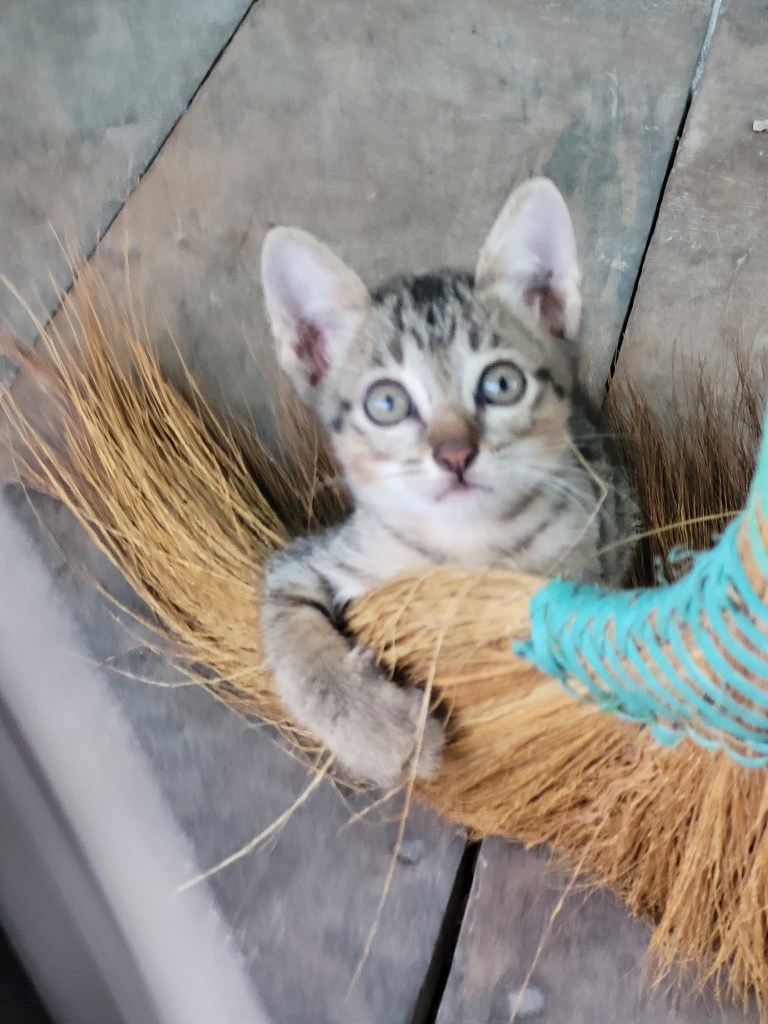
Out of context cat.

Saigon, Bathtub Vodka and Agent Orange

Ho Chi Minh City. That’s what it’s called officially, but I have yet to hear any native call it that. I don’t think anyone idolises Ho Chi Minh anymore, unless they are required to for employment.

I was staying in a tiny alleyway off Bui Vien Street, a street dedicated to transferring money from international travellers to the pockets of needy locals.

About as quiet as it gets

Bui Vien Street does provide just about anything a visitor may require. Food from everything from cheap local fare to overpriced Indian staples. Alcohol at a bewildering level of price points. Clubs with pretty local girls who will love you for either a short time or a long time, depending on your budget and your level of self-denial. Obviously, I felt at home, one could spend months here and not feel a moment of culture shock, and judging by the comfortable stance of some of the Westerners, clearly many only leave the street under sufference.

I had a cheerful and cheap dinner of Cantonese fried rice, washed down with three excellent Beer Saigon Greens. The bill came to less than the borderline inedible pizza I had in Dalat, and I tipped moderately, but enough that a few beers could be bought on the way home for one of the staff.

Booze and Ian Flemming

A walk to the other end of Bui Vien Street showed more nightclubs than I can remember seeing seven years ago, one of which had three very attractive, but very bored local girls dancing on podiums.

The next morning, I made my slow way to the War Remnants Museum.

The bastard offspring of a tank and a front-end loader

As is said often enough to become a cliche, history is written by the victors, and the War Remnants Museum reflects this. Almost gleefully, it has a whole section dedicated to the horrific effects of Agent Orange, which is entirely justified, but at least the deformed fetus in embalming fluid has been removed at some point in the last seven years.

Another section was devoted to photographers from many countries, many of whom had died during the conflict, including one of my idols, Robert Capa- “If your photos aren’t good enough, you’re not close enough”. He died how he lived.

Another section featured artwork from children, which tugged on the heart-strings, even though I knew I was being manipulated.

“Joining together to fight COVID”

I couldn’t help but notice the faces of the people walking around, many of which I felt, perhaps no better than myself, were only there out of a sense of obligation and were just ticking the box.

After dinner I returned to my hostel and walked up the stairs to check if my laundry was dry and was promptly invited into a drinking session with a sizeable bottle of homemade vodka. The wielder of this vodka was Dave, a Vietnamese-Australian, and his conspirators to this irresponsible drinking were two Russians hiding from Putin’s draft and Greta, a Lithuanian, who was smarter than the rest of us put together.

Already my composition powers are diminishing

The rest of the night is a blur of drunken debauchery that need not be documented for the reputation and future marriage and employment prospects for all concerned.

Dalat, Tombstones and Disappointing Pizzas

My plan for Dalat was to chill, catch up with my blog and take a break from the heat of humidity. Dalat seemed to be off the beaten track as far as mass tourism goes, and competition for tourist dollars meant I could afford a private room for barely more than a dorm bed in Hoi An. A basic one to be sure, but the lovely owner, after leaving me alone with coffee and some promotional material for tours, led me to the room, where I promptly collapsed on the bed and slept away most of the morning.

Six hours before this turned into the night market.

The next day I took a convoluted walk to Hang Nga Guesthouse, commonly called Crazy House.

Entrance.

Designed by Dalat architect Don Viet Ngu, the main building is shaped like a giant tree, with design elements such as mushrooms and cave systems.

And a healthy dose of vertigo.

All I know is that it felt like reading a Lewis Carroll novel while drinking a magic mushroom shake. It was only turned into a guesthouse tourist attraction when the money the architect borrowed to build the place became delinquent.

One of the rooms you can stay in.

The next day I took a Grab Bike to the outskirts of the city, to a minor tourist attraction called Two Graves Hill. Which had a convoluted, Romeo and Juliet-style story. Vu Minh Tam travelled to Dalat to study martial arts and fell in love with La Thi Theo, a lady from a poor family. His parents did not approve, and while he was fighting in a war, his love received the false report of his death in combat. Out of grief, she ended her own life. When against his family’s wishes, Tam returned to Dalat to reunite with his lady love, only to find her grave, and laid down next to her and died, heartbroken.

Still tended to.

The grave site itself seems much younger than the story seems to indicate, which makes me wonder how true the story is. Nearby are several much older style tombstones, overgrown by Lantana, forgotten and forlorn.

Someone paid a sizeable sum to have this made.

Further investigation into the pine-covered hill showed young people picnicking, construction dump sites (some things are sadly universal), homeless person camps and bizarrely, a campsite for the local Scout camp.

My next stop was Linh Phuoc Pagoda, an impressive complex.

Bell Tower

Most of the surfaces were covered in mosaics, a level of detail I have not seen outside of the oldest churches I have seen.

Bell Tower interior

Off to the side of the Belltower was the main Buddha statue, which was epic.

Under the watchful gaze of the nuns

I thought I had seen all there was to see, and I was about to order a Grab back to my hotel when on impulse I followed a group of Koreans to a set of stairs leading below the ground of the pagoda. The first sub-level was entirely devoted to a showroom with some very fancy furniture, the kind of furniture you would need a forklift to rearrange.

Also not that comfortable.

Then in the corner I noticed some interesting statues, and some more stairs.

I followed the stairs, which lead into a passage that turned out to be a depiction of an underworld or hell, which didn’t seem to match depictions of any of the common ideas of hell in Buddhism.

Creepy

Complete with glowing eyes, and sound effects of moans and the clanking of chains. Mildly disconcerted, I departed.

Hoi An, Lanterns and Tailors

Having survived the sleeper bus, I walked into the Back Home Hotel, just as the excellent receptionist, Hang, was wrangling a host of backpackers through check out and out the door and into a fleet of taxis. Check-in was not going to be possible, but I could leave my backpack and use the downstairs bathroom. I got a map, some recommendations and advice against the local scams and stepped out into the early afternoon heat to search for some coffee and elbow room.

Local garden on the way to the hotel.

I ate dinner twice at a small place on the edge of the old quarter, picking local specialties both times.

Pork and noodles, Delish.

Walking the streets, it seemed that the Cycle Rickshaws were doing a roaring trade, being the preferred transport for Japanese and Korean tourists, perhaps due to the sheer anachronism.

However, I don’t think it’s dignified to be pushed around by someone else’s energy.

To and from airports, the same tourists seem to prefer to be transported by those elongated golf cart things, which seem little better.

That first night I managed to avoid the touts, and taxi driver mafia, but was shocked by the sheer numbers of tailors, and leather goods shops lining the old quarter, but I had no need for any of them.

But at night, the old quarter shines. The lanterns festooning the shopfronts and strung across intersections and alleyways make for an impressive display.

Alleyway, and a pretty girl.

Even more so, on the Thu Ben River, with the lanterns on boats and the prayer candle boats.

Not the easiest to photograph with a phone.

However the mass tourism nature of the place made it not a place easy to relax, and prices for drinks seemed to double within the old quarter, so after a walk through the night market I didn’t linger.

Near the Night Market

I was here without a lover, and renting a little boat to float down that gentle river, would be incredibly romantic with someone you love, and utterly nonsensical on my own.

Sadface.

Upon this realization I had a strong impulse to run back to my hotel, pack up, pay up and take the first bus out of town. It probably would have been what my more confident alter ego would have done, but it would not have solved anything.

So I stayed and tried to ignore the couples walking hand in hand, along with the bodies sleeping feet away from me in the dorms.

Excellent receptionist and herder of backpackers, Hung.

Hue, Mango Shakes and the Scars of War

I immediately felt more at home at Hue than I had previously on this trip. While tourism is a welcome addition to the economy, I never got the feeling it was the only thing keeping people out of abject poverty, like I did in Hanoi.

I stayed at Hue Happy Homestay, and my host, Viet, seemed to genuinely care about his guest’s comfort and well-being.

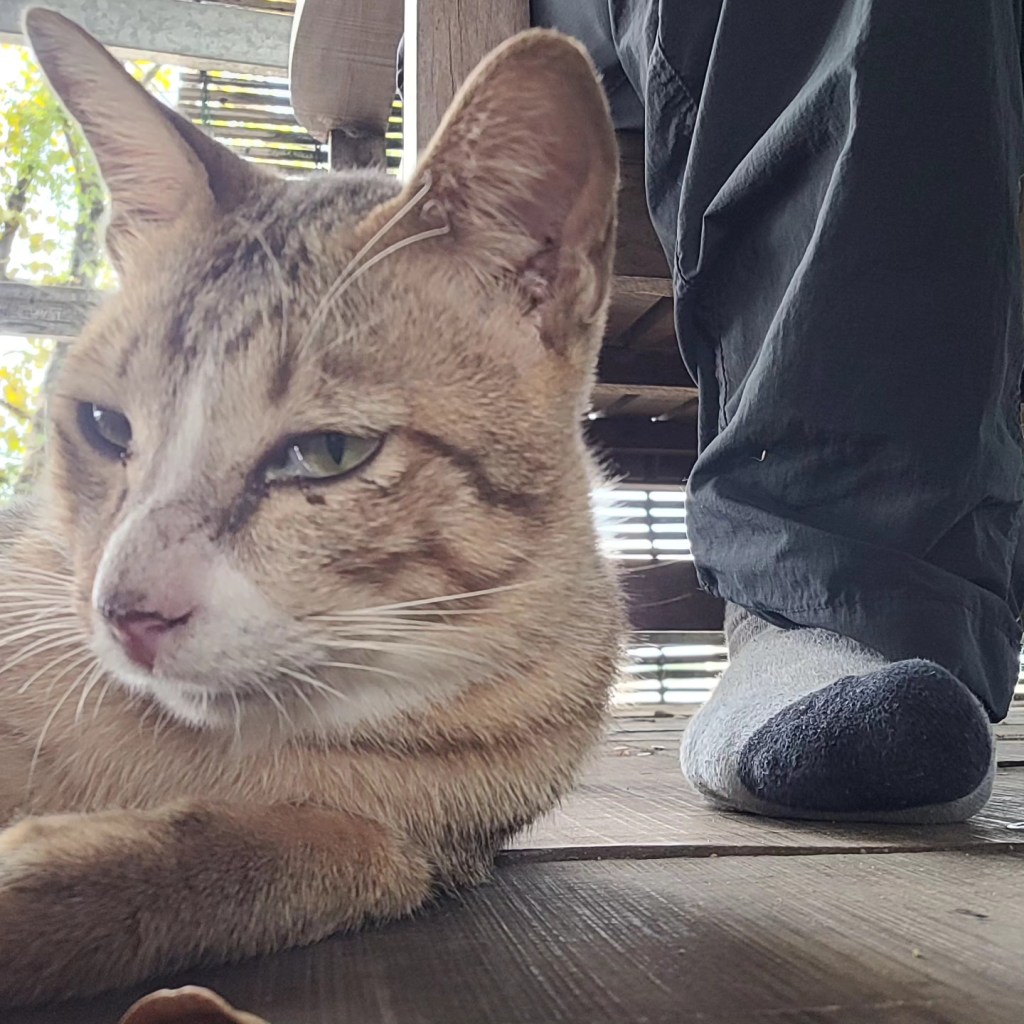
local cat deeply perturbed by my hat.

Over fruit and coffee, I decided to book a tour of the DMZ, which in hindsight turned out to be an excellent plan after the visit to the ancient palace turned out to be a major let-down. I am not sure where the 200K Dong ticket price is being spent but it certainly is not on restoration efforts.

Gate, one of the few shots I bothered to take.

Apparently, it was looted by the French, and to my mind, very little of it seemed to provide any historical context or even general interest to the average visitor.

This was the treasury, but was not open to the public, and empty.

The next morning after a hasty noodle soup breakfast, I was picked up for the tour. Our first stop was at a citadel on the outskirts of town, which featured a memorial to soldiers that fell during the war.

Memorial.

Also within the grounds were the remains of cells, where some South Vietnamese were imprisoned after the fall of Saigon. To three of my fellow guests on the tour, this was very personal, as the father was imprisoned in similar conditions as a young child before immigrating to the USA. And the emotion between him, his wife and his young son was very palatable. It’s worth noting that no one in the tour ever complained about them taking their time after this revelation, including our guide, who like me would not have been alive at the end of the war.

The cells, being explained by our guide.

The remains of the Khe Sanh air base was next, and a small museum featured artifacts and photos, with a clear pro-communist slant. here another visitor, Vietnamese perhaps mistaking me for an American, almost forced me to be in a photo with his arm around me.

That sarcasm is a beautiful thing to behold.

Near the museum was aircraft, tanks and APCs left behind by US troops.

“And why the Channel 7 Chopper chills me to my feet”

Further afield was a series of bunkers and tunnels, that would have provided scant protection and comfort to US servicemen and their allies.

Would you feel safe? Could you sleep?

The actual airstrip had long ago been dug up and reused for local roads, which is both sad, but the pragmatism is undeniable.

I had planned, here, to sing, roughly but with emotion, the first lines from Cold Chisel’s Khe Sanh,  which is something of an unoffical Ausralian anthem,  but when faced with the opportunity it seemed a pointless, redundant thing, so I had to resort to a selfie. 

Those sunnies are hiding a lot.

We had a nice lunch in one of those roadside restaurants that always seem to be empty except for tour groups, before continuing on.

All the beautiful people!
The penultimate stop was the border crossing of the DMZ, that divided North and South. Now entirely defunct, but highly poignant. How many families had been seperated by this bridge? It was a strange experience, and especially moving to see the Vietmanese-American family.

The family I have mentioned.

The final stop was the Vinh Moc Tunnels. An entire village was relocated underground for protection against US bombing.

looks cosy.

I managed to keep my claustrophobia under control as I was in the tunnels, which were obviously cramped and uncomfortable and contained kitchens, medical suites and bathrooms. I was grateful to be able to leave, and gladder to know that I have never been forced to live in such conditions.

On the long drive back to Hue, I couldn’t help but think how easy it would be to let the jungle take over and hide these scars of a terrible war. I am not normally in favour of pretending history, both good and bad, didn’t happen. But for the good of the Vietnamese people I could not help but think it was a wound that is best left alone.

“Leave these ancient places to the angels…”

Hanoi, Heartache and Egg Coffee Part 4

After Halong Bay, nothing was keeping me in Hanoi, except that every bus heading south was booked out, and I spent a few hours trying until I gave up, booked the next day and extended my stay in the hostel. I took another walk around Ho Houm Kiem Lake, this time I attracted the attention of a group of uni students, who had been tasked with interviewing a Westerner. They were lovely and spoke perfect if halting English, and we finished up with selfies and I handed over my Moo card which seemed to delight them (who the hell bothers with business cards in 2023?)

🙂

Five minutes later I was asked by a cheeky bunch of schoolboys if they could practice their English on me, which I was happy to go along with until they asked me if I was rich, and I made my excuses and kept moving. Five minutes after that this young girl asked the same and invited me to sit on a nearby raised garden bed, and we chatted happily for fifteen minutes while her mum chatted to another lady nearby.

a total sweetheart.

I finished up the day by visiting Saint Joseph’s Cathedral, and a local artists collective where I purchased a few things for Arum and I, which was about the best I could do for her considering our geographical estrangement.

St Joseph’s Cathedral.

Hanoi, Heartache and Egg Coffee Part 3

The only other thing I had to do before I departed Hanoi was a tour of Halong Bay. Seven years ago I visited on an overnight trip and had an amazing time. This was not repeated. Halong Bay is too far away from Hanoi to do it properly as a day trip, except in the most perfunctory, tick-box manner. Also, the crowds of different tours all visiting the same sites made me feel like I was on a conveyor belt.

A long bus ride takes us to a building dedicated to explaining the cultivation and setting of pearls to indifferent and impatient tourists. Fifteen minutes later we were herded back onto the bus for a short ride to the port, before being thrown onto a boat.

All the pretty English girls, and me.

After a fairly decent lunch most of us made our way to the upper decks for fashion shoots and selfies.

Strike a pose…

Eventually, we made our way to Titop Island, where we had forty-five minutes to sunbake, swim and otherwise frolic with hundreds of other tourists. I managed to get some swimming done, the first time in salt water this trip.

At least the water was nice and warm.

The next stop was a cave system I never quite managed to get the name of, but needless to say, it felt like every tourist in Vietnam was trying to visit at once, which didn’t do anything positive for my claustrophobia.

Say Cheese!

However the formations and sunlight shining through holes in the rock made it worth it.

It didn’t help when a pair of either Australian or New Zealander women started screaming abuse at other tourists taking selfies.

The last activity was kayaking or bamboo boating under a low cave entrance, which was nice but I trusted the boats about as much as I trust Hanoi pimps, so I left my phone behind.

The rest of the day involved a slow boat trip back, then the bus. It was a good, but not great day.