The modern city of Luxor was built on the remnants of the ancient city of Thebes, and both are built around the Temple of Luxor and the Karnak Temple. I quickly learned to orient myself with the Luxor Temple in relation to my hotel. Also, in some kind of locational genius, the local McDonald’s upper-floors offer incredible views of the Luxor Temple, which, in addition to the air-conditioning, makes it a great spot to enjoy a mediocre iced coffee.
View while waiting for a shitty burger.
Construction of Luxor Temple began in 1392 BCE by Amenhotep III, completed by Tutankhamen, and expanded by Rameses II. It was dedicated to the rejuvenation of kingship and may have been where many pharaohs were crowned. The temple also contains chapels Mut, Khonsu, and Amun, details which were lost to me due to my refusal to hire a guide.
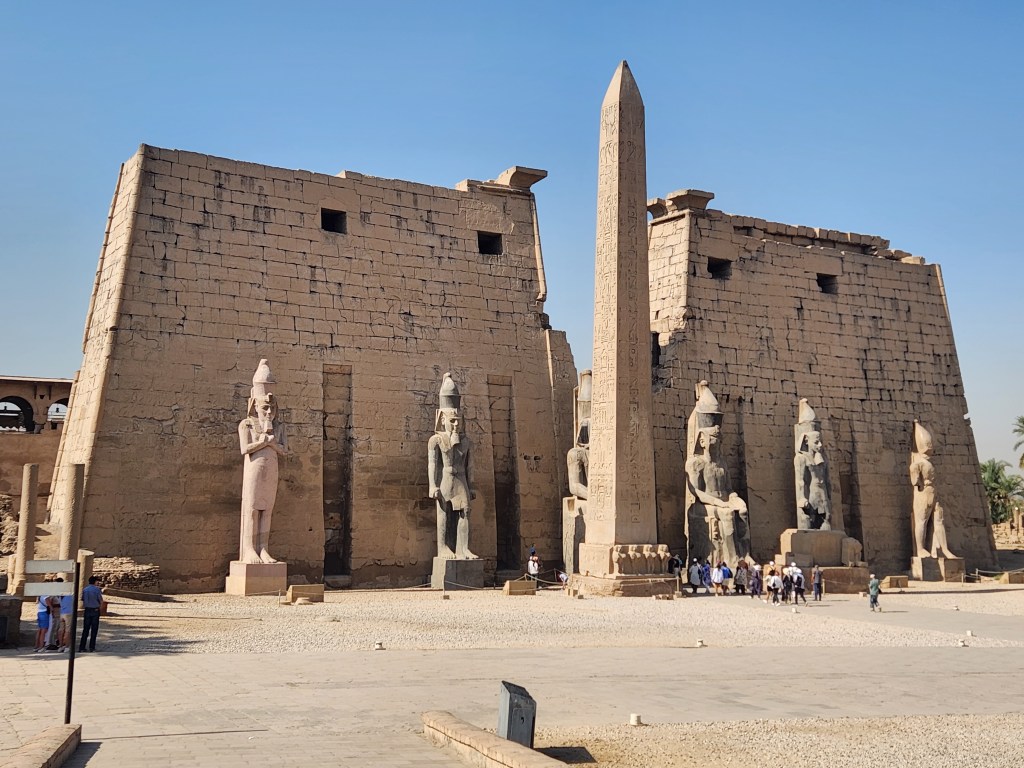
First Pylon
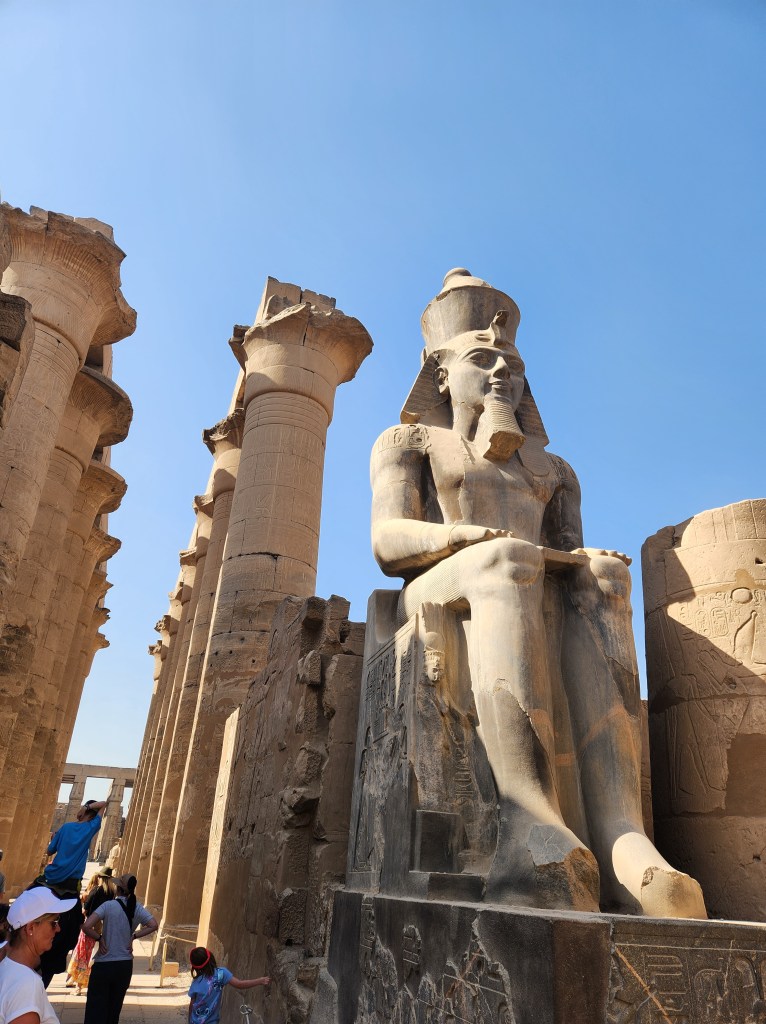
The main entrance (1st Pylon) was originally flanked by two obelisks, now only one remains due to the averienceness of the French. Behind the obelisks are six statues of Rameses II, just in case anyone might forget he was involved. Further into the temple, even more impressive statues stand sentinel.
Even more statues of Rameses II
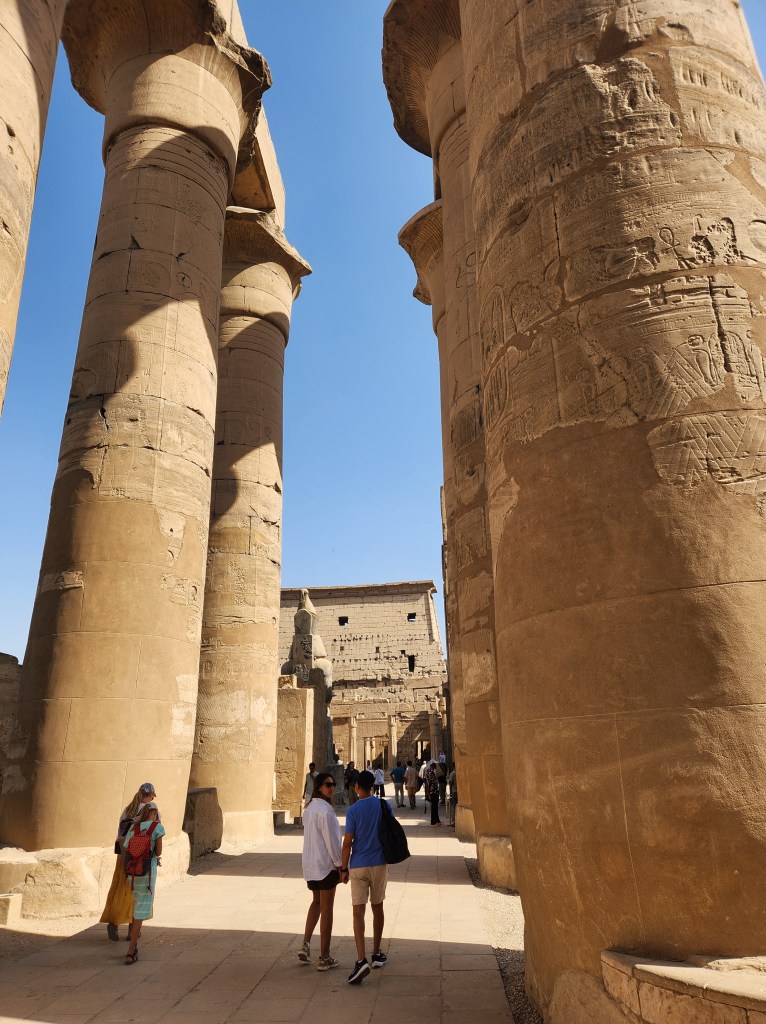
As one steps deeper into the temple, you pass through the court of Rameses II, and then the Great Colonnade of Amenhotep III, surrounded by massive columns. The presence of which made me feel disoriented, which I think was most likely the intent, and still lingering effects thousands of years after the death of everyone involved.
Great Colonnade
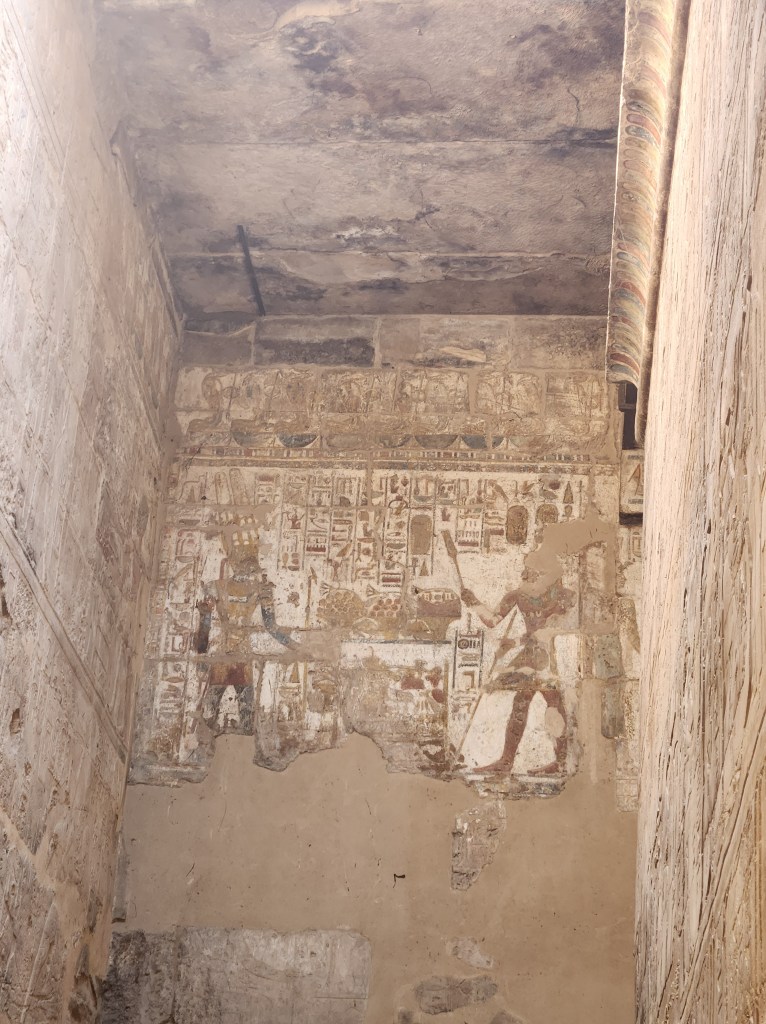
The inner sanctuary of the temple still features carvings and paintings, the significance of which was lost on me.
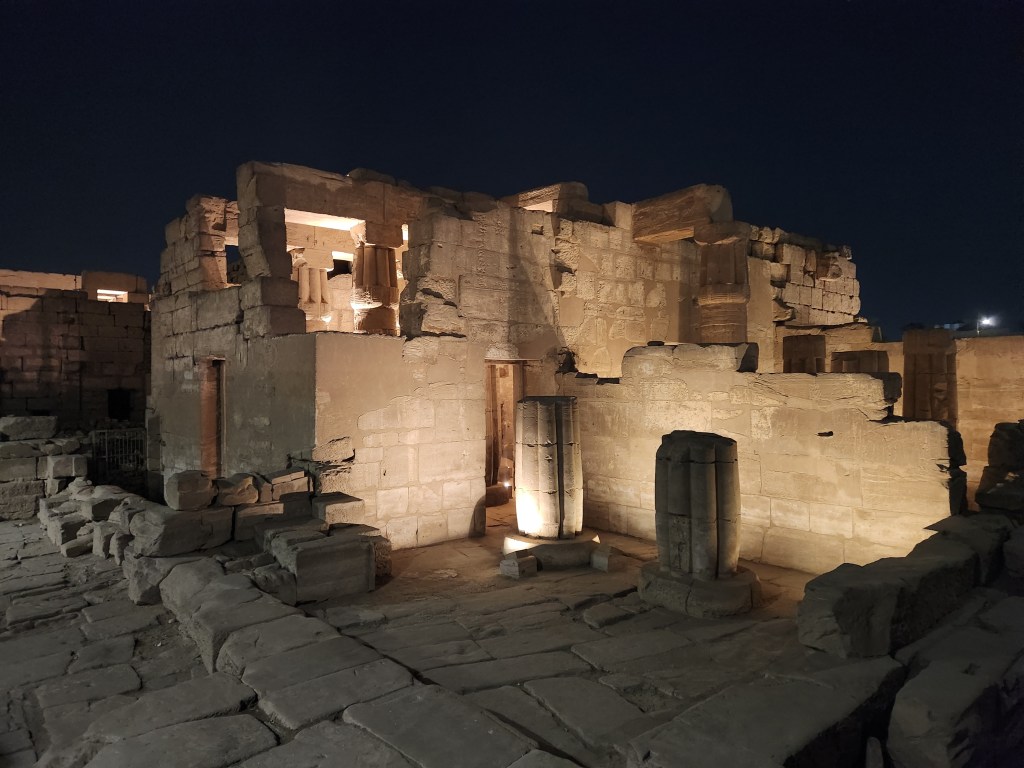
Google Lens tells me this is another temple entirely.
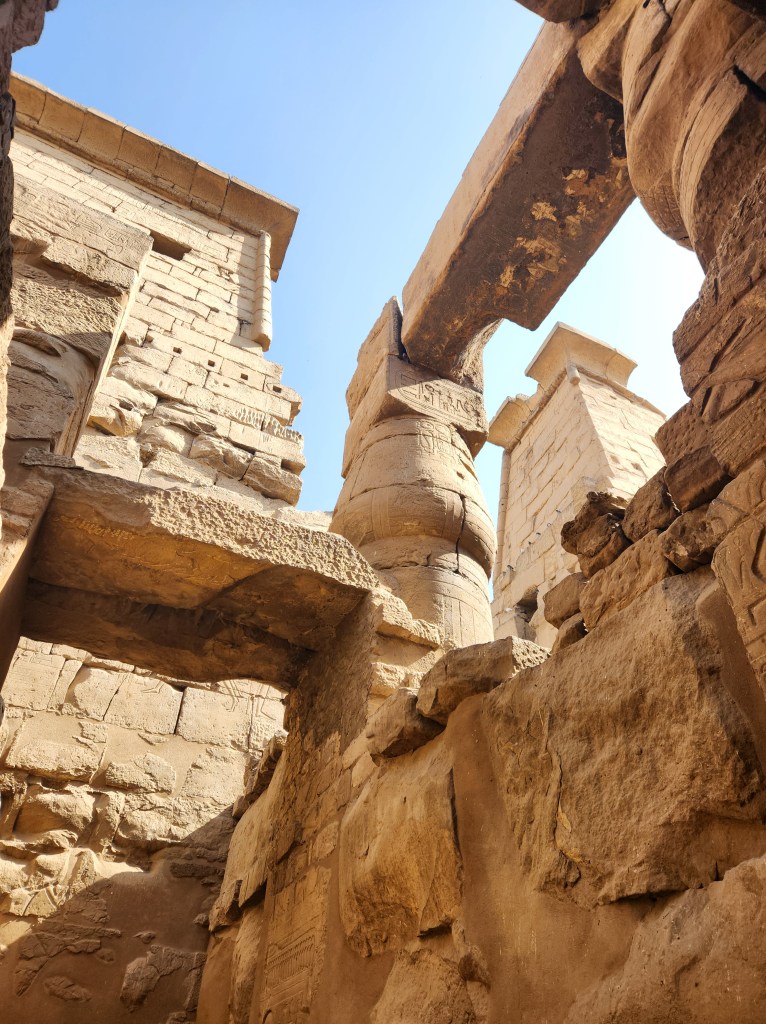
I quite liked the layered effect caused by damage.
Imagine putting detail like that so high.
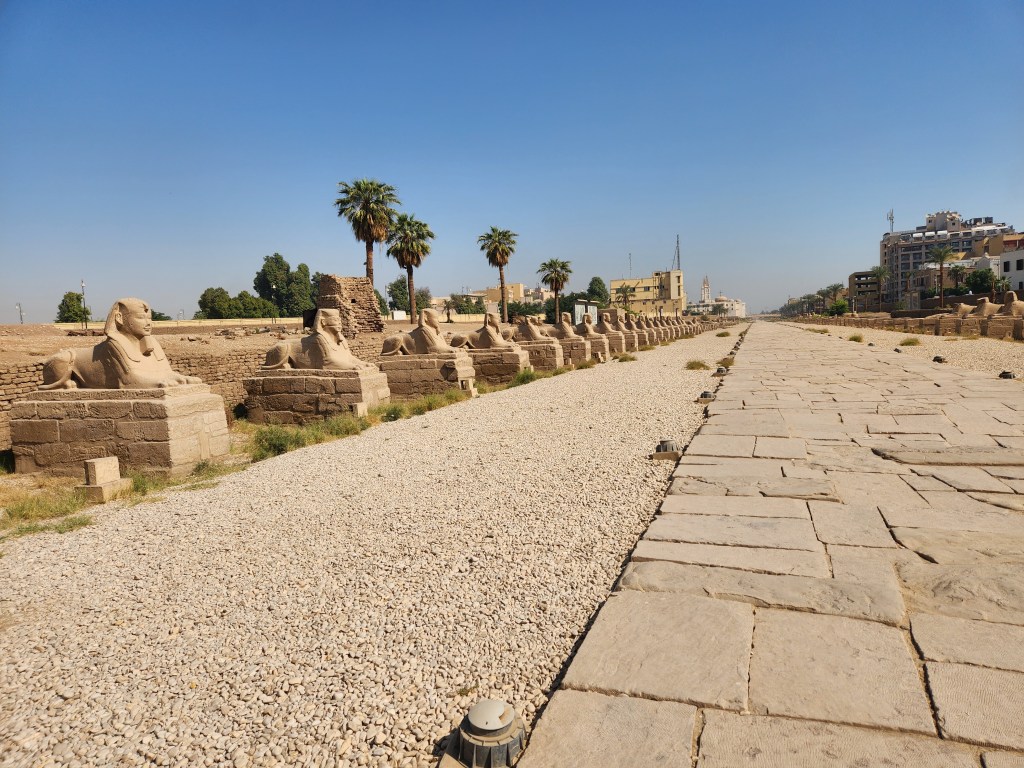
Returning through the First Pylon, I found the gift shop uninteresting and the cafe overpriced and uninspiring (and open to the vicious Egyptian sun). I walked through a short section of the Avenue of Sphinxes, which originally linked Luxor Temple to Karnak, 2.7 KM away, both sides lined with sphinxes.
Avenue of Sphinxes, with Downtown Luxor in the background.
I had originally planned on walking, but the heat, lack of shade, and my dwindling supply of Australian sunscreen led me to skipping that idea and having lunch before Ubering my way to Karnak.
If carving tombs underground instead of building massive pyramids made anyone think the Pharaohs were done with massive building projects, they would have been sorely mistaken.
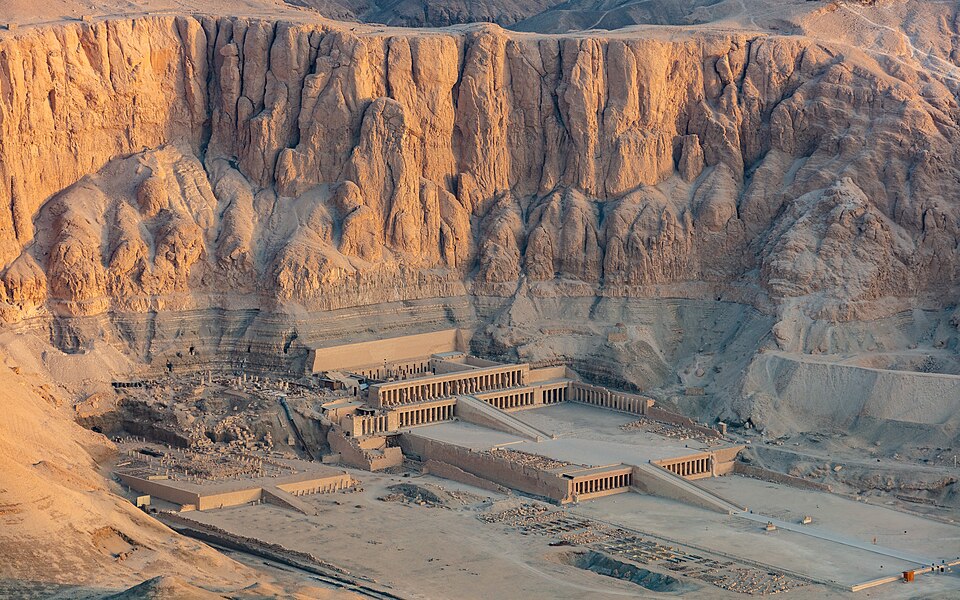
The Mortuary Temple of Hatshepsut was built into the cliff face on the other side of the Valley of the Kings, and I believe it is every bit as impressive as the Pyramids of Giza.
Aerial view. Attribution: Diego Delso
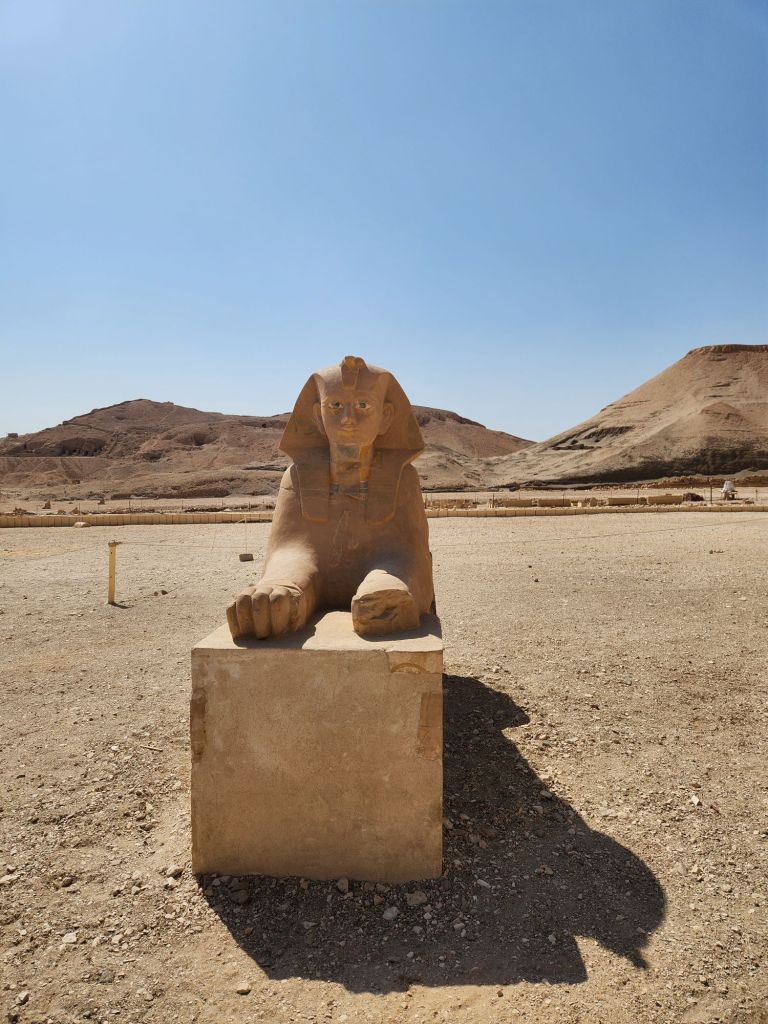
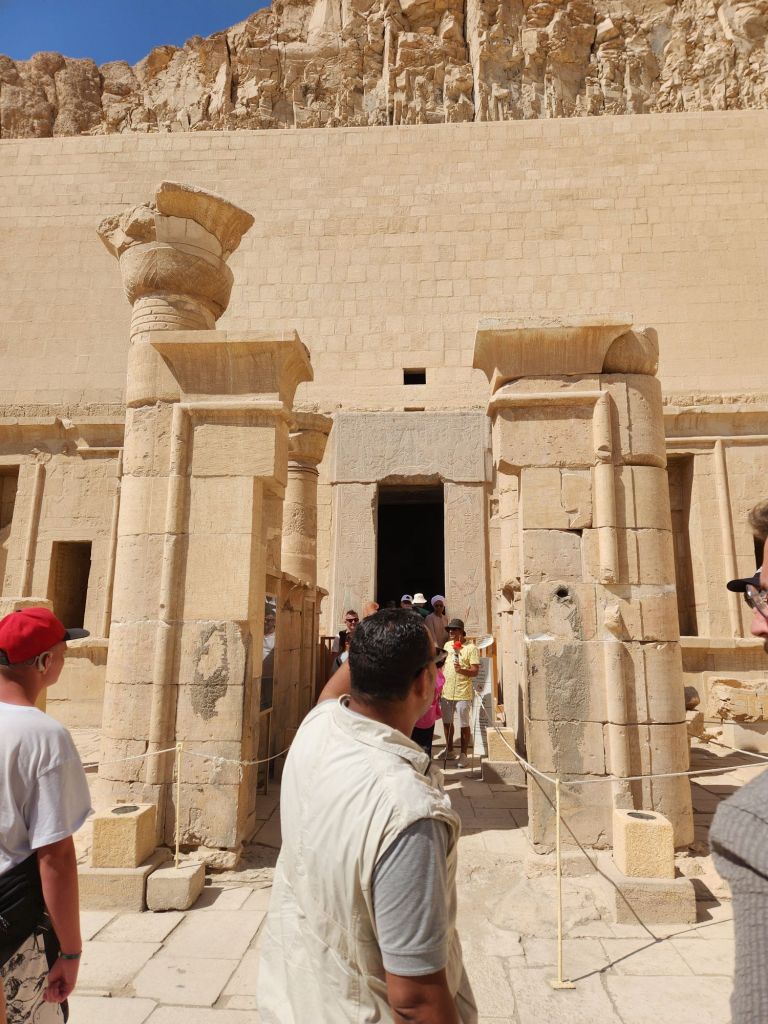
Three terraces lead to the main temple, with a central causeway that is guarded by a Sphinx on either side. One of each has been restored, gazing benevolently at visitors, and the other features the original, half-destroyed head.
The left-hand Sphinx, from memory.
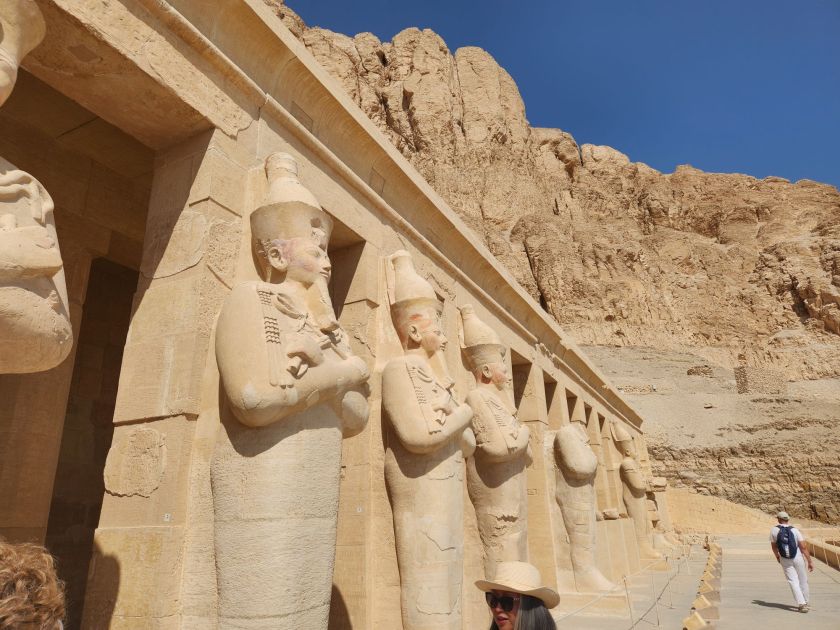
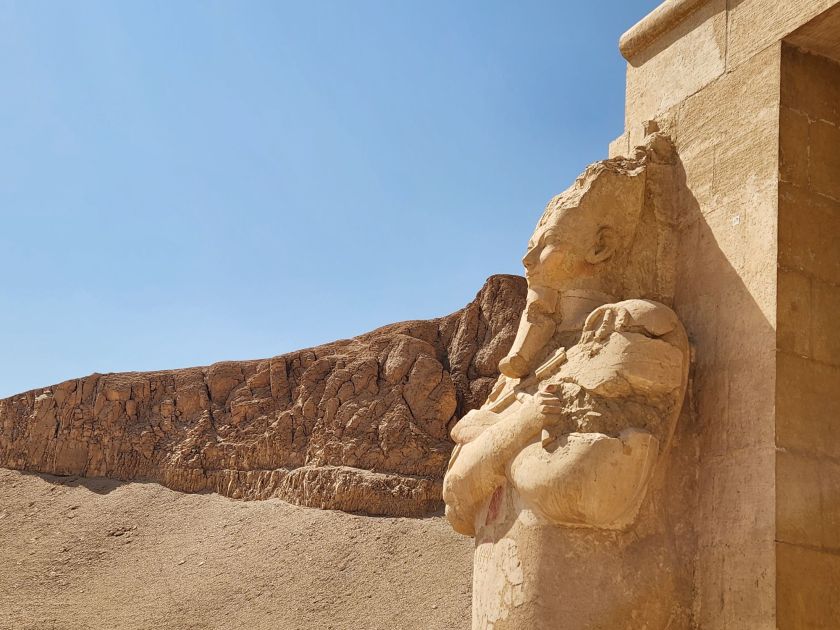
Each of the twenty-six columns of the upper terrace is fronted by a statue of the queen in her Osiris aspect, each over five metres tall.
Upper Terrace.
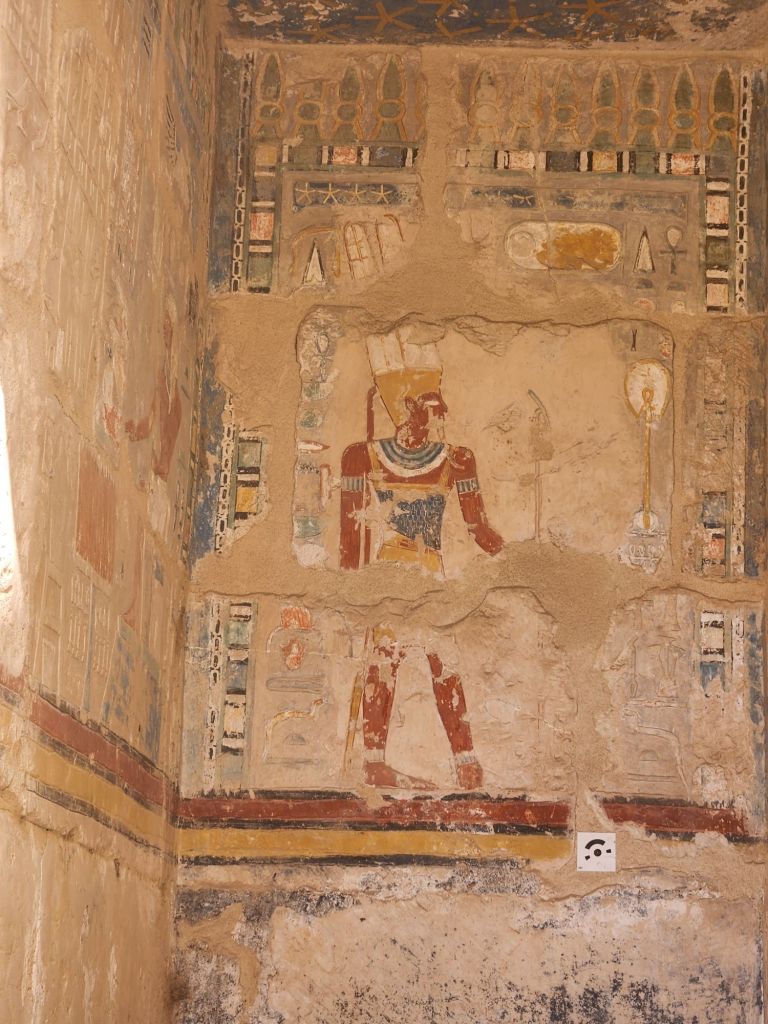
While her successor, Thutmose III, attempted to remove all references and proof of Hatshepsut’s rule, some of the carvings and paintings in this temple have survived.
Depictions of Amun.
As is typical, the innermost part of the temple is blocked off, leading to the crowd only being able to look into the sanctum.
Oh yeah, and our guide.
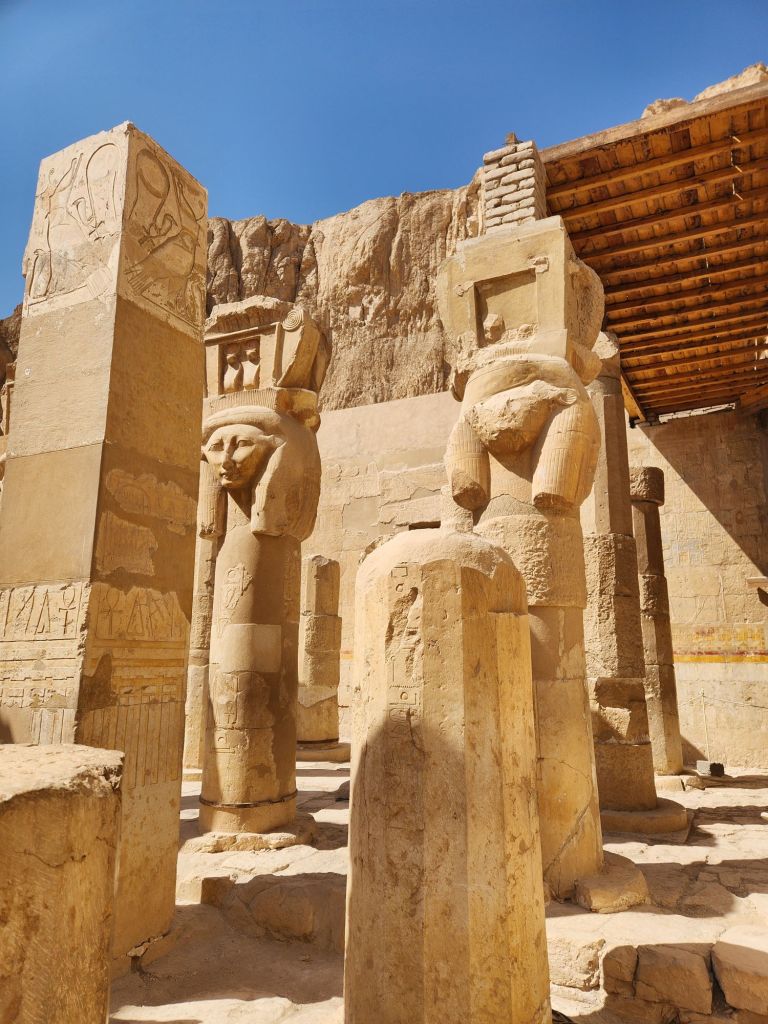
An area to the left of the main temple has a chapel dedicated to Hathor, which I quite liked. Plus, it was comparatively quiet.
Chapel of Hathor.
To the left was of interest, which included an altar of the solar cult, but much of the more interesting places were blocked off by locals on demand of baksheesh, so I did not linger.
Maybe the actual altar?
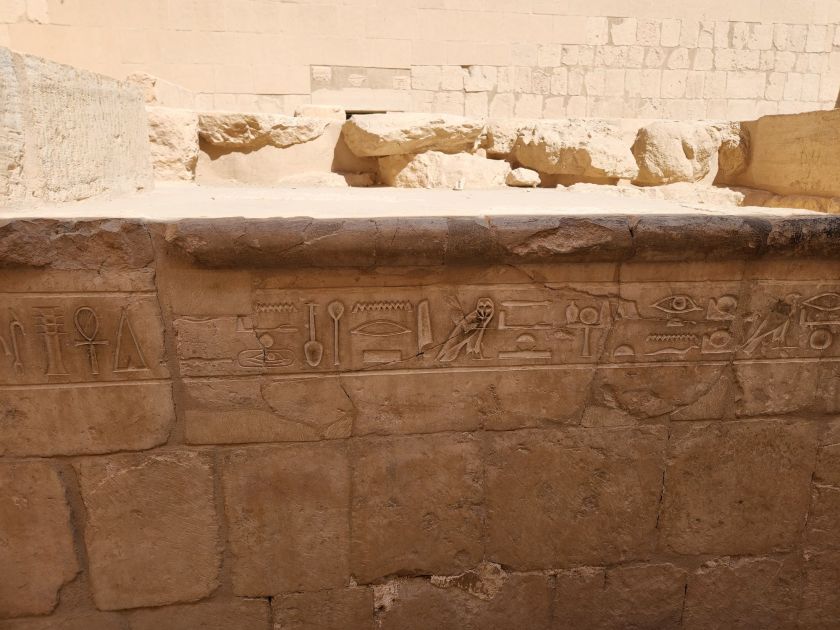
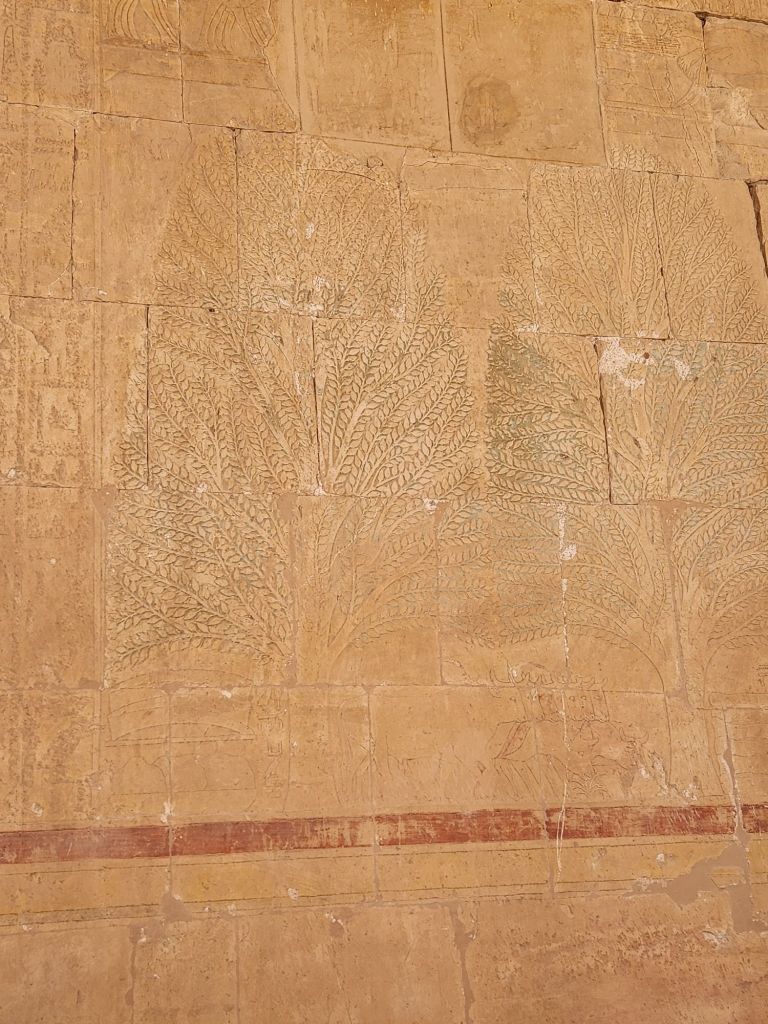
Behind the row of statues, I spotted carvings that document the Queen’s trading expedition to the Land of Punt, believed to be to the south-east of ancient Egypt, bordering the west bank of the Red Sea.
Believed to be Sandalwood trees, brought back from Punt.
I think what I liked about this temple was the fact that it was designed to complement, rather than just be placed, in the surrounding geography.
Statue of Hatshepsut, overlooking the nearby cliff.
Our next step was a nearby factory throwing out alabaster carvings, in the traditional, hand-carved methods. What this had to with ancient Egypt was tenious at best, but had much to do with our guide and driver earning commission. I was also somewhat dubious about how the half dozen guys with small pieces of alabaster and sandpaper outside could produce so much product. While some of the pieces were beautiful, and I would have loved one of the smaller “scribe” figures for my desk back home, I didn’t relish having to haggle over one or lugging it back home. But I did appreciate the offer of a cold drink without being charged ten times the retail price. Eventually, the three of us convinced them that we were not in the market for anything, and we headed back to the bus. Before we left, one of the workers made his way to me and, with a look askance for supervisors, palmed me a “gift” of a half-finished sacarab and some rough alabaster pebbles. I gave him a small note of Egyptian pounds, which was probably less than he hoped.
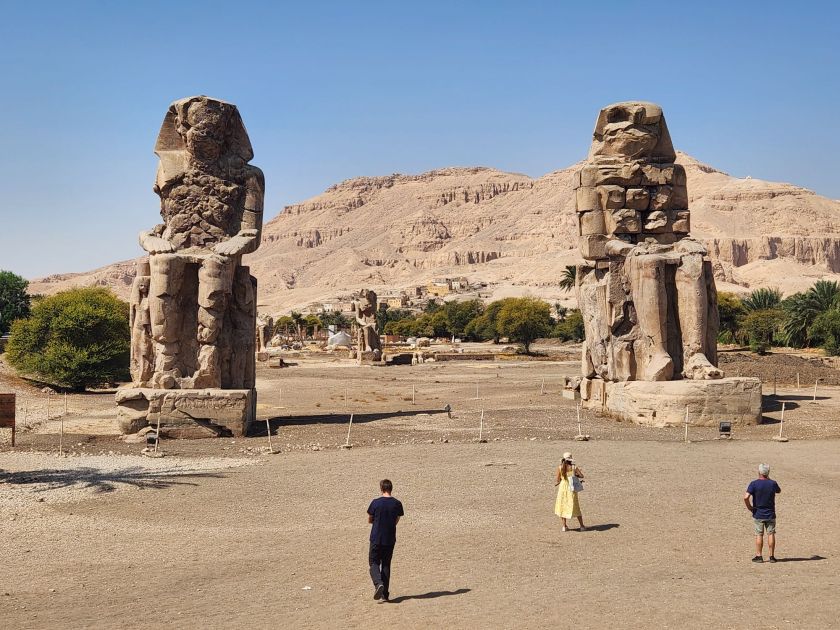
Our final stop was the Colossi of Memnon, two huge statues that depict Amenhotep III, built to guard his mortuary temple, of which little remains.
Colossi of Memnon.
Both statues are eighteen metres tall, and can be seen for fifteen kilometres around, which was most likely a deliberate choice for them to become a landmark. Both statues are quite damaged, despite various restoration efforts. The bases of both statues feature inscriptions in Greek and Latin.
The confusion of the name is an interesting (at least to me) story. At one point in time, the northern statue made a screaming sound when the dawn winds through it. This was due to damage it had sustained, which was later fixed. This screaming led to an association with Mennon, a hero of the Trojan War, who was said to be the son of Eos, the goddess of dawn.
By now, all three of us were tired and in need of air-con and affordable cold drinks, and after ten minutes, we made our way back to our bus. Our guide then offered to take us to a nearby restaurant for lunch, but one of my street-wise fellow guests asked about the cost, and it turned out we had a very different understanding of what affordable was, and so we declined and were driven back to Luxor, where we parted ways.
Due to the Valley of the Kings being on the West Bank of the Nile, opposite to the modern city of Luxor, visiting the Valley under my own steam, short of hiring a car, seemed impossible. Against my usual nature, I decided to book a tour through my hotel.
Shortly after eight o’clock, I was picked up in a mini-bus, with one other client on board, and proceeded to pick up another to the north of my hotel. One South African who works on oil rigs, and one Englishman, a tradie from Bristol. With the addition of myself, an agreeable bunch who immediately formed a pact with the tour guide as our enemy.
At the Valley of the Kings ticket office, an expansive and soulless building, which was still much more impressive than the simple ticket booths at Giza. Our guide directed us to the automated kiosks, rather than to fight for a position in the queues for a human. Here, we discovered that the minimal entry ticket only provided access to a handful of the least interesting tombs in the Valley. This is how the Egyptian Government keeps these sites as a massive cash cow. With our guide’s dubious advice, I chose three add-on tombs. Later, I made the mistake of checking my bank app for the transaction; I could have stayed in a luxury accommodation anywhere in Egypt outside of Cairo for a few nights for less than that figure.
Heading through the turnstiles and battling through the hordes of people who thought nothing of standing in front and immediately behind them, we were hit up for 30 EGP for a ride to the main entrance via those extended-cab gold carts so beloved by governments the world over. The driver also made a stringent attempt for backsheesh at the end of this two-minute trip, which I pretended to not hear. While this did save us a walk, uphill and in the sun, it was still irritating.
After the main entrance, our guide bustled us past the covered market with warnings about how aggressive the sellers are. Then we were set loose, with the announcement that we would have forty-five minutes in the Valley of the Kings. This is one of the reasons I avoid tours; entirely unreasonable time restraints.
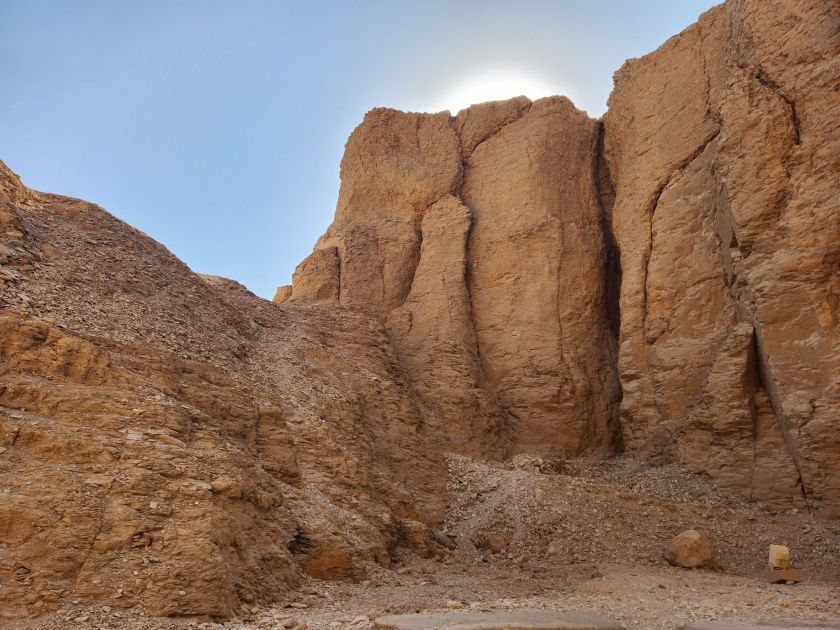
During the New Kingdom, the Pharaohs made an observation that building massive tombs in the shape of pyramids did nothing but advertise where all that sweet loot was piled up, and that a more subtle approach was needed. Thus, to the West of the Nile and the ancient city of Thebes, a wadi was reserved for the burial of the royals. The idea being that once the tombs were sealed, no one would know that gold, silver, and gems equivalent to multiple years of Ancient Egypt’s GDP was hidden behind the stone. Of course, it was all for naught, as all but one of the tombs were looted before the end of the Twentieth Dynasty, most of them within years of the pharaoh’s death, at least sometimes with the consent of the new pharaoh, with him or her taking a cut. I suspect that the suggestion that Pharaohs not be interred with so much wealth was never stated by anyone wishing to keep their head attached to their bodies.
Impossible to take a pic of the entire valley.
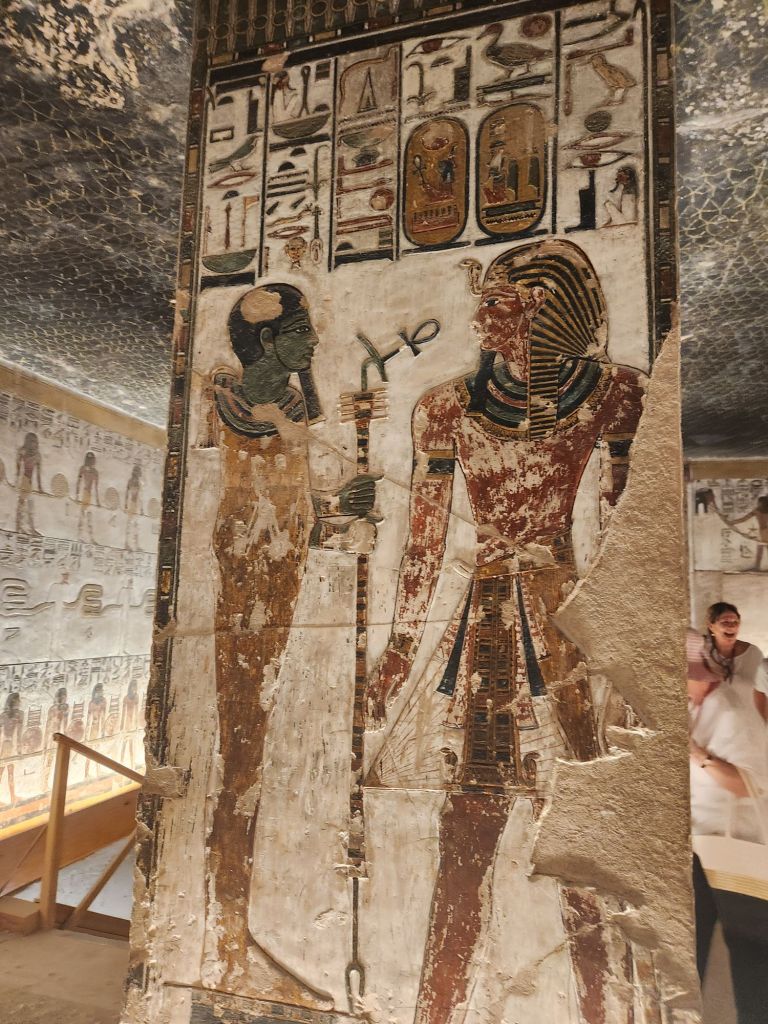
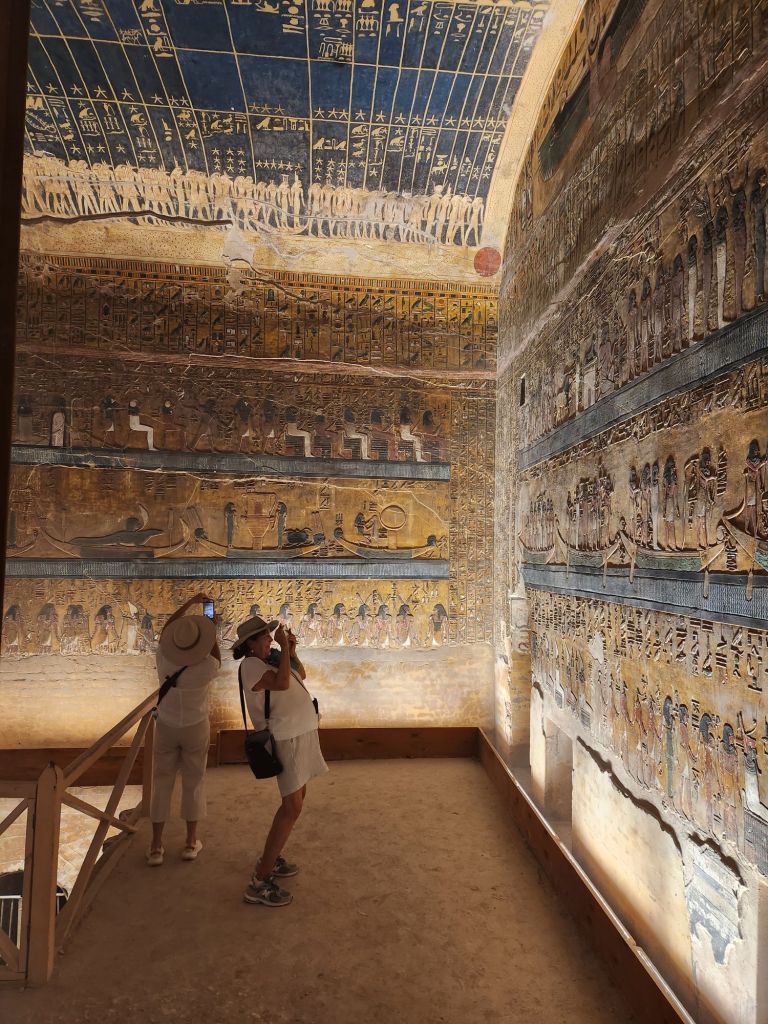
The first, and most impressive tomb I visited was KV 17, the former home of Seti I, son of Rameses I. He was most notable for his military campaigns, especially into Libya and the Levant. KV17 is famous for its decorated walls.
Pillar.
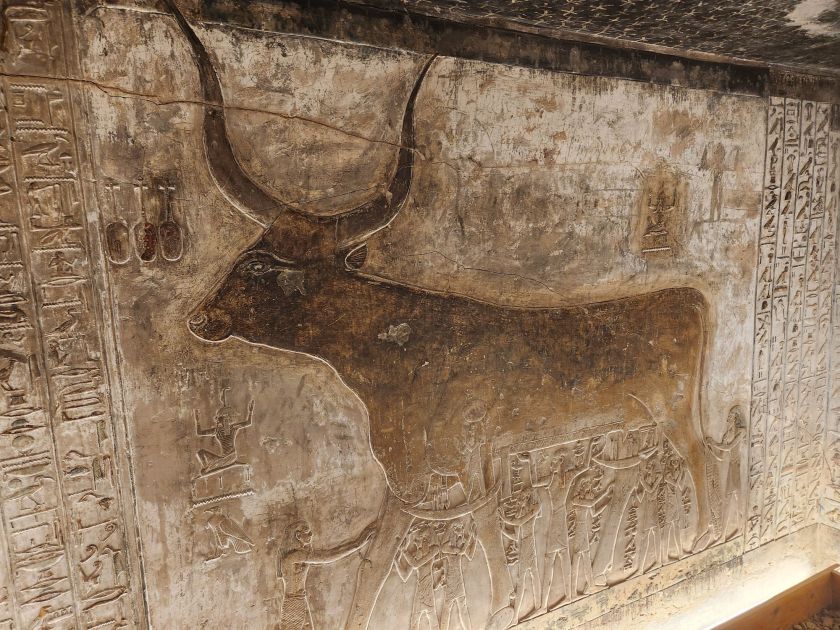
While the whole tomb was stunning, I was greatly drawn to a depiction from The Book of the Heavenly Cow, which I will pretend I knew all about before I visited this tomb.
Depiction from the Book of the Heavenly Cow.
The tomb was very crowded, with hordes of Americans, Germans, and (sigh) Australians getting in my way at every turn.
Having spent fruitless time and megabytes attempting to book a bus ticket to Luxor without having to book out an entire bus, I decided to wing it and do things the old school way. I arose at seven, dumping my room keys at the reception and took an Uber to the local microbus station.
The driver drove past the station two hundred metres before dropping me off, not quite believing this white guy was not on a tour. When I walked uphill to the train station, with help from a staff member at a nearby coffee shop, I discovered that no microbuses were heading to Luxor, but I could get one to Cairo, which I was trying to avoid, and then find something to Luxor. I hopped on the bus, which was nearly empty, and waited.
The deal with these decidedly tourist-unfriendly buses is that they leave when full, not to any schedule known to man or gods. I have been told you can pay for the empty seats to leave quickly, but I have never been asked to do this, and the suggestion seems to go against the whole principle of the situation. The fare must be paid in cash, and is handed to either the driver’s offsider or an elder customer acting as trip treasurer. This leaves the driver free to talk on the phone, honk his horn, and generally make life unpleasant for other road users.
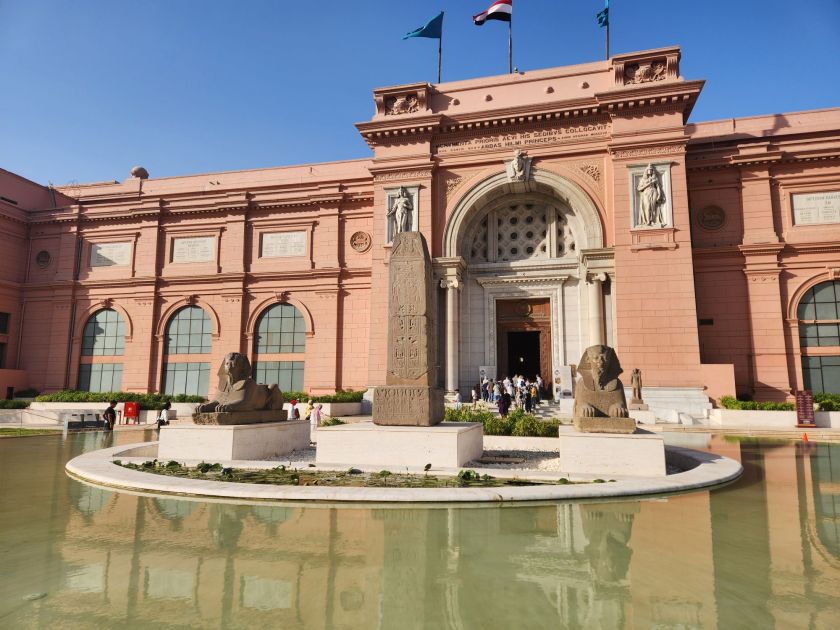
This time, it took an hour for the bus to fill up, and as usual, I was the only Westerner on board, which made me happy. I paid 160 EGP for this uncomfortable trip, with my duffel bag shoved under my seat- they are not really set up for large amounts of luggage, but it didn’t seem like I was asked to pay extra- which was virtually nothing compared to the 500 EGP I was charged for shorter trips on Gobus coaches. I arrived in Cairo just before noon, which turned out to be the dusty lot I left Cairo from. Due to a confusing series of events, I walked in traffic to another station to buy a ticket to Luxor, which ended up being a Gobus service, leaving from the dusty lot of just walked from, leaving in six hours. The staff member assumed I was a rich American and sold me some kind of deluxe VIP ticket. I took an Uber back to where the bus was leaving, and left my bag there (another 50 EGP). From there I walked, had a very Western lunch, then a more traditional coffee on Meret Basha, overlooking the Ritz Carlton. Next to the Ritz was the old Egyptian Museum, formerly the grand jewel holding the majority of the Ancient Egyptian artifacts. Now it’s dusty and has been eclipsed by the brand new and very sexy Grand Egyptian Museum in Giza. Regardless, I was close and had time to kill, so I crossed multiple lanes of chaotic traffic, passed through security measures more stringent than most airports, paid the fee, and avoided the offer of a guide, and entered.
Egyptian Museum.
It’s still worth a look and displays some mummified remains and smaller artifacts. Additionally, the building itself has its own old-world charm.
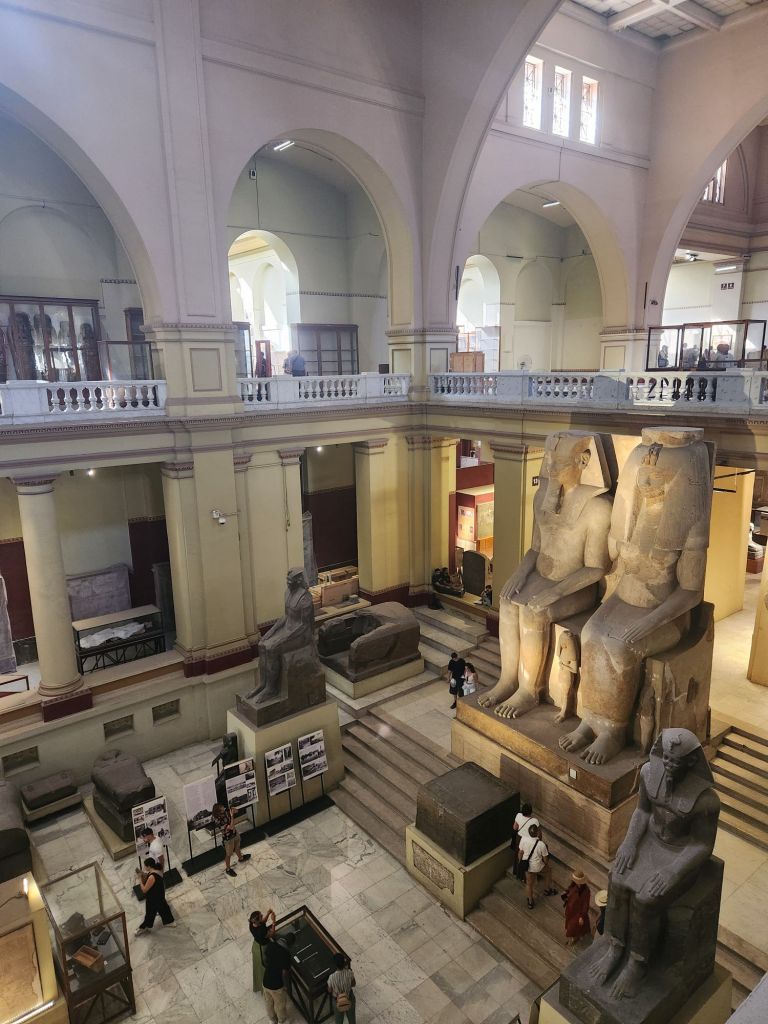
Main Atrium, featuring King Amenhotep III and Queen Tiye.
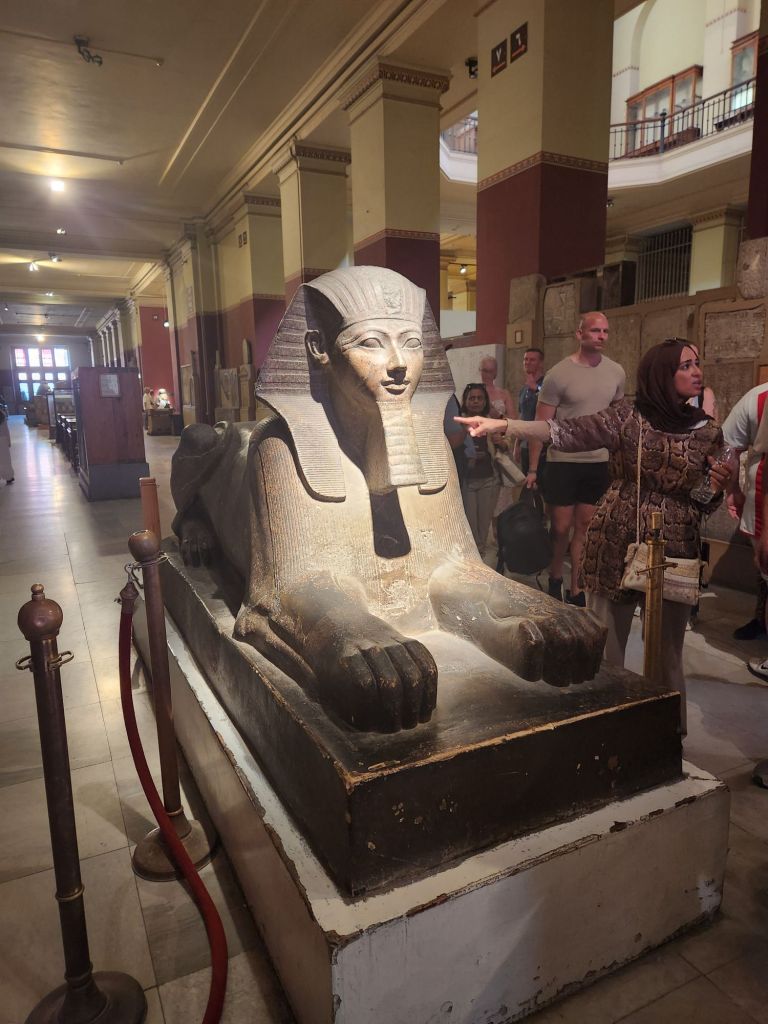
During my visit, the place was somehow busier than the GEM during my visit, and I only stayed an hour, concerned I was going to be swept up in a tour group and suffer an existential crisis. I didn’t take many photos, but I did like this Sphinx depicting Hatshepsut, a female pharaoh from the Eighteenth Dynasty.
In remarkable condition.
Crossing the roads again, I made the mistake of buying some mints from a gentleman sitting against a tree, and another man struck up a conversation, and next thing I knew, I was drinking coffee around the corner with him. I knew it was part of a sales pitch, but the path of least resistance led me to go along with it. After coffee and a chat, he led me to his handicrafts and perfume store, and I managed to leave without buying anything, but I did promise I would come back when I am back in Cairo.
When I returned to the bus company office and was reunited with my bag, I walked back over to the dusty lot that served as the overflow bus station where the bus was leaving. This is why I usually avoid expensive bus rides. They typically end up being much like the cheaper ones. The bus, once I was able to board, was very nice, with an LCD screen in front of me in case I wanted to watch any Arabic TV, a USB port for charging (yay), and a very comfortable reclining seat. I was also offered snacks, coffee or tea, and a bottle of water. I slept on and off for the entire trip, read and watched YouTube videos, and wished I had the budget for my internal flights.
At 2 am, the bus attendant woke me as we stopped at Luxor. I gathered my things and acted dumb as a different attendant tried to get a tip out of me for taking my bag out of the bus. I stumbled in the vague direction of my hotel. The first half of this walk I had to fend off the increasingly desperate taxi drivers. In the second half of the walk I had to convince someone walking with his family that I really didn’t want to book a tour while half-asleep.
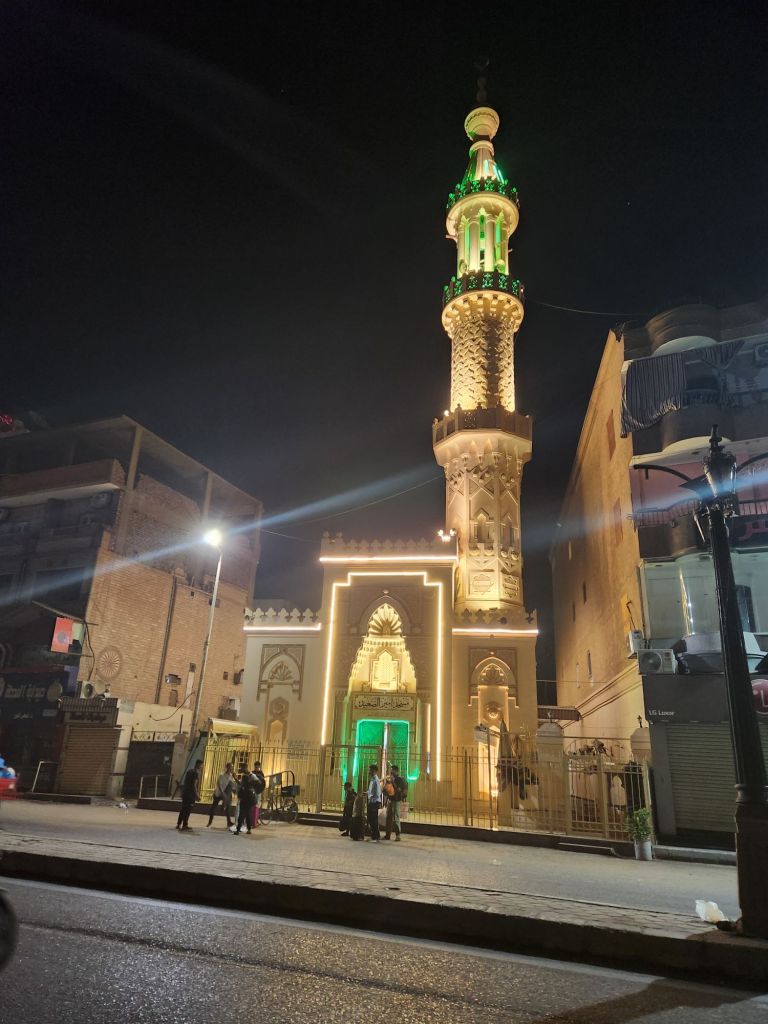
Mosque I spotted, the only well-lit building at that time.
Luckily, my host was awake, and, showing an incredibly non-Egyptian pragmatism, simply grabbed my bag, showed me to my room, and left me to dream of puppies and maniac pixie dream girls.
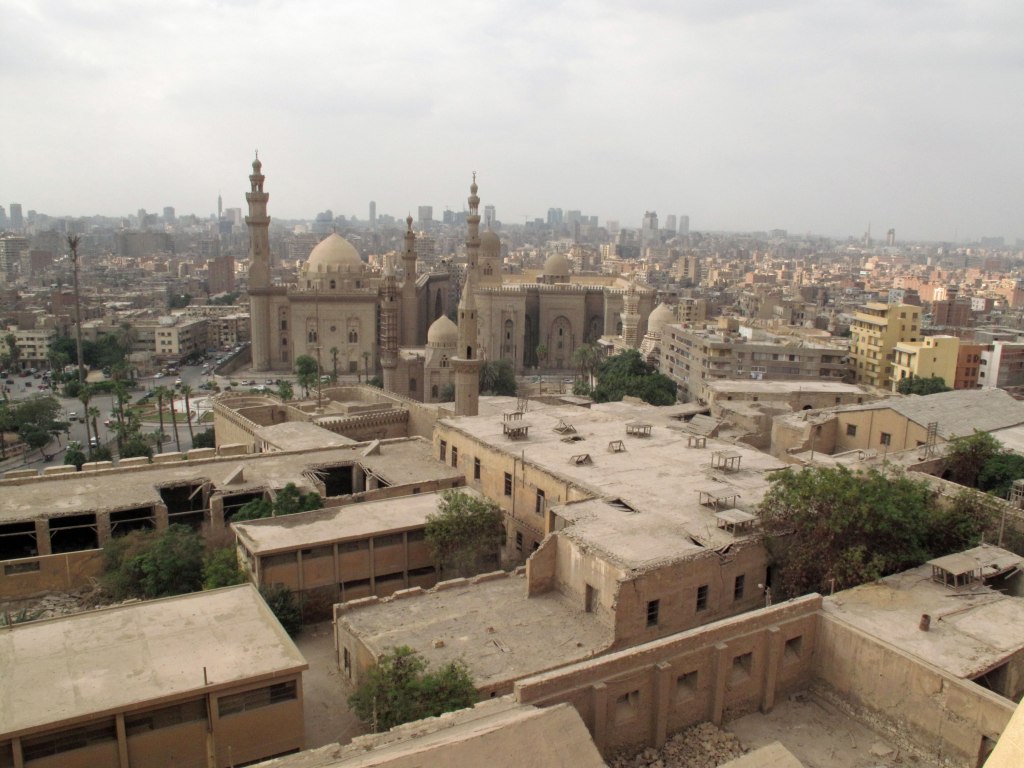
Cairo, the city of a thousand minarets. A city with both feet firmly in the past, trying to sway into the future.
View from The Citadel.
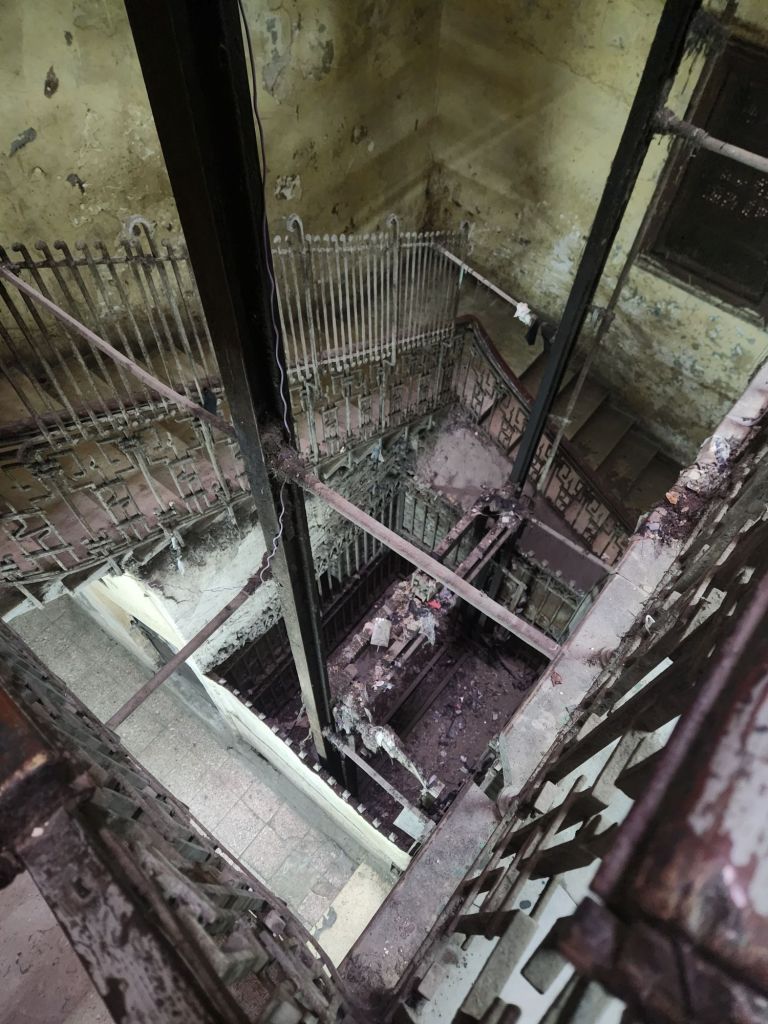
I would love to claim that I booked my hotel in Cairo with deliberate care, with consideration for location, amenities, and reviews. In fact, I booked it after ten seconds of thought, based on price, while frustrated about my lack of progress on planning this part of my trip. My hotel was five stories above an alley dedicated to selling car parts. The staircase wrapped around the old elevator shaft, which had stopped working decades ago.
Would you believe it looks even worse in reality?
The handrails may have once been quite ornate, but any pretense of grandeur had long ago been given up. My room was small, being divided up from a larger suite, two walls made up of unpainted plasterboard, the ceiling peeling paint, and plaster dropping away from the wooden beams. I had to provide my own soap and toilet paper; the shared bathroom did not even feature a bum gun or bucket and jug. It was clean and safe enough, but I took care not to leave anything in my room worth stealing.
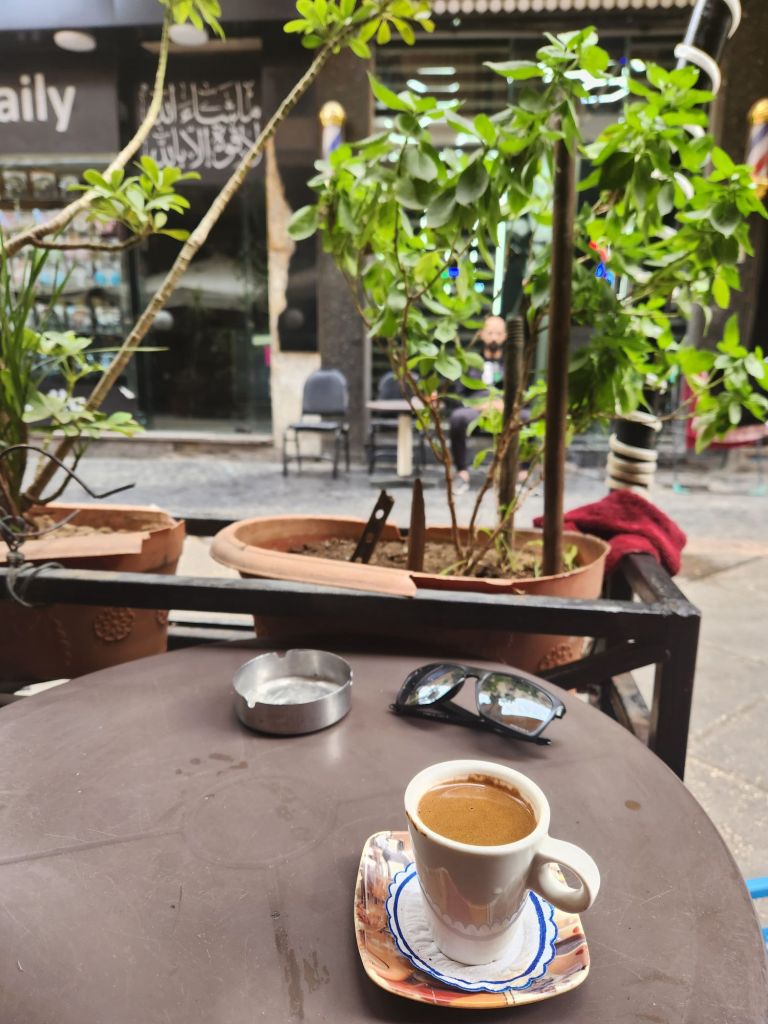
In the morning, I walked a short distance from my hotel and found a traditional cafe in an alleyway. There, I enjoyed my first Arabic coffee since COVID.
Strong, gritty, and without pretension.
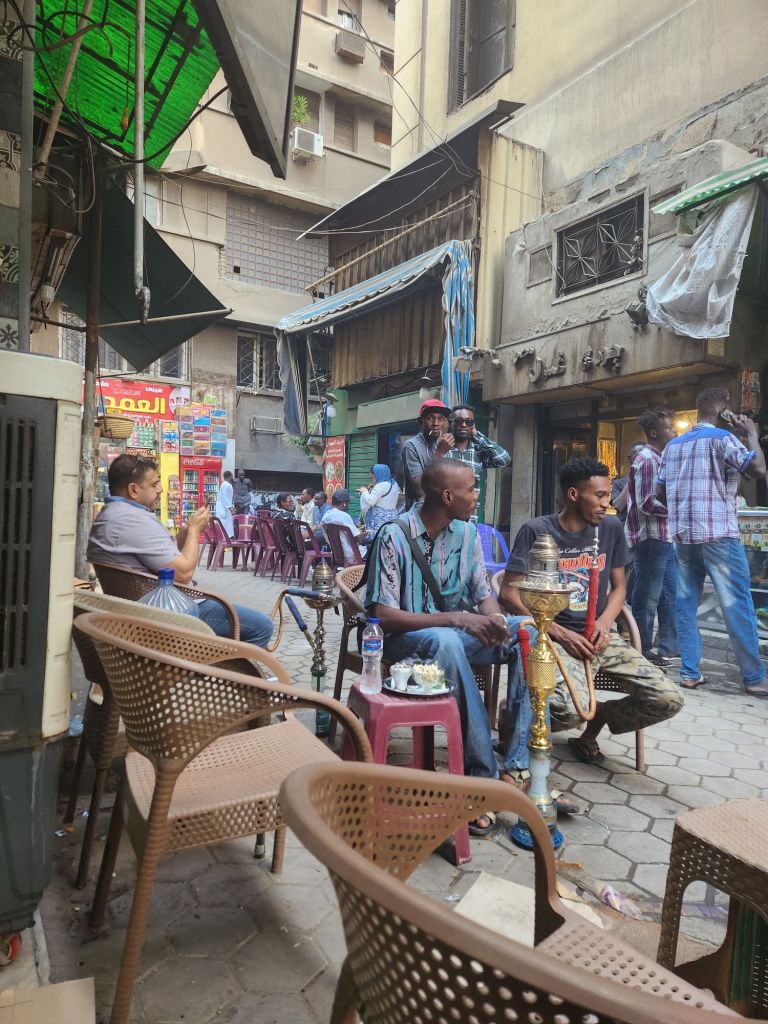
I think what draws me to these sorts of places is that in a world where you are never far away from a Starbucks, these cafes are largely doing business in the same way for the last hundred years. Cash only, coffee brewed by hand above flames, and barely any English spoken. Fully caffeinated, I completed my efforts in returning to full human status by getting a shave and a haircut at a tiny barber shop I passed earlier. I was, however, not feeling up to any serious sightseeing, so I continued walking aimlessly. I got lost in a series of streets lined with shops selling name plaques, name stamps and similar office supplies. When I managed to escape this enclave, I got lost in a series of streets focused on selling lighting fixtures and other electrical parts. Eventually I found myself in an alleyway where the focus was more useful to me; coffee and shisha. I spent a few hours here, drinking coffee, reading, and watching the tide of humanity, which seemed to be darker-skinned than what I expected to see in Egypt, which I assumed to be Nubian.
Tokyo never seemed further away.
There was a lot of traditional dress, traditional three-kisses greetings between men, and, of course, mobile phone use, which was the single sign of modernity, apart from the noise of traffic.
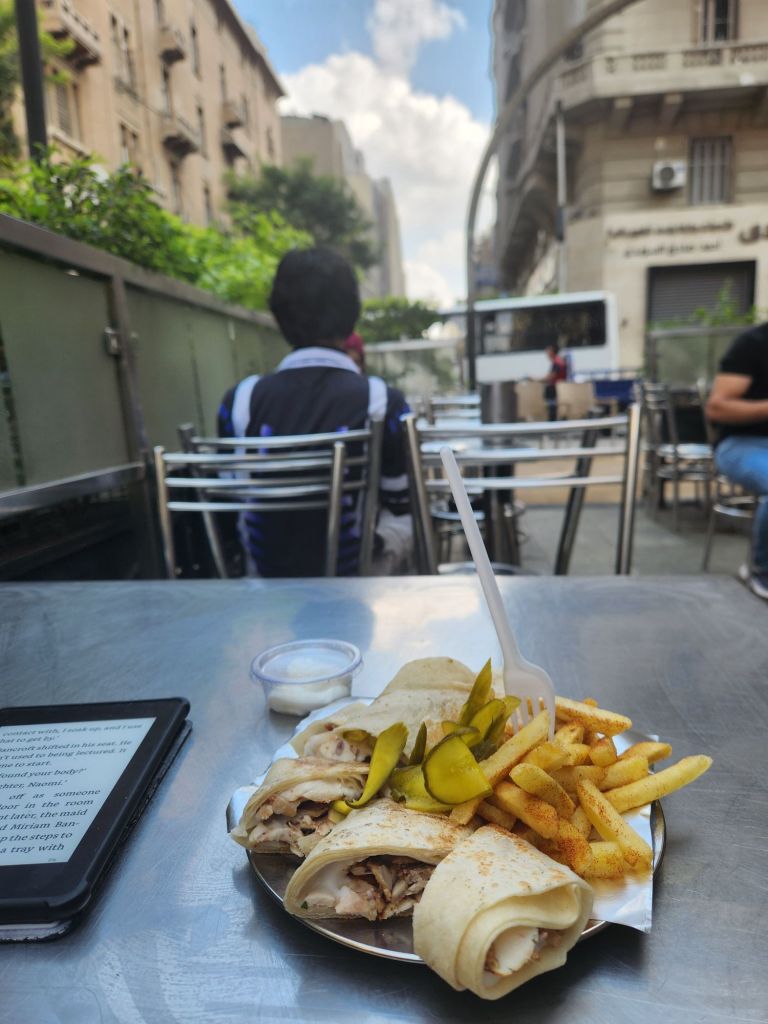
Early evening, I found myself in a pedestrian boulevard, having eaten nothing in Cairo yet, I discovered a no-frills restaurant, which was something of a local favourite.
Cheap and tasty.
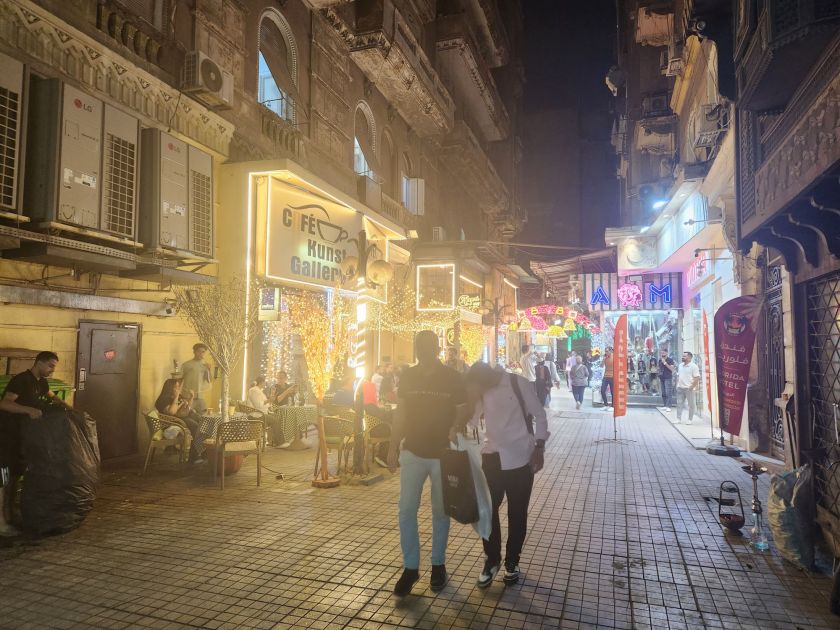
I wandered some more after my early dinner, finding some nice, more modern cafes down alleyways closed off to traffic.
Good mango smoothie.
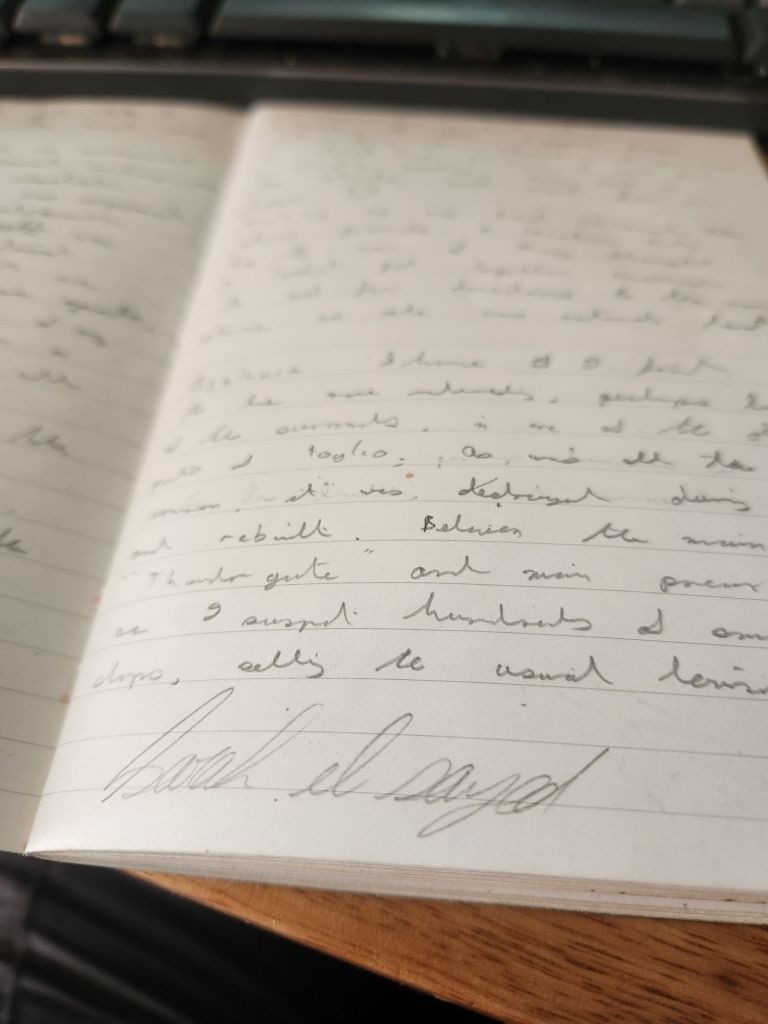
Later, I was craving air-con and a place where I could do some writing unmolested. I walked to a nearby McDonald’s and ordered a tea from the kiosk before heading upstairs. After waiting half an hour, another patron took pity on me and sent a staff member to find out what was going on. Sarah appeared and commented on my handwriting being much like hers, then proved herself wrong by writing her name in my notebook much neater than I could ever manage.
See?
When Sarah returned to me with my tea, I handed her one of my mini business cards, which delighted her, but she seemed to make a point in accepting it as a souvenir rather than any interest in contacting me. My hopes of gaining a beautiful Egyptian girlfriend dashed, I drank my tea and returned to my hotel to climb the stairs, alone and rejected.

 Adrian's Got The Moose