The modern city of Luxor was built on the remnants of the ancient city of Thebes, and both are built around the Temple of Luxor and the Karnak Temple. I quickly learned to orient myself with the Luxor Temple in relation to my hotel. Also, in some kind of locational genius, the local McDonald’s upper-floors offer incredible views of the Luxor Temple, which, in addition to the air-conditioning, makes it a great spot to enjoy a mediocre iced coffee.
View while waiting for a shitty burger.
Construction of Luxor Temple began in 1392 BCE by Amenhotep III, completed by Tutankhamen, and expanded by Rameses II. It was dedicated to the rejuvenation of kingship and may have been where many pharaohs were crowned. The temple also contains chapels Mut, Khonsu, and Amun, details which were lost to me due to my refusal to hire a guide.
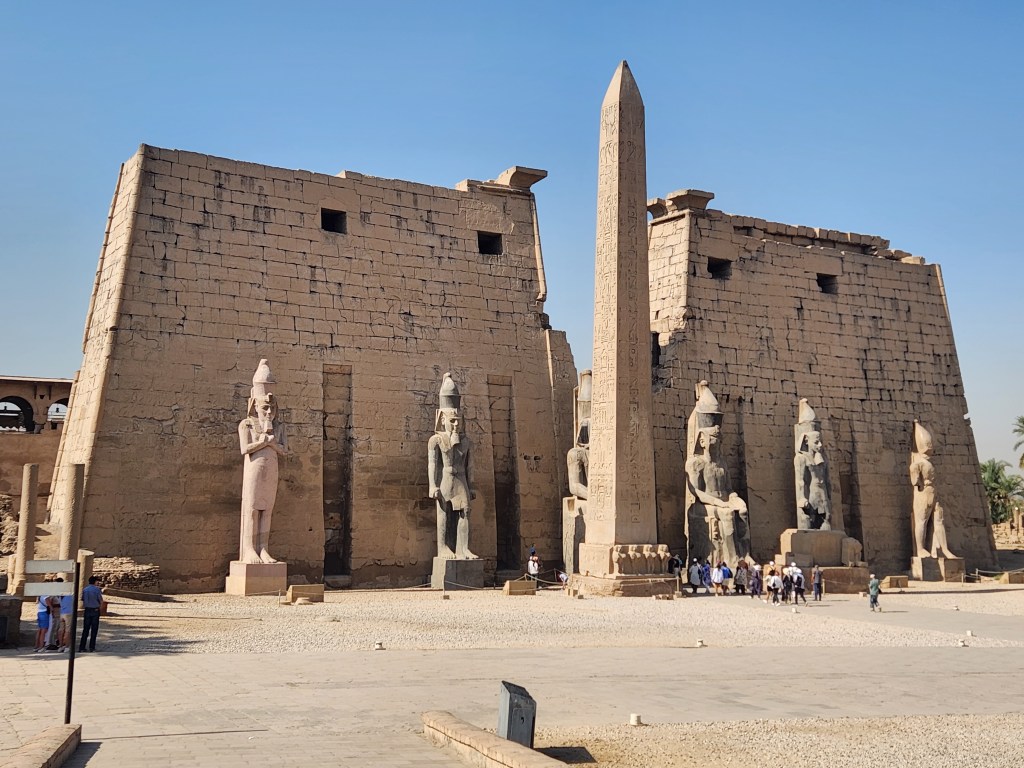
First Pylon
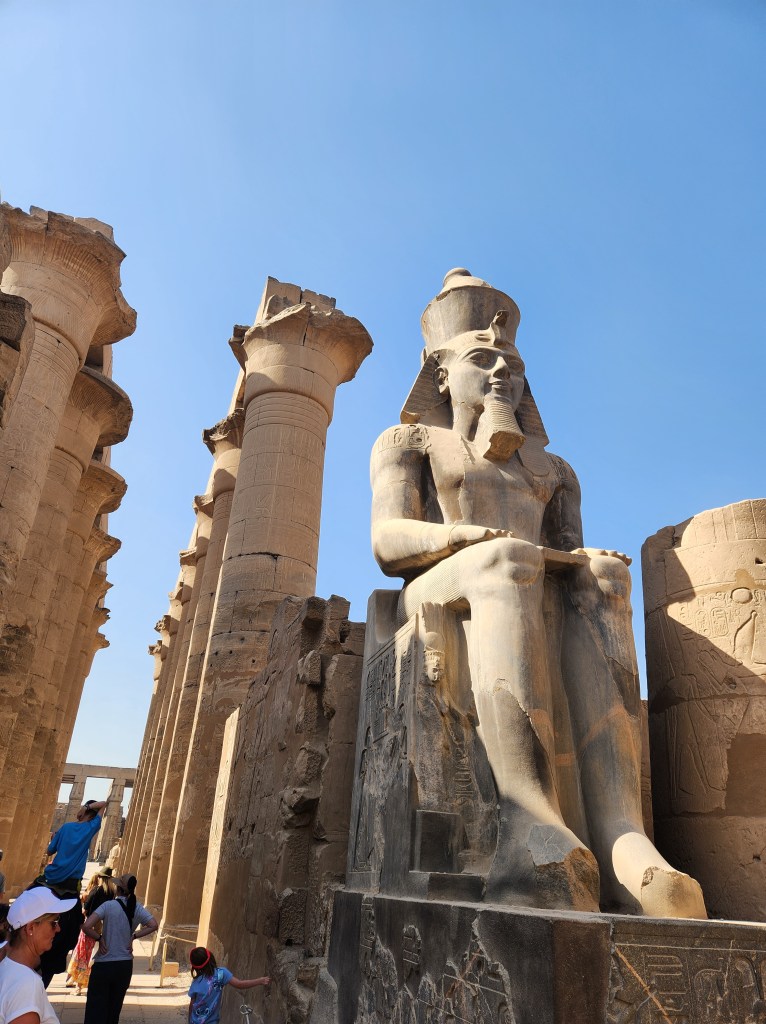
The main entrance (1st Pylon) was originally flanked by two obelisks, now only one remains due to the averienceness of the French. Behind the obelisks are six statues of Rameses II, just in case anyone might forget he was involved. Further into the temple, even more impressive statues stand sentinel.
Even more statues of Rameses II
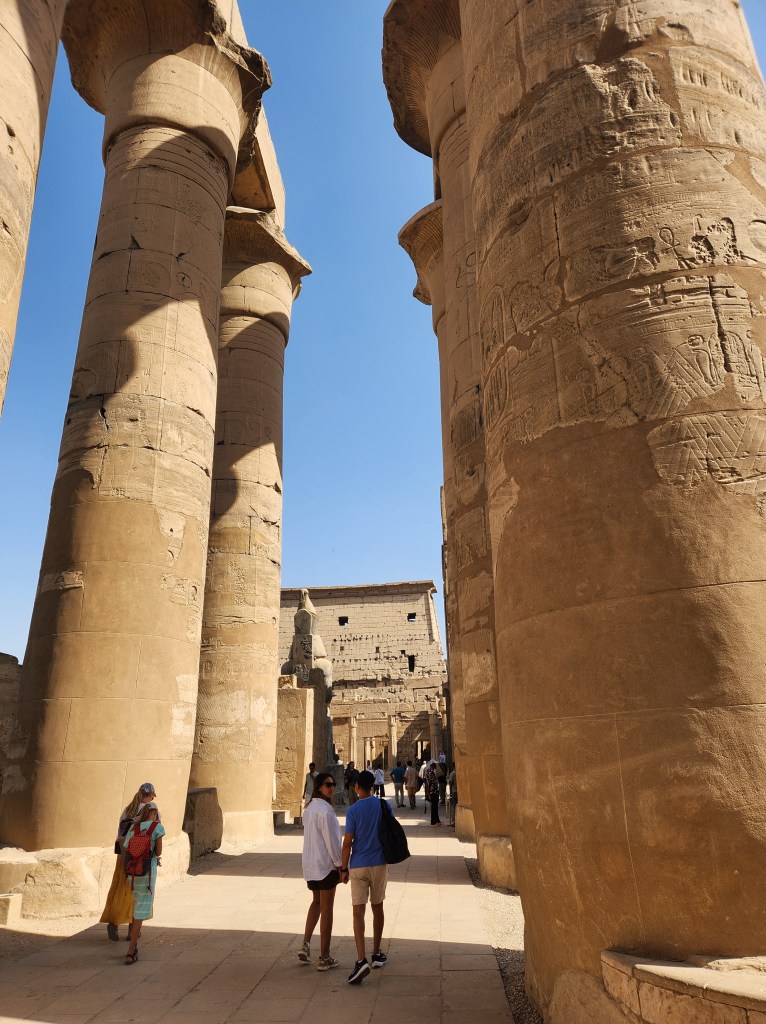
As one steps deeper into the temple, you pass through the court of Rameses II, and then the Great Colonnade of Amenhotep III, surrounded by massive columns. The presence of which made me feel disoriented, which I think was most likely the intent, and still lingering effects thousands of years after the death of everyone involved.
Great Colonnade
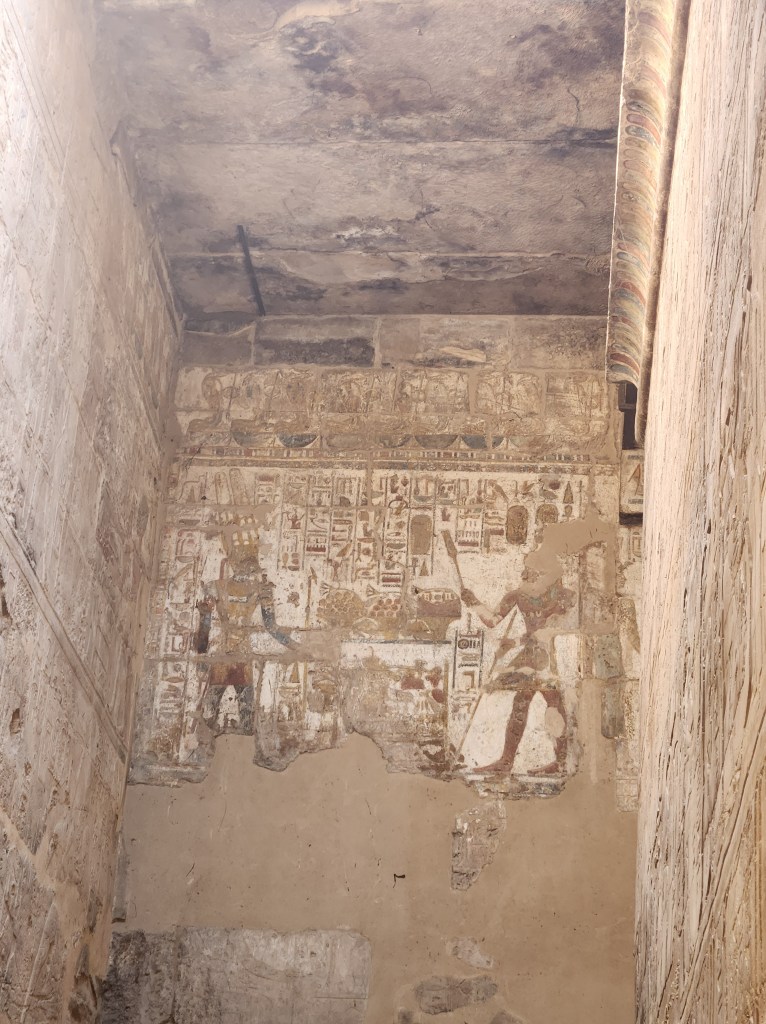
The inner sanctuary of the temple still features carvings and paintings, the significance of which was lost on me.
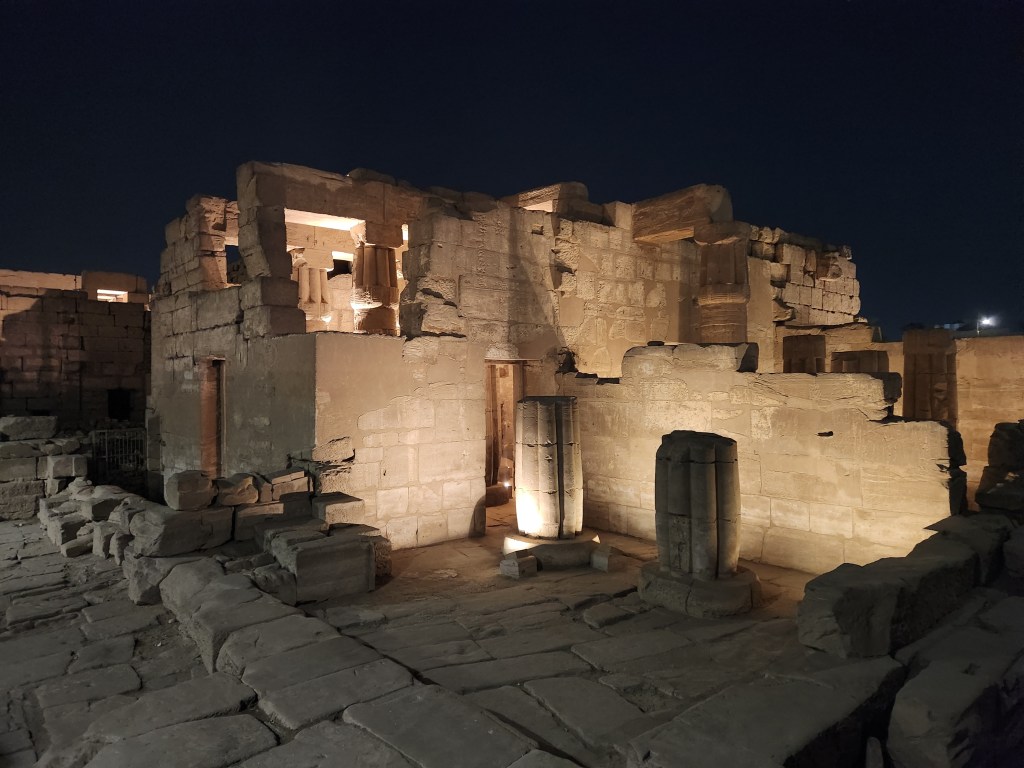
Google Lens tells me this is another temple entirely.
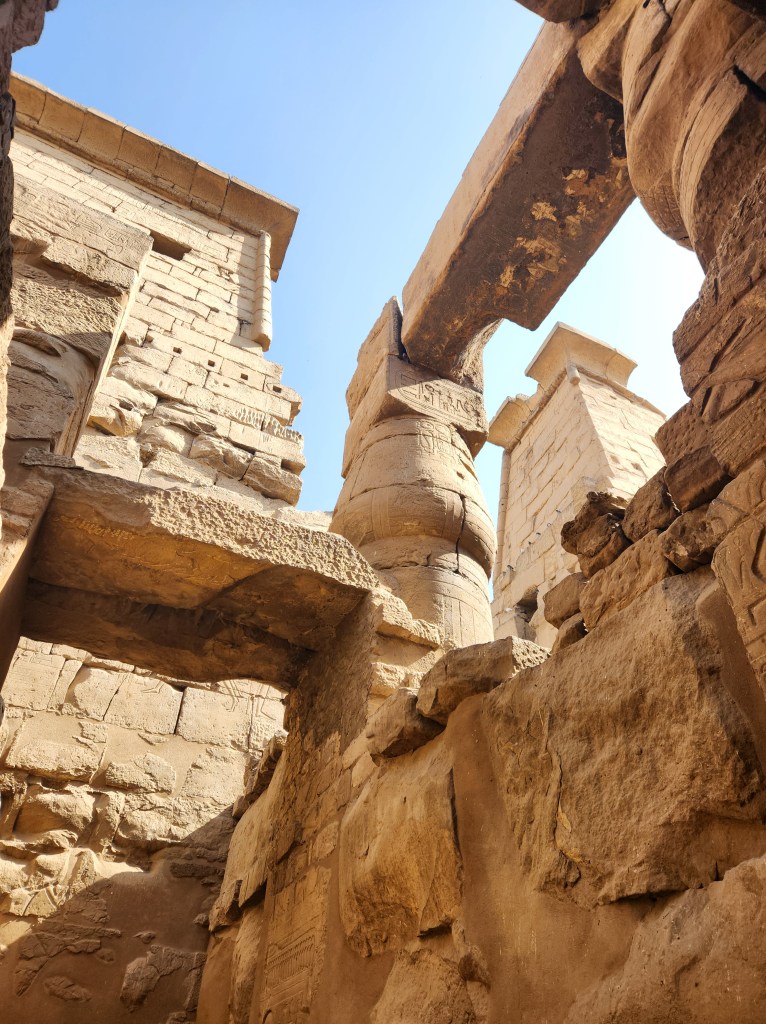
I quite liked the layered effect caused by damage.
Imagine putting detail like that so high.
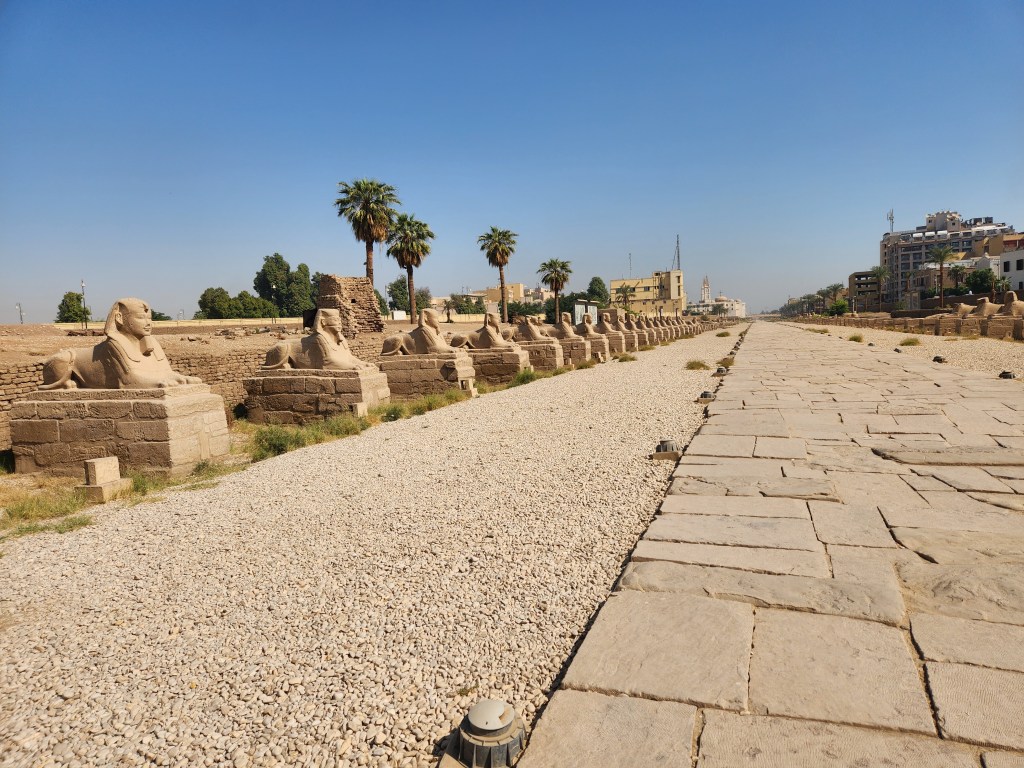
Returning through the First Pylon, I found the gift shop uninteresting and the cafe overpriced and uninspiring (and open to the vicious Egyptian sun). I walked through a short section of the Avenue of Sphinxes, which originally linked Luxor Temple to Karnak, 2.7 KM away, both sides lined with sphinxes.
Avenue of Sphinxes, with Downtown Luxor in the background.
I had originally planned on walking, but the heat, lack of shade, and my dwindling supply of Australian sunscreen led me to skipping that idea and having lunch before Ubering my way to Karnak.
If carving tombs underground instead of building massive pyramids made anyone think the Pharaohs were done with massive building projects, they would have been sorely mistaken.
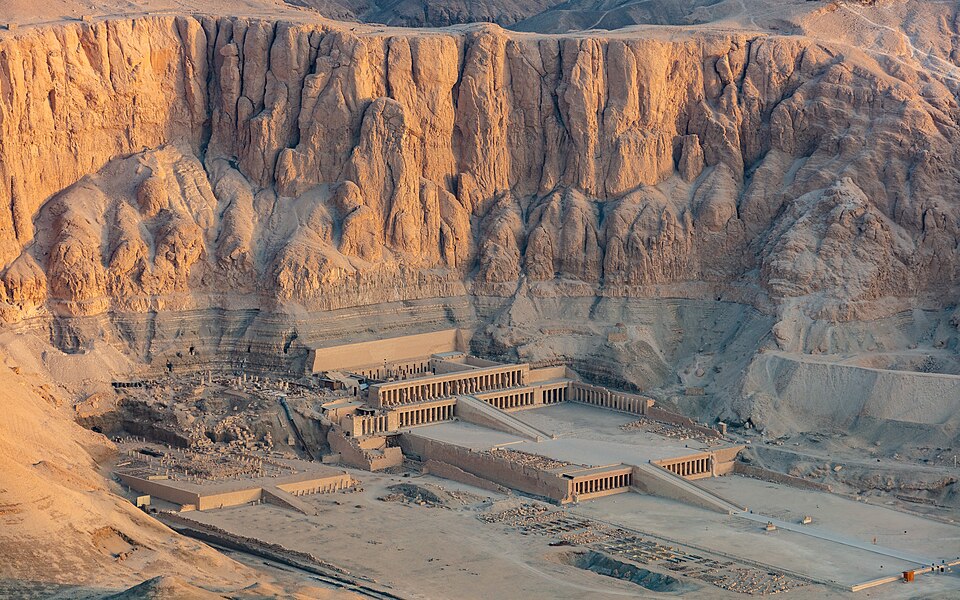
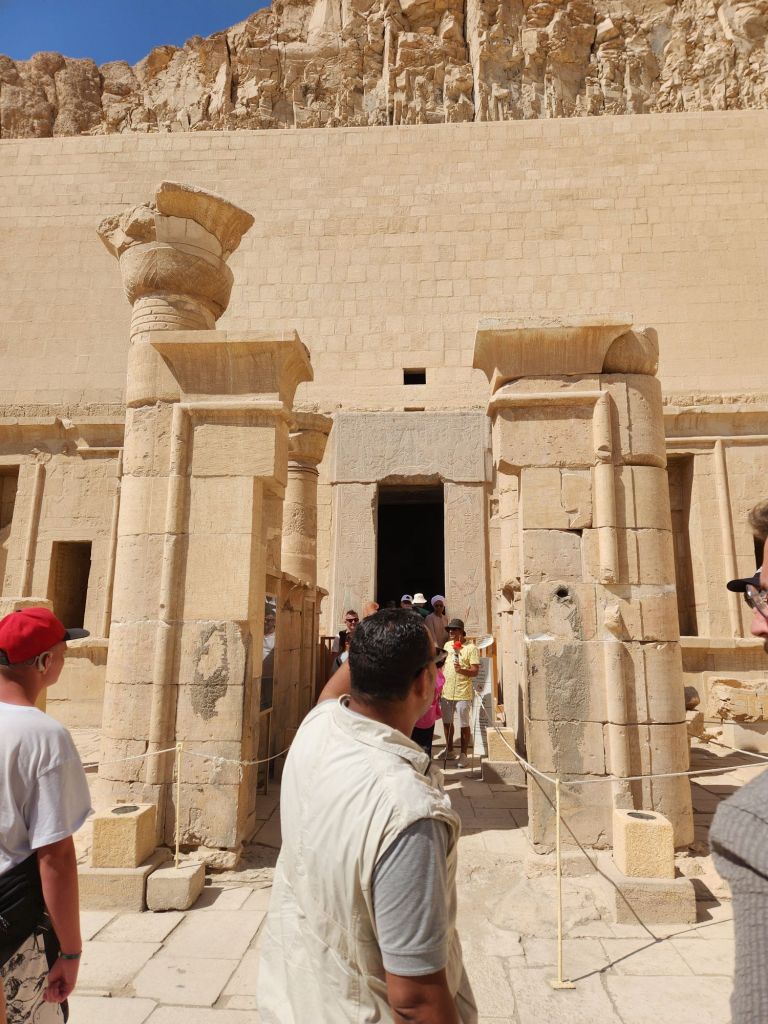
The Mortuary Temple of Hatshepsut was built into the cliff face on the other side of the Valley of the Kings, and I believe it is every bit as impressive as the Pyramids of Giza.
Aerial view. Attribution: Diego Delso
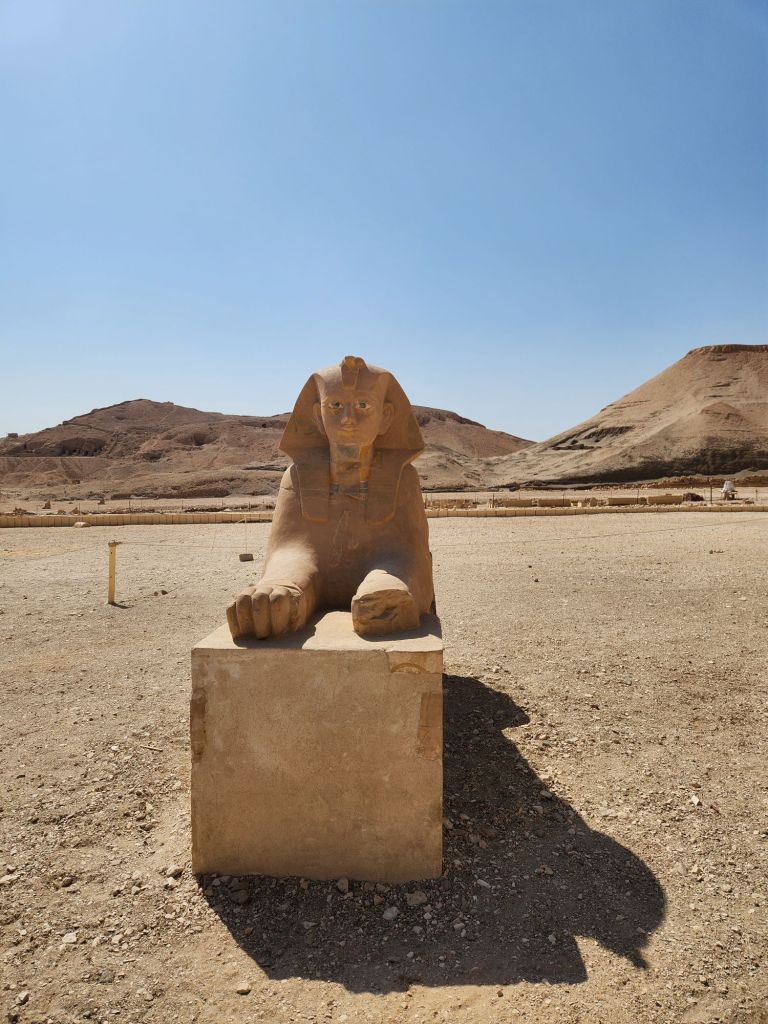
Three terraces lead to the main temple, with a central causeway that is guarded by a Sphinx on either side. One of each has been restored, gazing benevolently at visitors, and the other features the original, half-destroyed head.
The left-hand Sphinx, from memory.
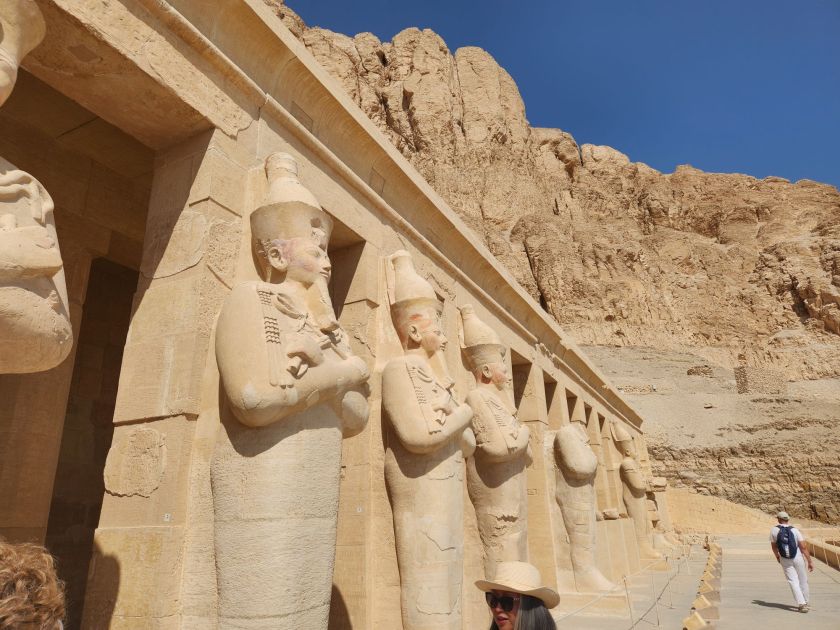
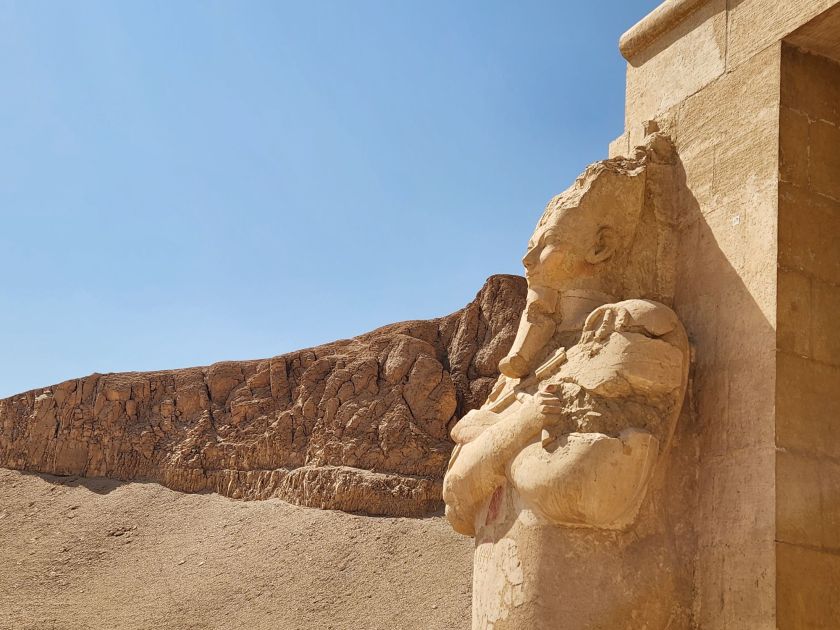
Each of the twenty-six columns of the upper terrace is fronted by a statue of the queen in her Osiris aspect, each over five metres tall.
Upper Terrace.
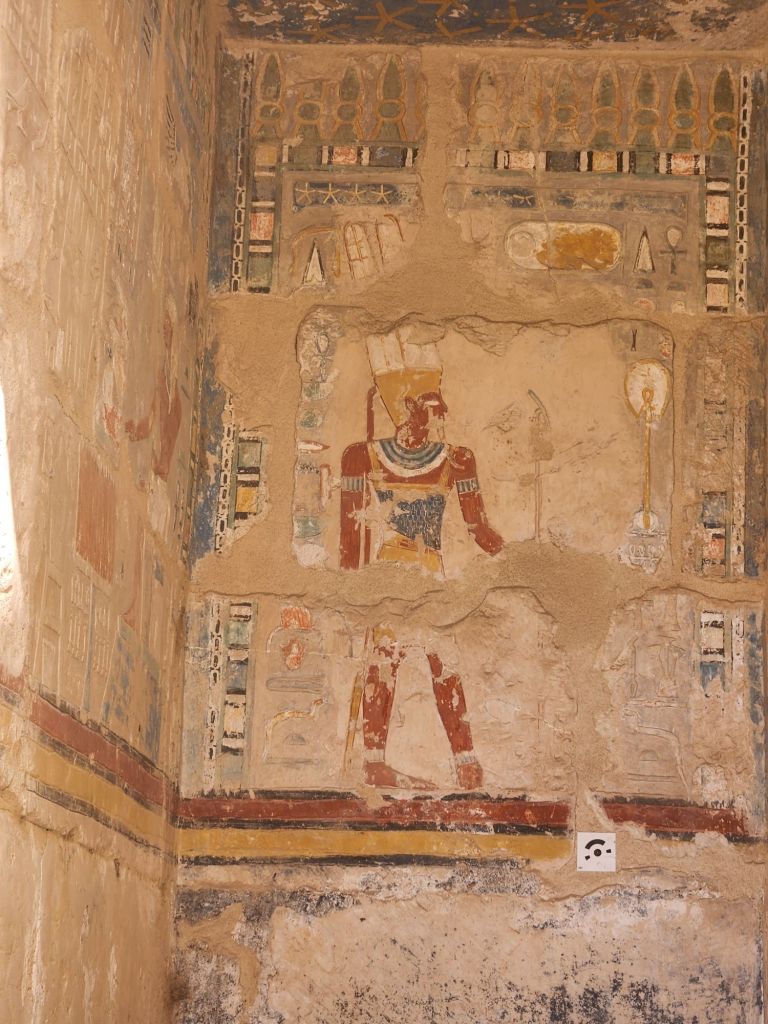
While her successor, Thutmose III, attempted to remove all references and proof of Hatshepsut’s rule, some of the carvings and paintings in this temple have survived.
Depictions of Amun.
As is typical, the innermost part of the temple is blocked off, leading to the crowd only being able to look into the sanctum.
Oh yeah, and our guide.
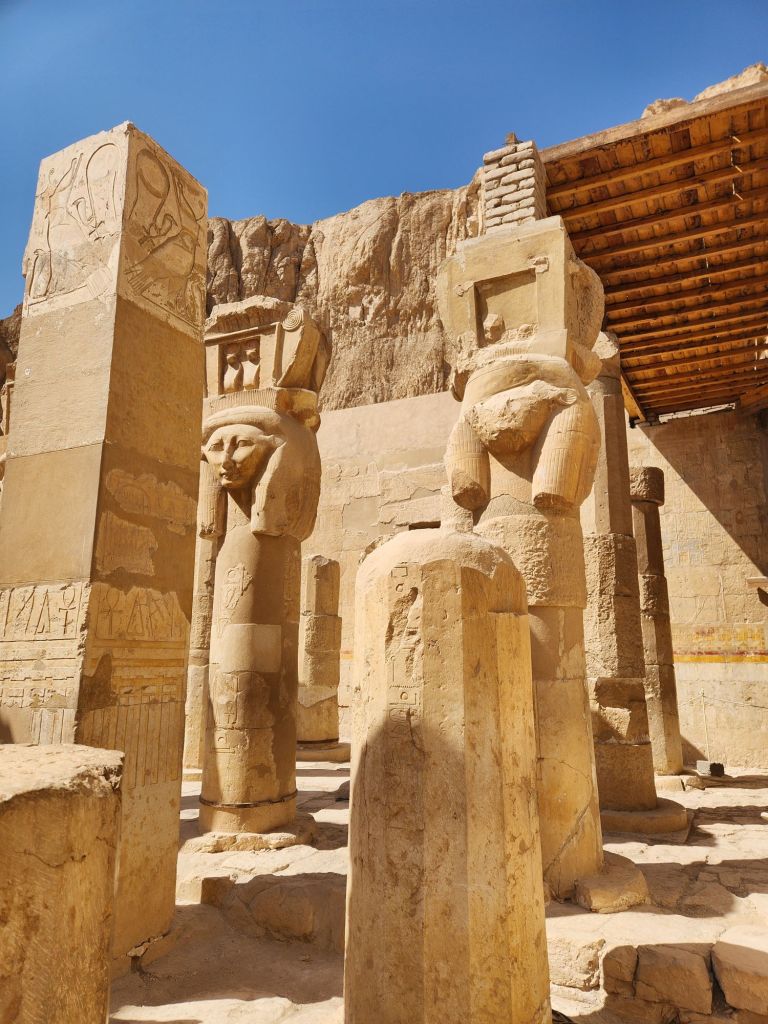
An area to the left of the main temple has a chapel dedicated to Hathor, which I quite liked. Plus, it was comparatively quiet.
Chapel of Hathor.
To the left was of interest, which included an altar of the solar cult, but much of the more interesting places were blocked off by locals on demand of baksheesh, so I did not linger.
Maybe the actual altar?
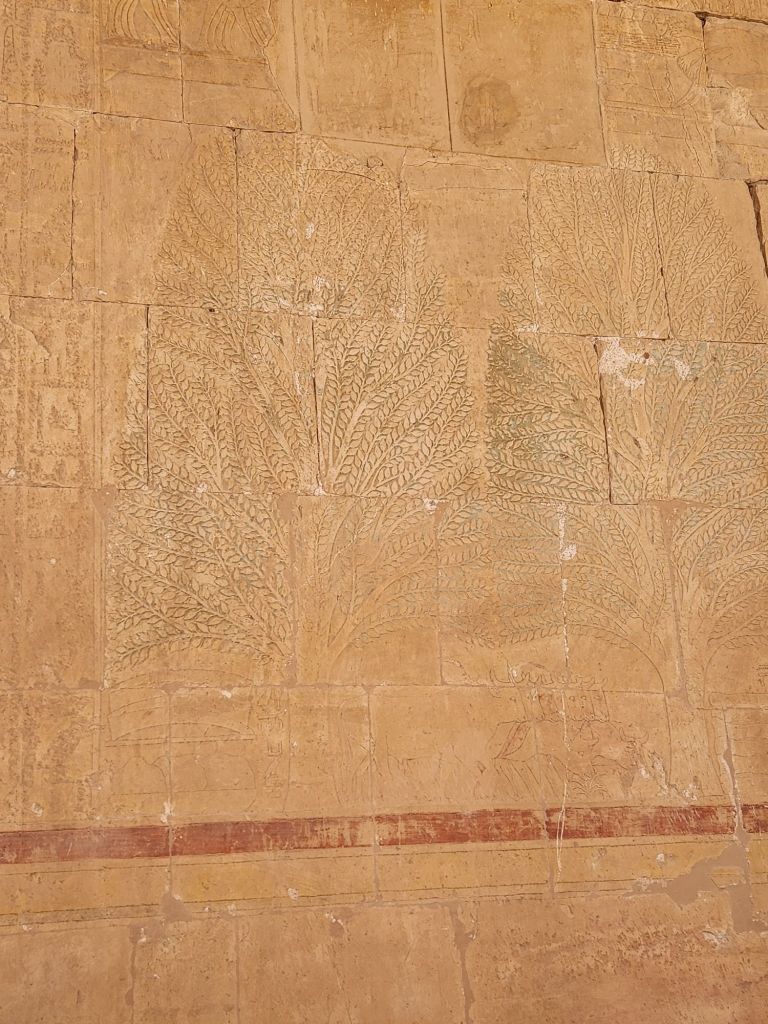
Behind the row of statues, I spotted carvings that document the Queen’s trading expedition to the Land of Punt, believed to be to the south-east of ancient Egypt, bordering the west bank of the Red Sea.
Believed to be Sandalwood trees, brought back from Punt.
I think what I liked about this temple was the fact that it was designed to complement, rather than just be placed, in the surrounding geography.
Statue of Hatshepsut, overlooking the nearby cliff.
Our next step was a nearby factory throwing out alabaster carvings, in the traditional, hand-carved methods. What this had to with ancient Egypt was tenious at best, but had much to do with our guide and driver earning commission. I was also somewhat dubious about how the half dozen guys with small pieces of alabaster and sandpaper outside could produce so much product. While some of the pieces were beautiful, and I would have loved one of the smaller “scribe” figures for my desk back home, I didn’t relish having to haggle over one or lugging it back home. But I did appreciate the offer of a cold drink without being charged ten times the retail price. Eventually, the three of us convinced them that we were not in the market for anything, and we headed back to the bus. Before we left, one of the workers made his way to me and, with a look askance for supervisors, palmed me a “gift” of a half-finished sacarab and some rough alabaster pebbles. I gave him a small note of Egyptian pounds, which was probably less than he hoped.
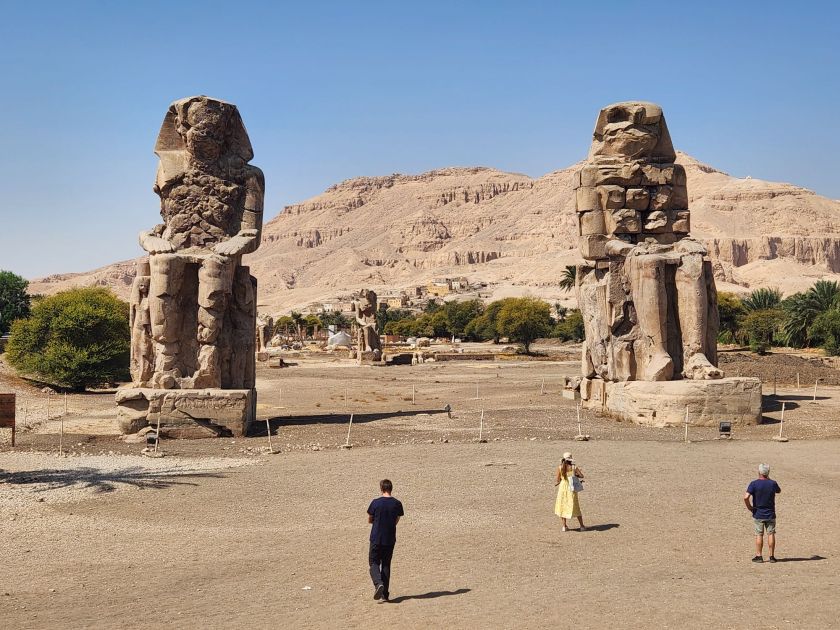
Our final stop was the Colossi of Memnon, two huge statues that depict Amenhotep III, built to guard his mortuary temple, of which little remains.
Colossi of Memnon.
Both statues are eighteen metres tall, and can be seen for fifteen kilometres around, which was most likely a deliberate choice for them to become a landmark. Both statues are quite damaged, despite various restoration efforts. The bases of both statues feature inscriptions in Greek and Latin.
The confusion of the name is an interesting (at least to me) story. At one point in time, the northern statue made a screaming sound when the dawn winds through it. This was due to damage it had sustained, which was later fixed. This screaming led to an association with Mennon, a hero of the Trojan War, who was said to be the son of Eos, the goddess of dawn.
By now, all three of us were tired and in need of air-con and affordable cold drinks, and after ten minutes, we made our way back to our bus. Our guide then offered to take us to a nearby restaurant for lunch, but one of my street-wise fellow guests asked about the cost, and it turned out we had a very different understanding of what affordable was, and so we declined and were driven back to Luxor, where we parted ways.
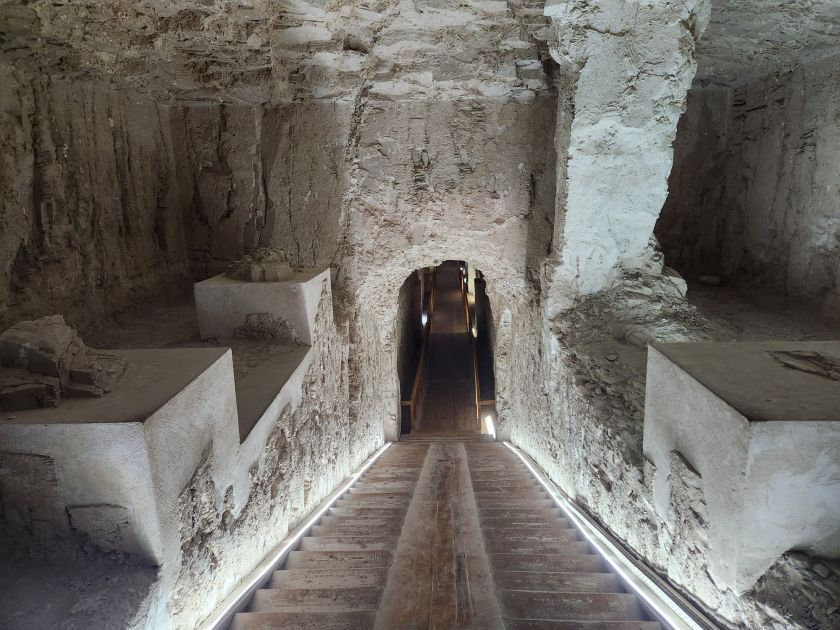
The next tomb was KV47, the eternal home of Siptah, who ascended the throne at fourteen. Siptah was perhaps the illegitimate son of King Merneptah and his Syrian concubine. The tomb was never completed, which explains why it was so austere compared to the first tomb I visited, but it was also the victim of damage and pillaging.
Central passageway
The other obvious difference when I visited was the almost complete absence of tourists. I waited for a couple to exit the burial chamber before stepping into it myself. Into this incredible still space. It took me a while to work out what was so peculiar and disconcerting about this space, then it was obvious; it was silence, something I had not experienced since I had landed in Egypt.
Burial Chamber, KV47
I would have happily curled up on the floor and slept, but five minutes later, I was out, avoiding the ticket seller’s demands for baksheesh. A tomb I had paid extra to see had a long queue, and so I made a vague promise to circle back to it and continued on.
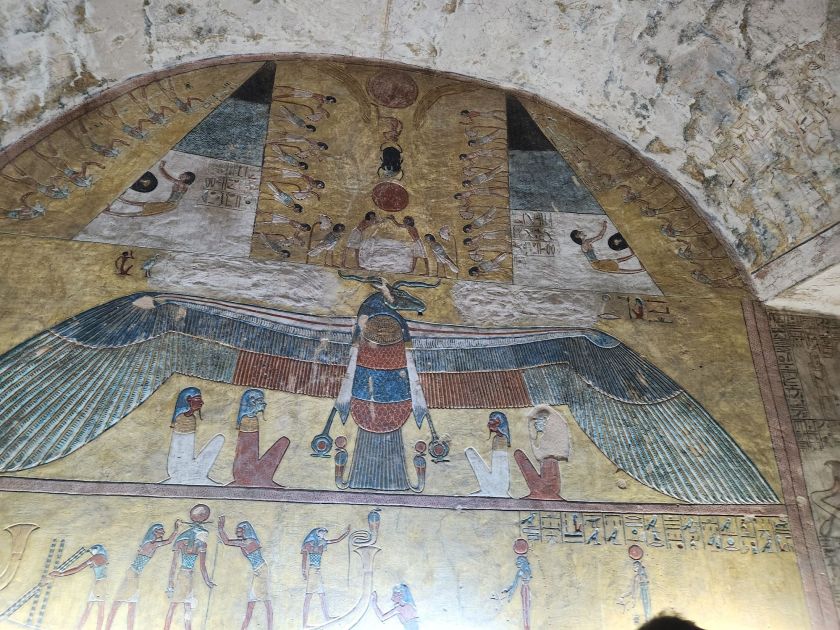
The third tomb I explored was KV14, tomb of Queen Tausert, and then reused and extended by King Setnakht. Tausert was the final Pharaoh of the nineteenth Dynasty. Her claim came from her marriage to Setti II rather than through her bloodline. Hence, her successor was also not of royal blood and usurped her during a time of crisis and political upheaval. Both only resided for a short time. It is thought that Setnakht co-opted the Queen’s tomb out of both pragmatism and as a way to further cement his right to rule. Renocations by Setnakht also made it one of the largest tombs in the valley. What I liked the most was this large painting winged goddess, which is assumed to represent the afterlife.
KV14
The tomb was quite busy when I visited, and was well-decorated leading up to the burial chamber.
Corridor.
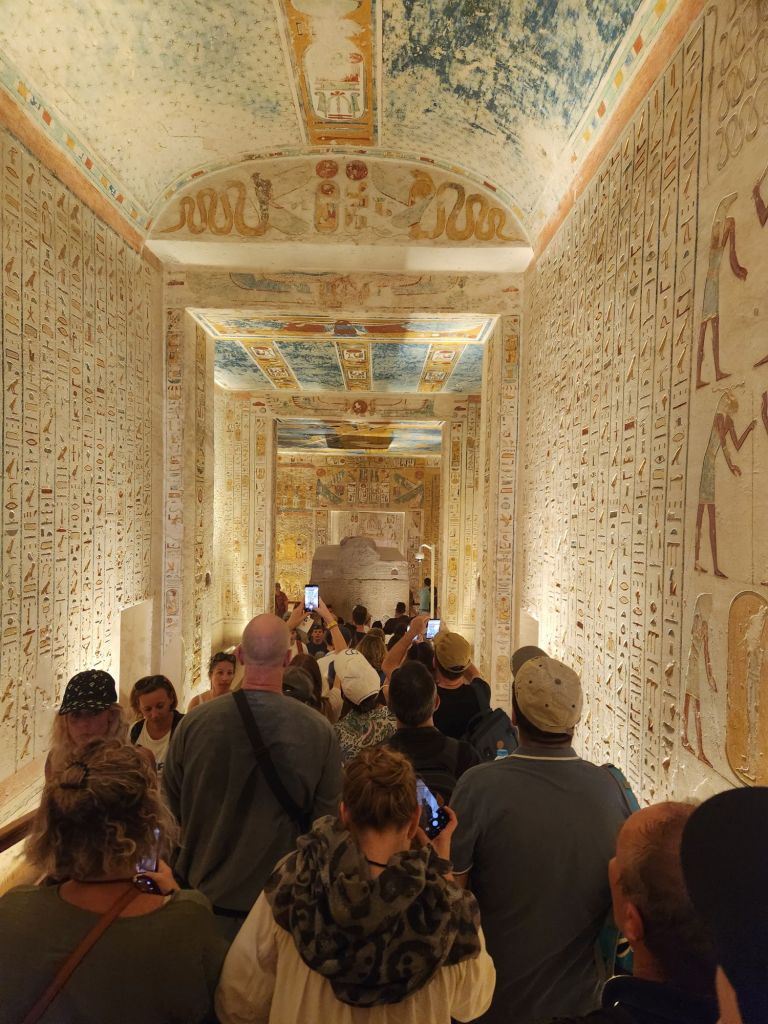
The fourth and final tomb I explored was KV2- the tomb of Ramesses IV. Ramesses IV came to the throne after his father was assassinated, and his first act as Pharaoh was the arrest and execution of the conspirators.
The tomb has been open since antiquity, and visitors often vandalised the tomb with their names and other details. At one point, it was believed to house Coptic priests, who also left their mark. Fortunately, enough decoration remains along the corridor, which probably led to it being choked with people, much to my frustration.
Main Corridor.
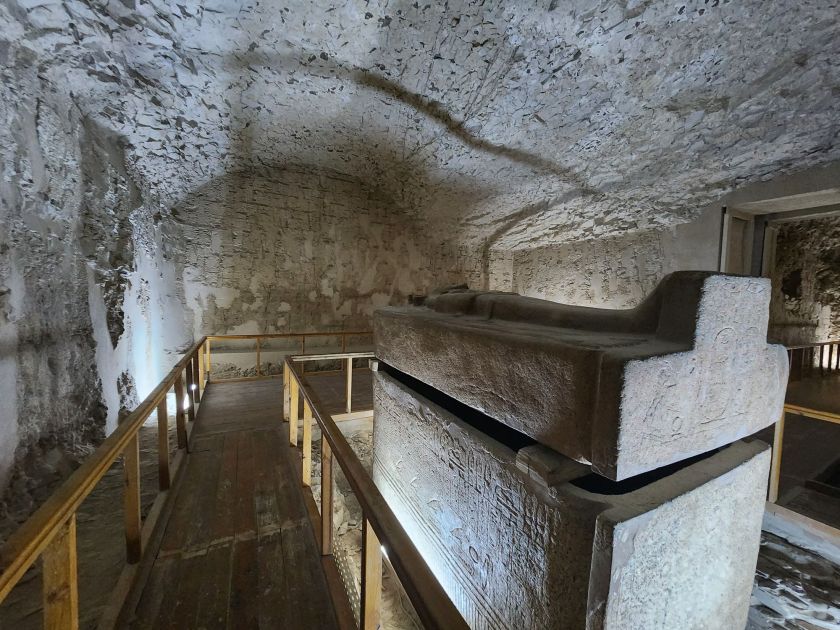
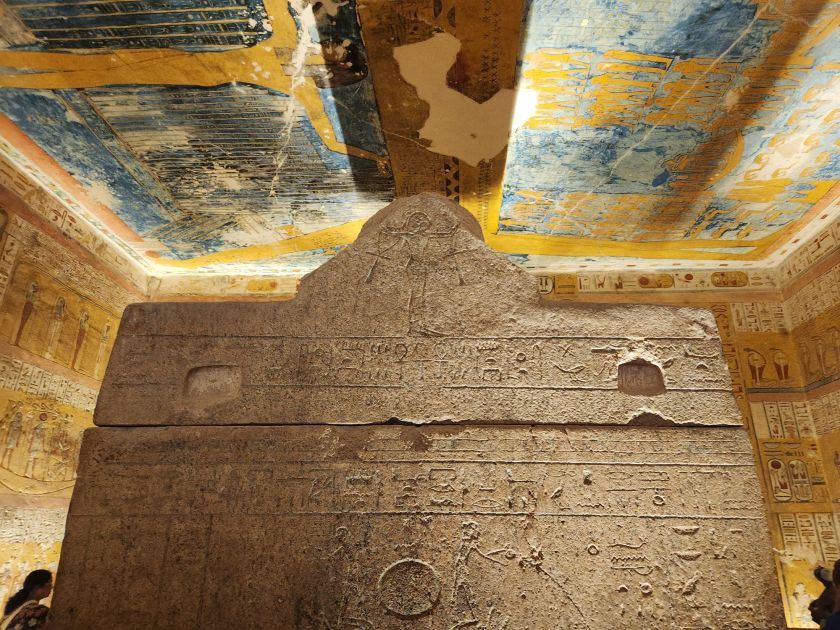
The sarcophagus, still present, was of course the focus of much attention, but I did manage to make my way to it, However I struggled to get a proper angle on it.
Ugh. Can only assume it was too heavy for the English to cart away.
Feeling equal parts awe and irritation, I made my way back out and to the cafe that was our meeting point, where I discovered that a simple iced coffee would cost me more than the entire tour. Instead, passing through the market on our way back to our bus, I bought a pomegranate juice can for a more mild rip-off.
Due to the Valley of the Kings being on the West Bank of the Nile, opposite to the modern city of Luxor, visiting the Valley under my own steam, short of hiring a car, seemed impossible. Against my usual nature, I decided to book a tour through my hotel.
Shortly after eight o’clock, I was picked up in a mini-bus, with one other client on board, and proceeded to pick up another to the north of my hotel. One South African who works on oil rigs, and one Englishman, a tradie from Bristol. With the addition of myself, an agreeable bunch who immediately formed a pact with the tour guide as our enemy.
At the Valley of the Kings ticket office, an expansive and soulless building, which was still much more impressive than the simple ticket booths at Giza. Our guide directed us to the automated kiosks, rather than to fight for a position in the queues for a human. Here, we discovered that the minimal entry ticket only provided access to a handful of the least interesting tombs in the Valley. This is how the Egyptian Government keeps these sites as a massive cash cow. With our guide’s dubious advice, I chose three add-on tombs. Later, I made the mistake of checking my bank app for the transaction; I could have stayed in a luxury accommodation anywhere in Egypt outside of Cairo for a few nights for less than that figure.
Heading through the turnstiles and battling through the hordes of people who thought nothing of standing in front and immediately behind them, we were hit up for 30 EGP for a ride to the main entrance via those extended-cab gold carts so beloved by governments the world over. The driver also made a stringent attempt for backsheesh at the end of this two-minute trip, which I pretended to not hear. While this did save us a walk, uphill and in the sun, it was still irritating.
After the main entrance, our guide bustled us past the covered market with warnings about how aggressive the sellers are. Then we were set loose, with the announcement that we would have forty-five minutes in the Valley of the Kings. This is one of the reasons I avoid tours; entirely unreasonable time restraints.
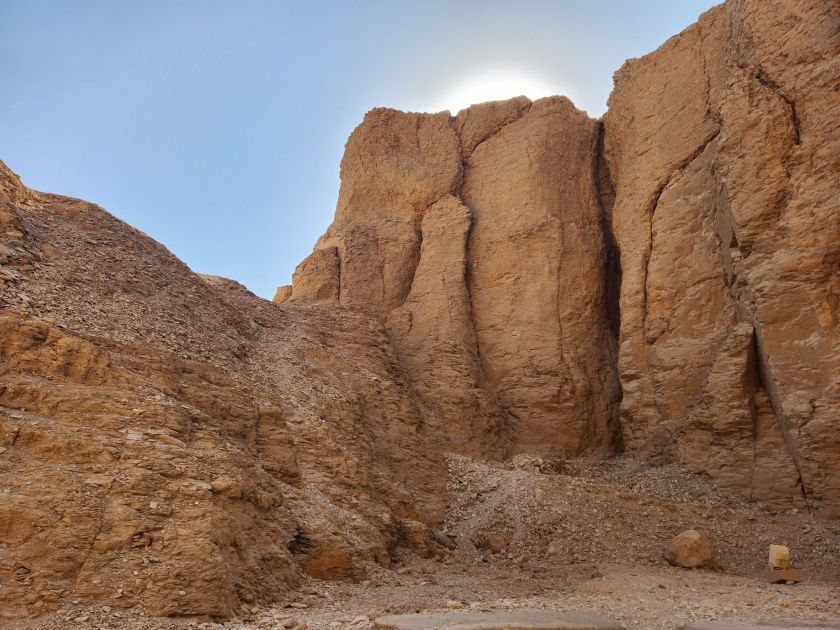
During the New Kingdom, the Pharaohs made an observation that building massive tombs in the shape of pyramids did nothing but advertise where all that sweet loot was piled up, and that a more subtle approach was needed. Thus, to the West of the Nile and the ancient city of Thebes, a wadi was reserved for the burial of the royals. The idea being that once the tombs were sealed, no one would know that gold, silver, and gems equivalent to multiple years of Ancient Egypt’s GDP was hidden behind the stone. Of course, it was all for naught, as all but one of the tombs were looted before the end of the Twentieth Dynasty, most of them within years of the pharaoh’s death, at least sometimes with the consent of the new pharaoh, with him or her taking a cut. I suspect that the suggestion that Pharaohs not be interred with so much wealth was never stated by anyone wishing to keep their head attached to their bodies.
Impossible to take a pic of the entire valley.
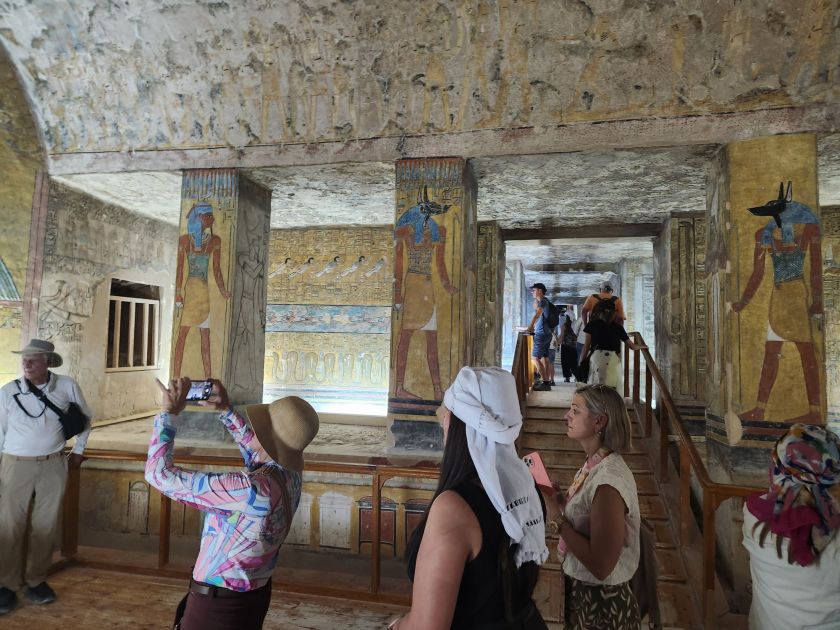
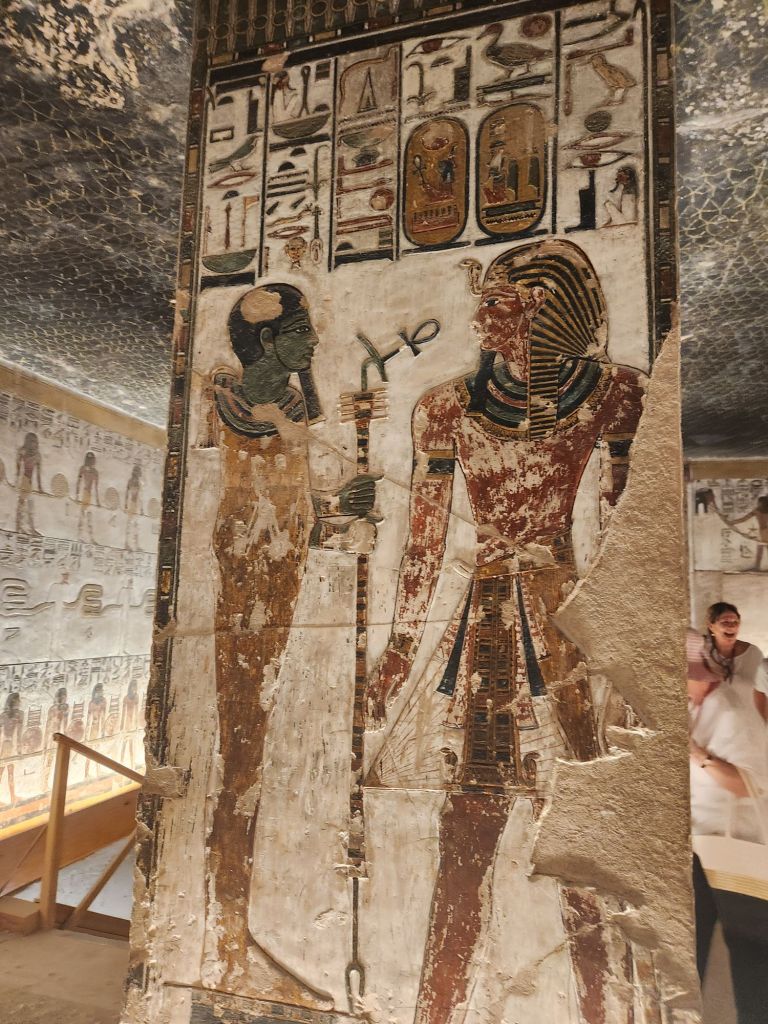
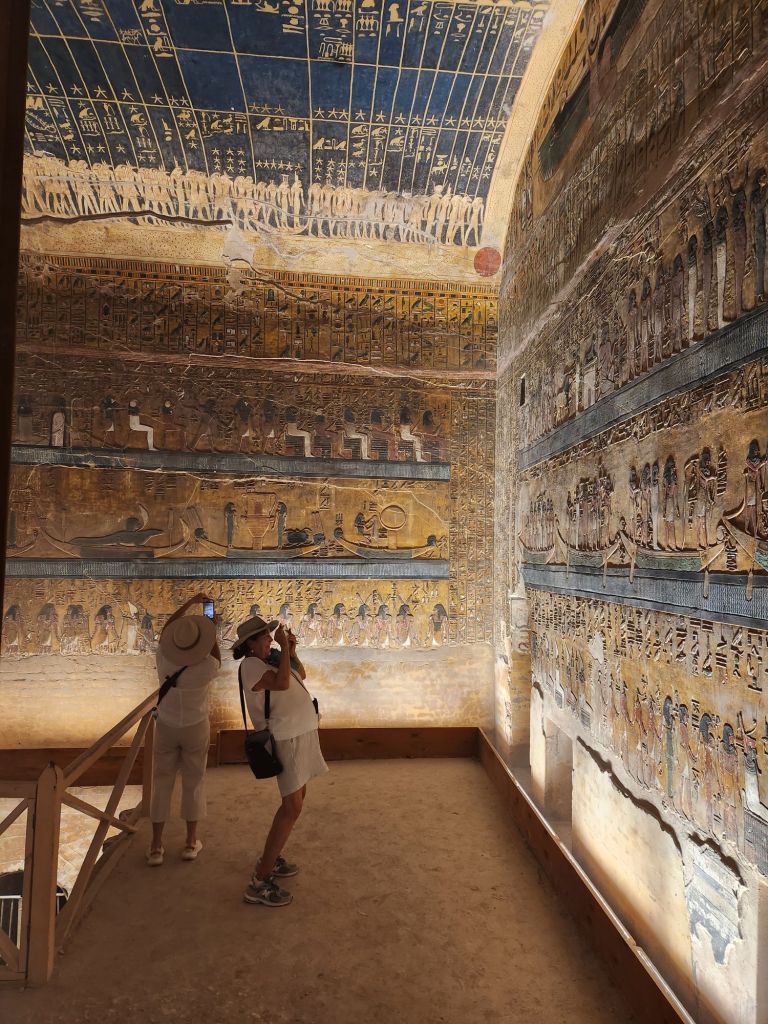
The first, and most impressive tomb I visited was KV 17, the former home of Seti I, son of Rameses I. He was most notable for his military campaigns, especially into Libya and the Levant. KV17 is famous for its decorated walls.
Pillar.
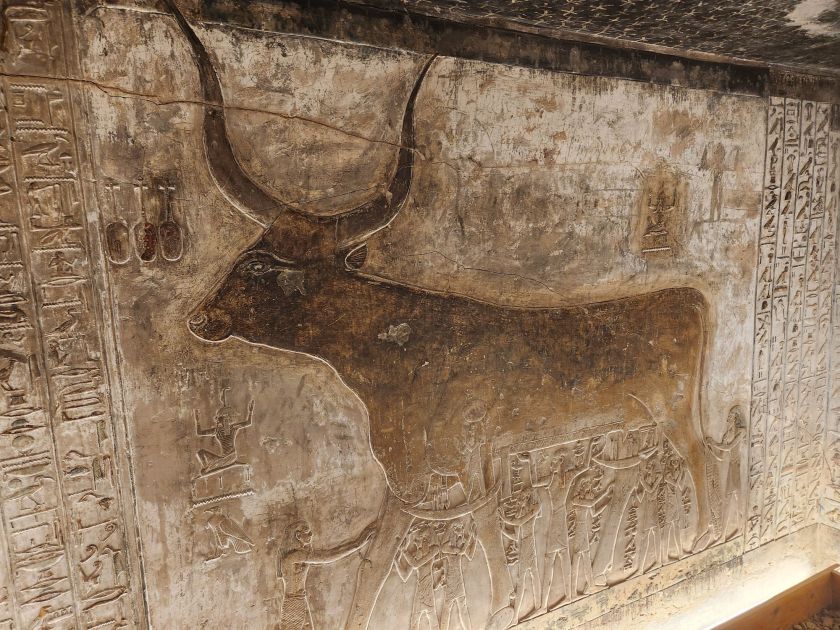
While the whole tomb was stunning, I was greatly drawn to a depiction from The Book of the Heavenly Cow, which I will pretend I knew all about before I visited this tomb.
Depiction from the Book of the Heavenly Cow.
The tomb was very crowded, with hordes of Americans, Germans, and (sigh) Australians getting in my way at every turn.
Having spent fruitless time and megabytes attempting to book a bus ticket to Luxor without having to book out an entire bus, I decided to wing it and do things the old school way. I arose at seven, dumping my room keys at the reception and took an Uber to the local microbus station.
The driver drove past the station two hundred metres before dropping me off, not quite believing this white guy was not on a tour. When I walked uphill to the train station, with help from a staff member at a nearby coffee shop, I discovered that no microbuses were heading to Luxor, but I could get one to Cairo, which I was trying to avoid, and then find something to Luxor. I hopped on the bus, which was nearly empty, and waited.
The deal with these decidedly tourist-unfriendly buses is that they leave when full, not to any schedule known to man or gods. I have been told you can pay for the empty seats to leave quickly, but I have never been asked to do this, and the suggestion seems to go against the whole principle of the situation. The fare must be paid in cash, and is handed to either the driver’s offsider or an elder customer acting as trip treasurer. This leaves the driver free to talk on the phone, honk his horn, and generally make life unpleasant for other road users.
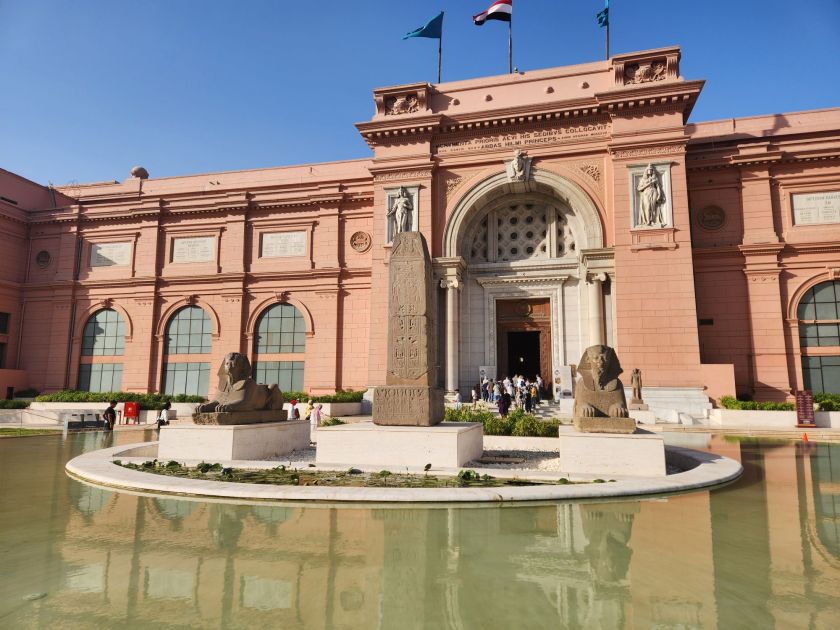
This time, it took an hour for the bus to fill up, and as usual, I was the only Westerner on board, which made me happy. I paid 160 EGP for this uncomfortable trip, with my duffel bag shoved under my seat- they are not really set up for large amounts of luggage, but it didn’t seem like I was asked to pay extra- which was virtually nothing compared to the 500 EGP I was charged for shorter trips on Gobus coaches. I arrived in Cairo just before noon, which turned out to be the dusty lot I left Cairo from. Due to a confusing series of events, I walked in traffic to another station to buy a ticket to Luxor, which ended up being a Gobus service, leaving from the dusty lot of just walked from, leaving in six hours. The staff member assumed I was a rich American and sold me some kind of deluxe VIP ticket. I took an Uber back to where the bus was leaving, and left my bag there (another 50 EGP). From there I walked, had a very Western lunch, then a more traditional coffee on Meret Basha, overlooking the Ritz Carlton. Next to the Ritz was the old Egyptian Museum, formerly the grand jewel holding the majority of the Ancient Egyptian artifacts. Now it’s dusty and has been eclipsed by the brand new and very sexy Grand Egyptian Museum in Giza. Regardless, I was close and had time to kill, so I crossed multiple lanes of chaotic traffic, passed through security measures more stringent than most airports, paid the fee, and avoided the offer of a guide, and entered.
Egyptian Museum.
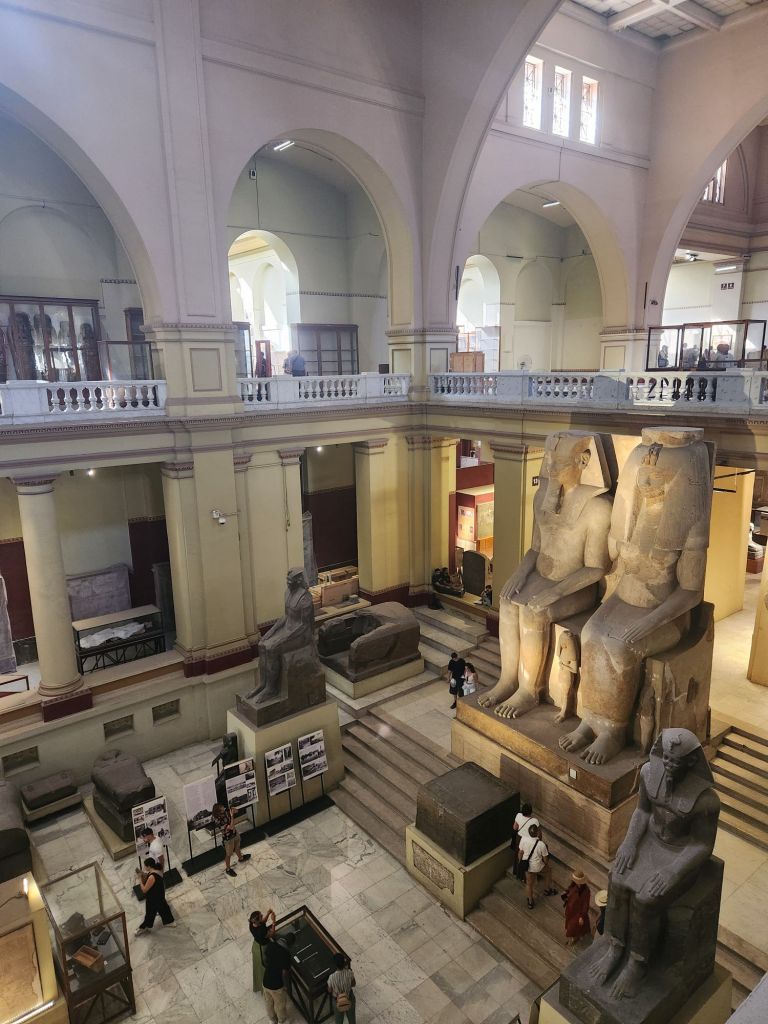
It’s still worth a look and displays some mummified remains and smaller artifacts. Additionally, the building itself has its own old-world charm.
Main Atrium, featuring King Amenhotep III and Queen Tiye.
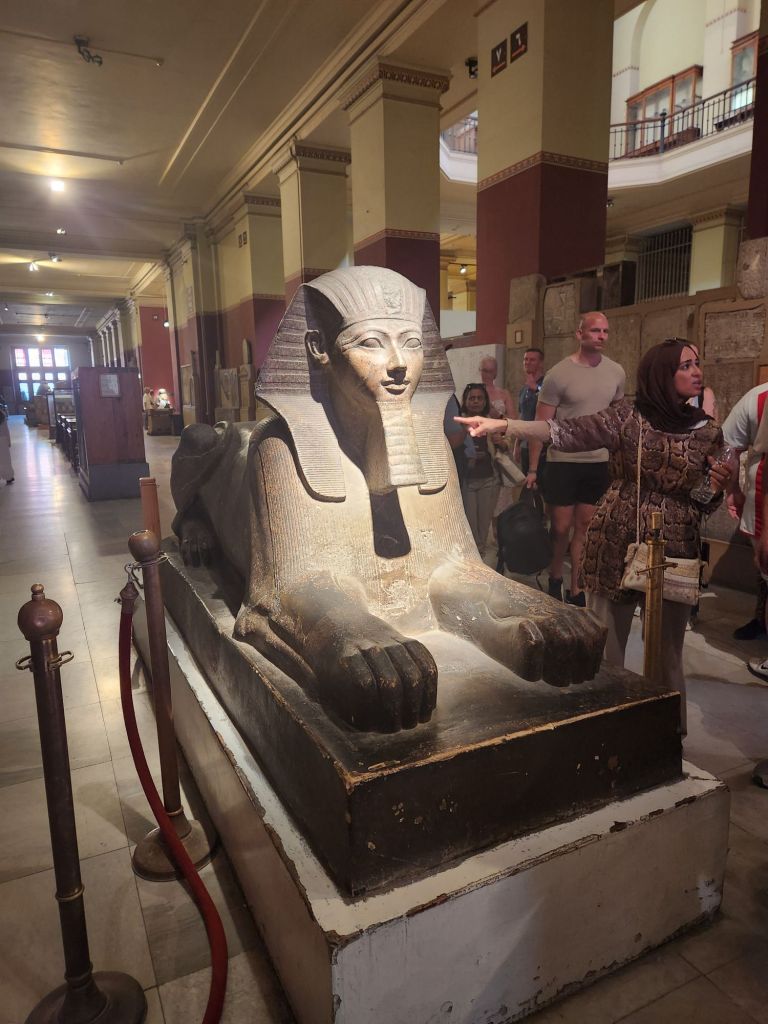
During my visit, the place was somehow busier than the GEM during my visit, and I only stayed an hour, concerned I was going to be swept up in a tour group and suffer an existential crisis. I didn’t take many photos, but I did like this Sphinx depicting Hatshepsut, a female pharaoh from the Eighteenth Dynasty.
In remarkable condition.
Crossing the roads again, I made the mistake of buying some mints from a gentleman sitting against a tree, and another man struck up a conversation, and next thing I knew, I was drinking coffee around the corner with him. I knew it was part of a sales pitch, but the path of least resistance led me to go along with it. After coffee and a chat, he led me to his handicrafts and perfume store, and I managed to leave without buying anything, but I did promise I would come back when I am back in Cairo.
When I returned to the bus company office and was reunited with my bag, I walked back over to the dusty lot that served as the overflow bus station where the bus was leaving. This is why I usually avoid expensive bus rides. They typically end up being much like the cheaper ones. The bus, once I was able to board, was very nice, with an LCD screen in front of me in case I wanted to watch any Arabic TV, a USB port for charging (yay), and a very comfortable reclining seat. I was also offered snacks, coffee or tea, and a bottle of water. I slept on and off for the entire trip, read and watched YouTube videos, and wished I had the budget for my internal flights.
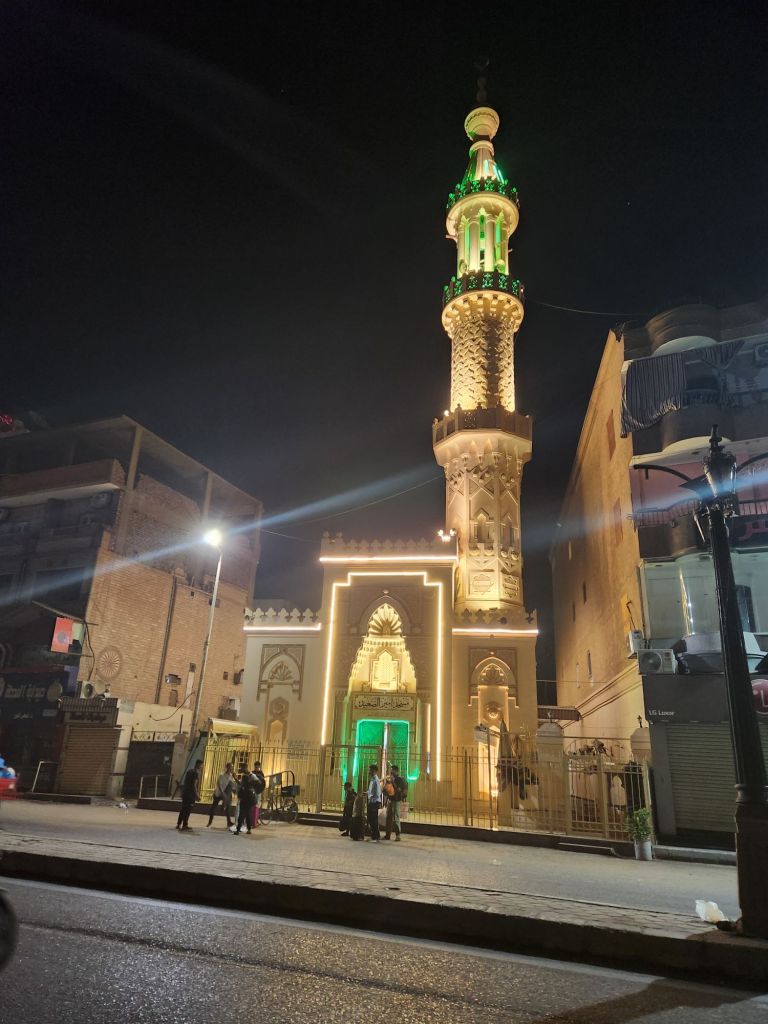
At 2 am, the bus attendant woke me as we stopped at Luxor. I gathered my things and acted dumb as a different attendant tried to get a tip out of me for taking my bag out of the bus. I stumbled in the vague direction of my hotel. The first half of this walk I had to fend off the increasingly desperate taxi drivers. In the second half of the walk I had to convince someone walking with his family that I really didn’t want to book a tour while half-asleep.
Mosque I spotted, the only well-lit building at that time.
Luckily, my host was awake, and, showing an incredibly non-Egyptian pragmatism, simply grabbed my bag, showed me to my room, and left me to dream of puppies and maniac pixie dream girls.
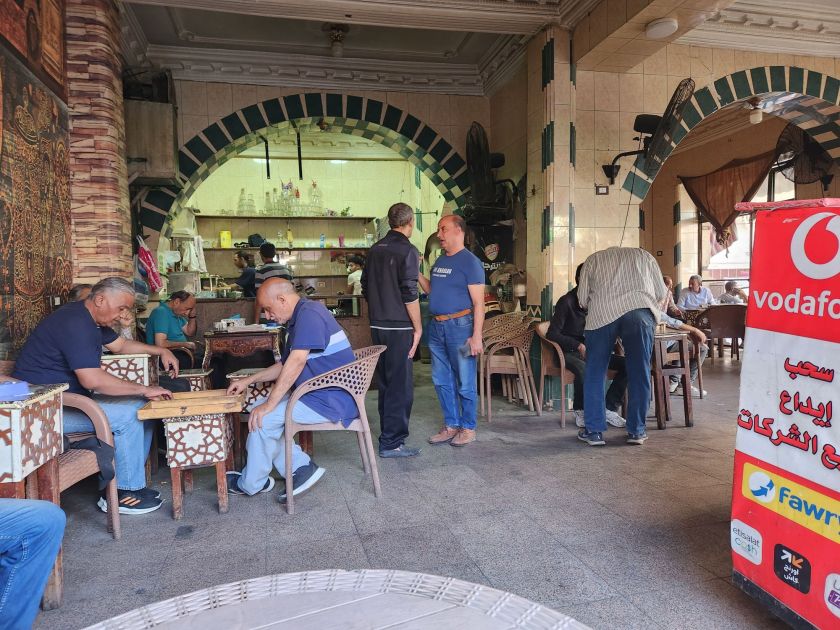
After the congestion of the catacombs, I decided I would simply walk the streets for a while. I stopped ten minutes later at a coffee shop. The place clearly didn’t see many tourists, but the lovely staff member knew enough English to understand coffee, little sugar, and I enjoyed myself, watching the other customers play backgammon and pass the time.
“What’s that creepy white dude doing here? “Never mind that, it’s your turn”
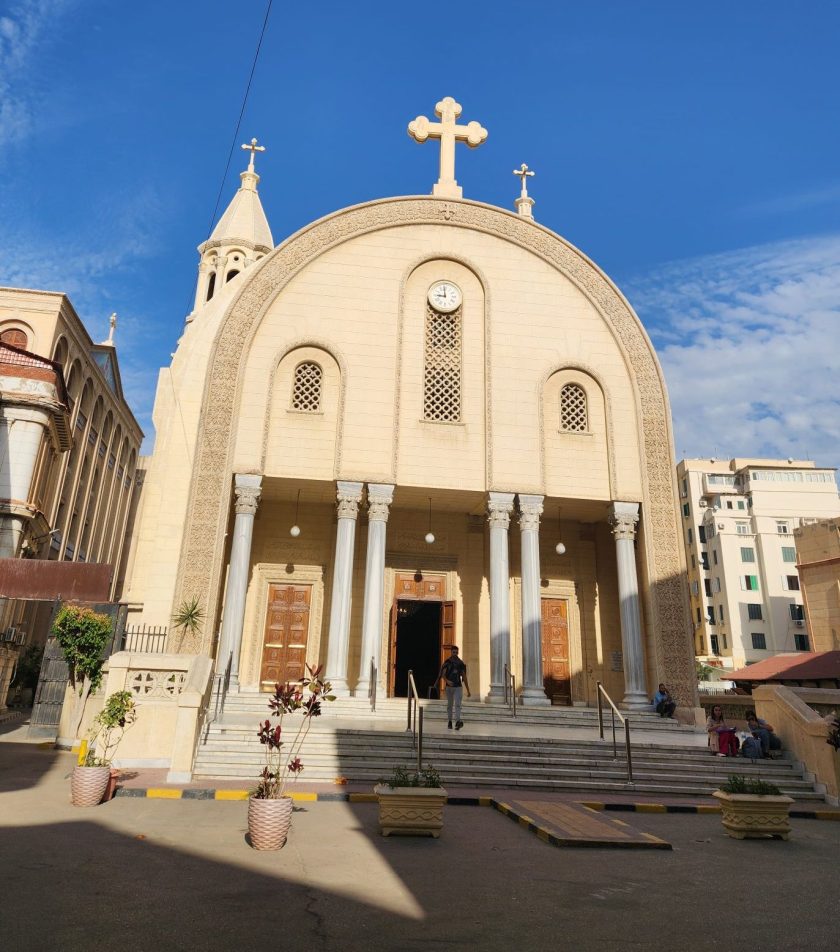
After a few chapters of Ian Fleming, I continued to walk, with the vague aid of Google Maps, towards the Mediterranean Sea. Purely by accident, Google sent me to Saint Mark’s Cathedral, and I decided to have a look. I went through a metal detector, and then was approached by a policeman who asked for my passport. After a cursory check (Australian? Yes) I was informed I could collect my passport when I left. Nervously- never like having my passport out of sight or not locked away- I continued on through another metal detector in case I managed to acquire a weapon in the last fifteen seconds, and entered the secure compound.
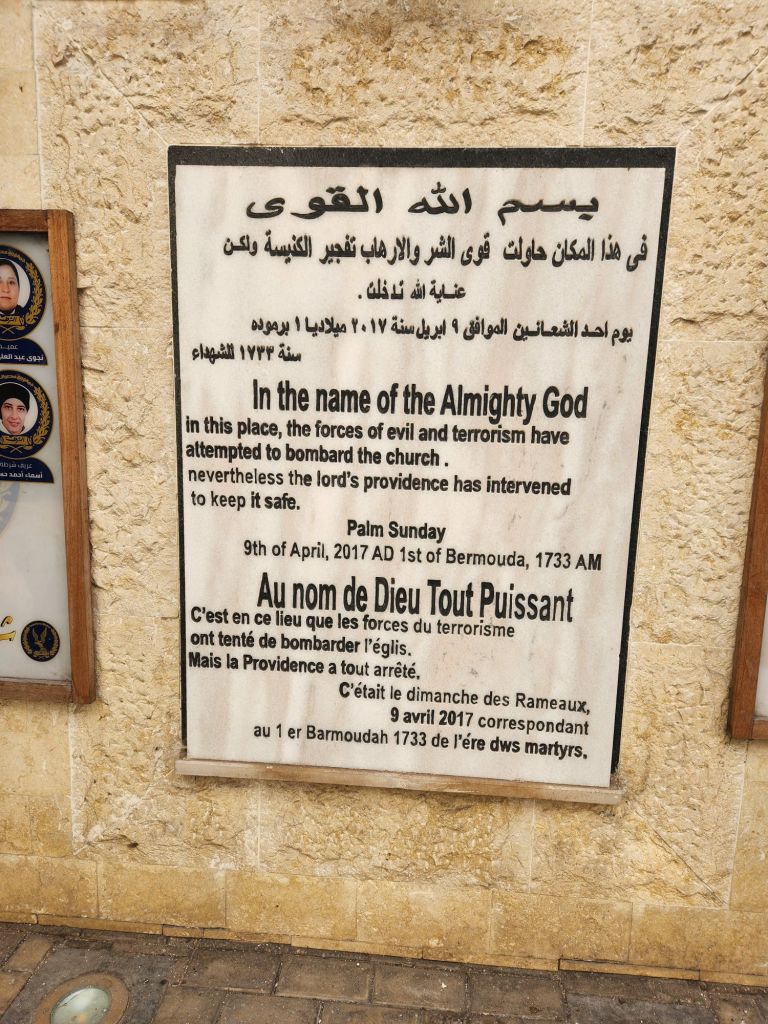
A nearby wall explained all the security. 9th of April 2017, an ISIS suicide bomber fufilled his title at the cathedral- the seat of the Pope of Alexandria, head of the Coptic Orthodox Church- killing seventeen and wounding forty-eight, as part of the Palm Sunday Church Bombings.
Largely understated explanation compared to the security presence.
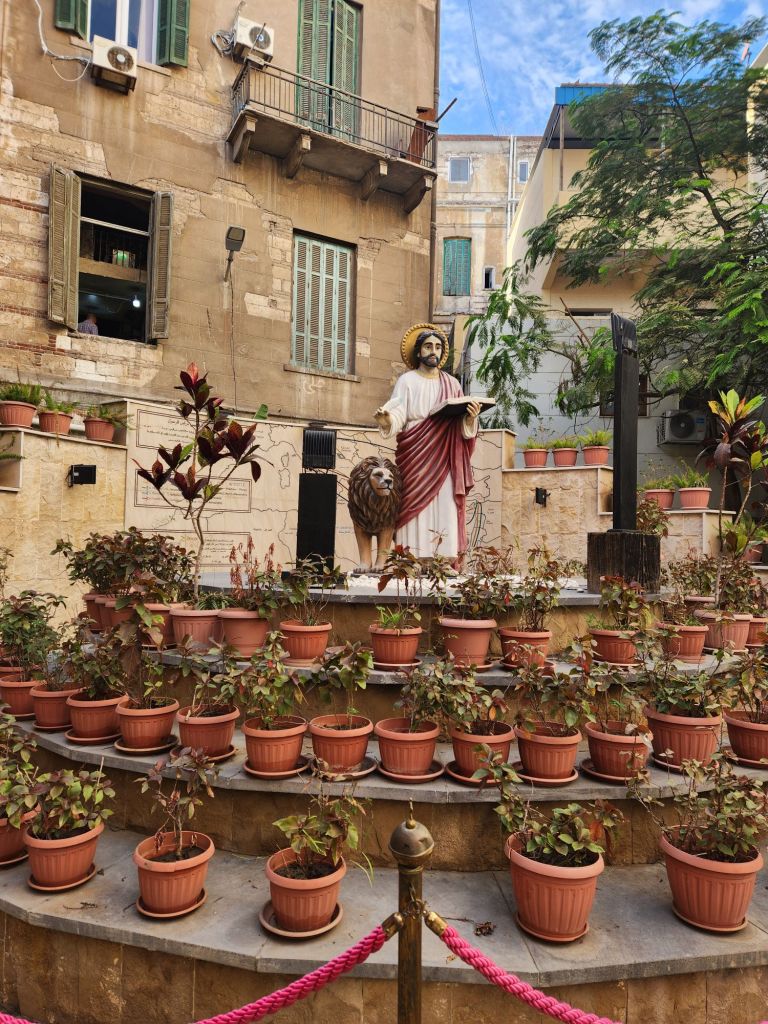
A pretty alleyway featured a display explaining the pilgrimages of Saint Mark, and I took delight in knowing I had been to some of these places in my own travels. Considering that Saint Mark was born in what is now Libya, travelling to places such as the Holy Land, modern Jordan, and Turkiye would have been a considerable undertaking.
I think they are apartments above.
I had a quick look in the cathedral, which like most modern churches, I didn’t find particularly interesting. But I did put the US dollars the police officer foisted on me in their collection box, thinking that the Copts would have solid arrangements to take advantage of international currencies.
Modern churches tend to all look the same to me.
On the way out and collecting my passport, I had a good chat with the police officer about the bombings and the security. I shook his hand and told him I hope he always gets home safe. It was a nice moment of sincerity.
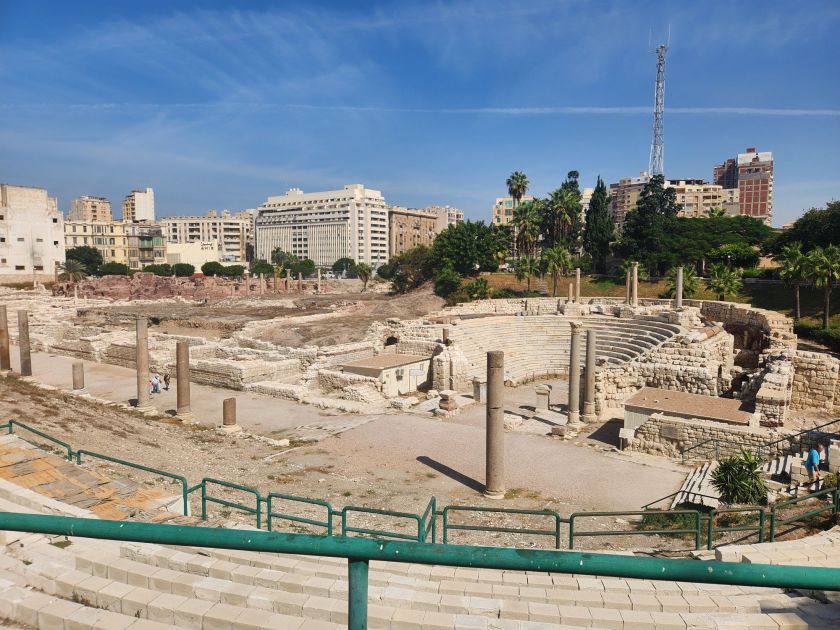
The next day I embarked to visit some of Alexandria’s lesser known sites. The first being Kom El Deka, more commonly called the Ancient Roman Theatre. The area was an upper-class residential area in the first to third century CE, by the fourth to seventh century it was much changed, and featured numerous public facilities, such as the theatre and a bathhouse.
Ancient Roman Theatre, modern neighbourhood in the background.
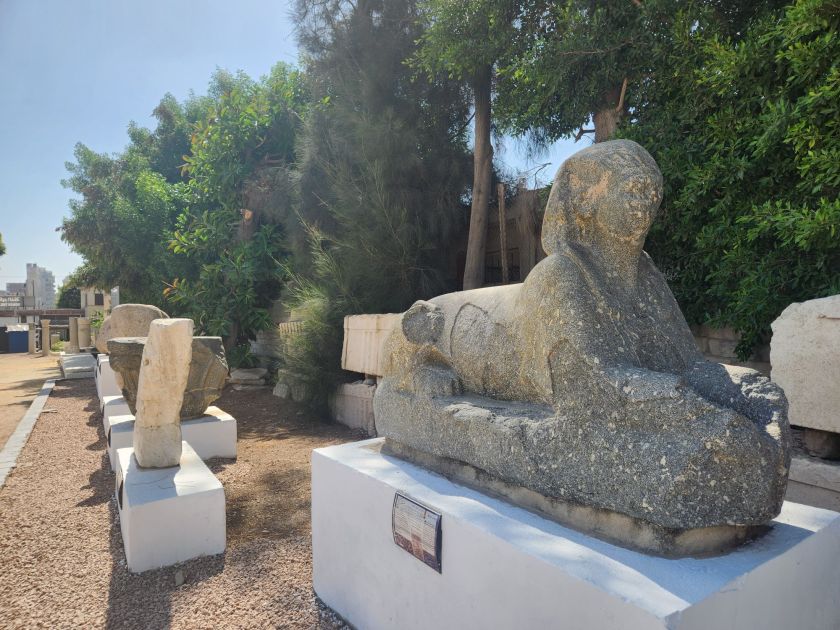
Oddly, I soon discovered statues and blocks of stone that appeared to be have been part of the lighthouse, and transported from the ocean floor to here.
Including this Sphinx
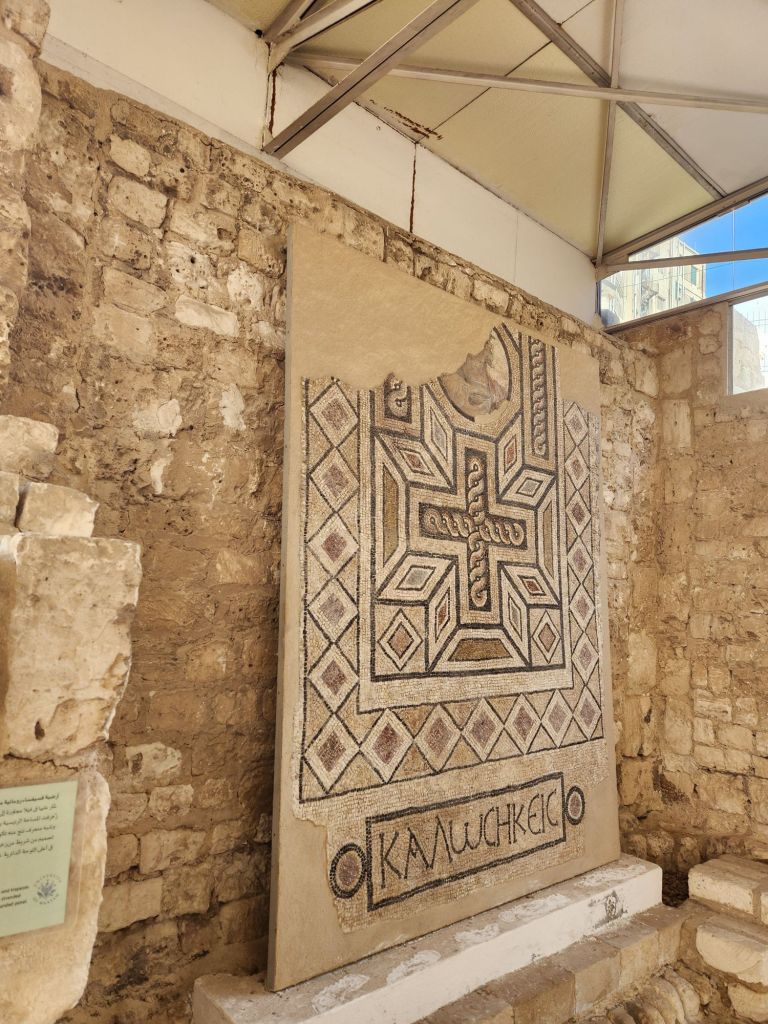
Tucked into the corner of the site was a partially restored villa, which contained several amazing mosaics and decorations.
Villa of the Birds
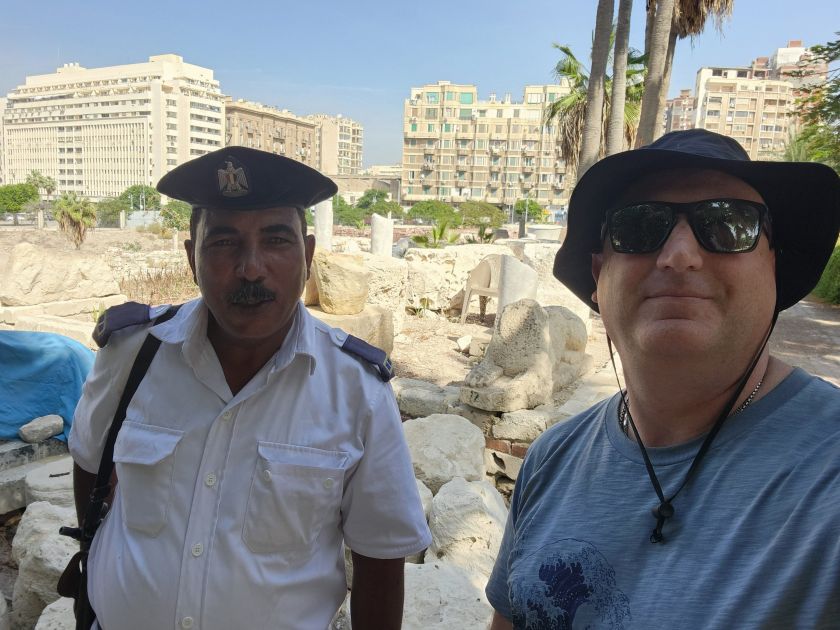
After a lap around, there was nothing further to keep me here, and I was about to leave when a machine-gun-wielding policeman offered me a cup of tea, that I accepted. We had a nice chat, and while he declined payment for the tea, he immediately hit me up to exchange some USD for Egyptian Pounds. Caught, I complied and made a mental note to be more careful about this in the future.
I kept my promise of not posting this on Facebook.
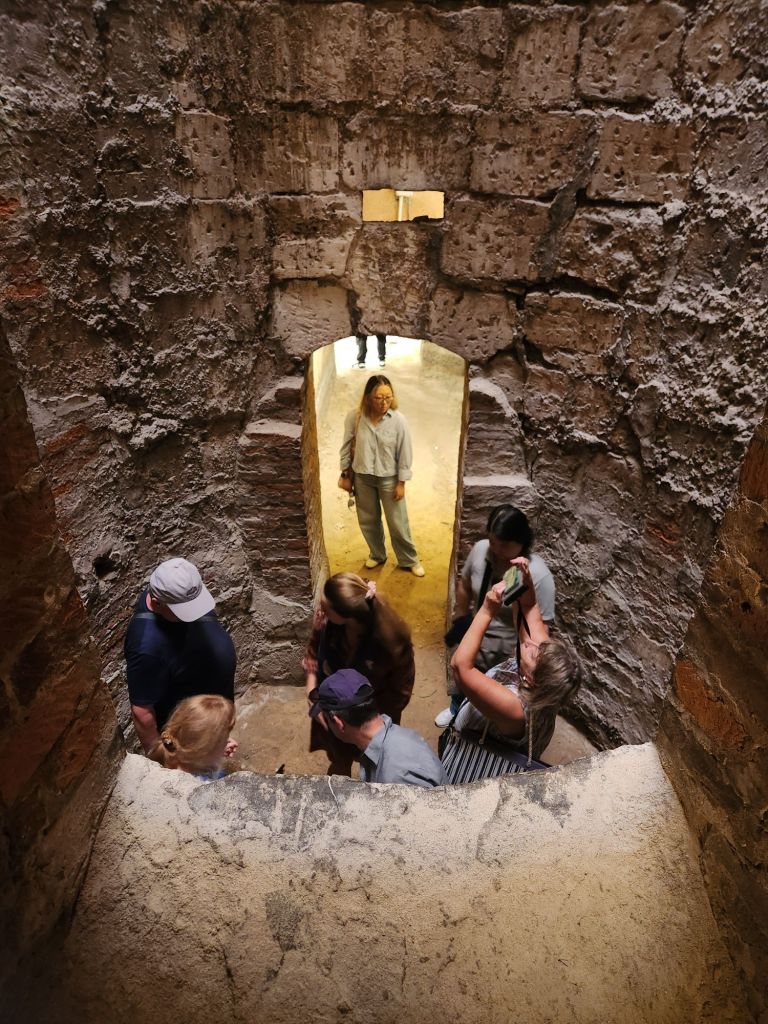
Next I visited the Catacombs of Kom El Shoqufa. Believed to have been created in the second century CE for a single family, it was expanded greatly for unknown reasons. It was rediscovered in 1900 when a donkey fell through a shaft-perhaps considering the way animals are treated, it was a deliberate act of protest. The catacombs consist of three levels, multiple chambers, and two large circular shafts that may have been used to lower the deceased into the catacombs.
shaft with a staircase wrapping around it
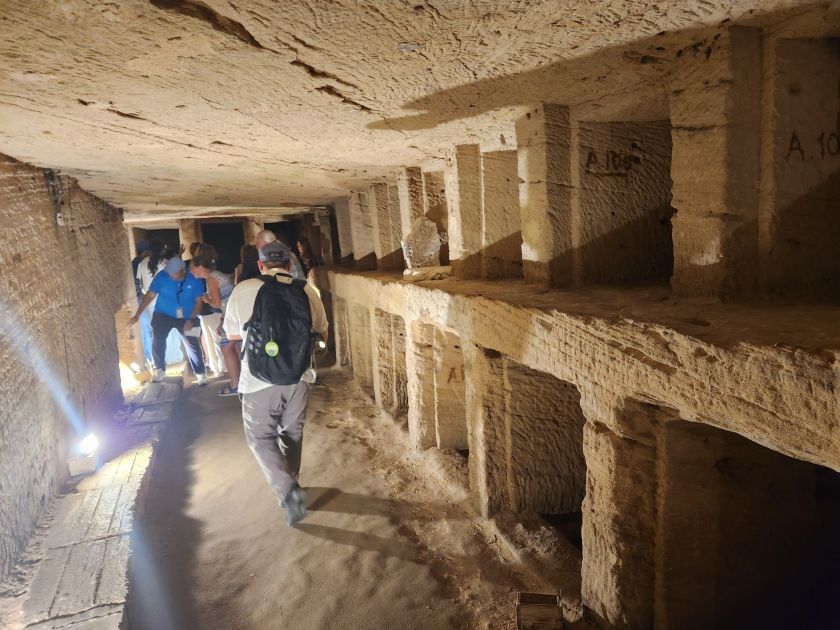
Many of the corridors and chambers feature simple stone ledges for a body to be laid to rest.
Niches
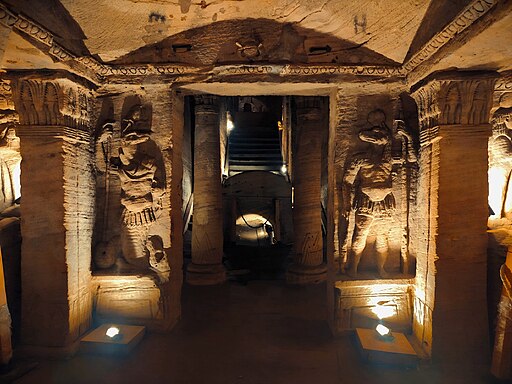
The main drawcard here is an elaborate chamber, perhaps the original families, featuring ornate carvings, and a blend of Roman, Ancient Egyptian and Greek art styles. Between the hordes of tourists and the limited ability of my phone, I struggled to document this chamber, so I will include this one from Wikipedia.
Bilal Detailz, CC BY-SA 4.0
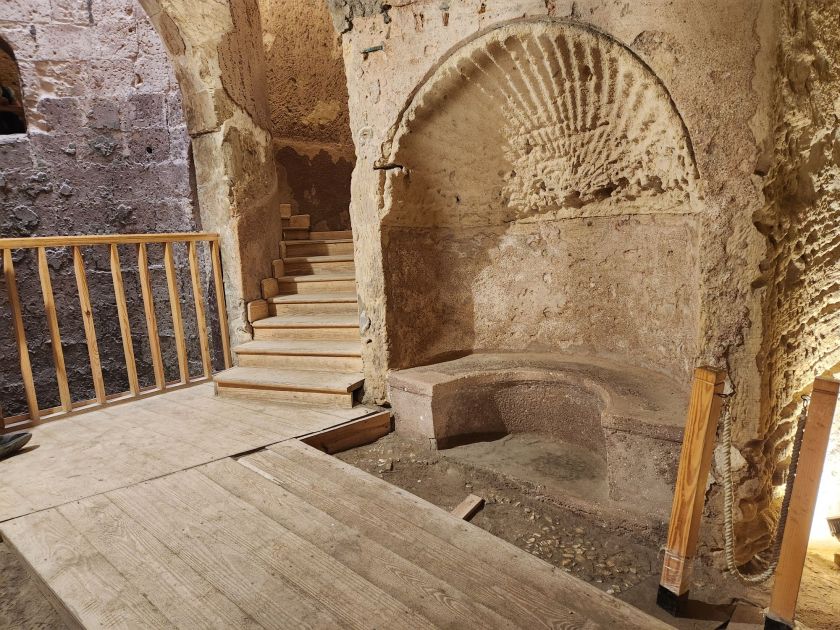
The catacombs also featured benches where mourners could sit and rest, and perhaps even eat meals close to their deceased loved ones, something that would seem very odd to modern Western eyes, but I suspect was very normal in the ancient world.
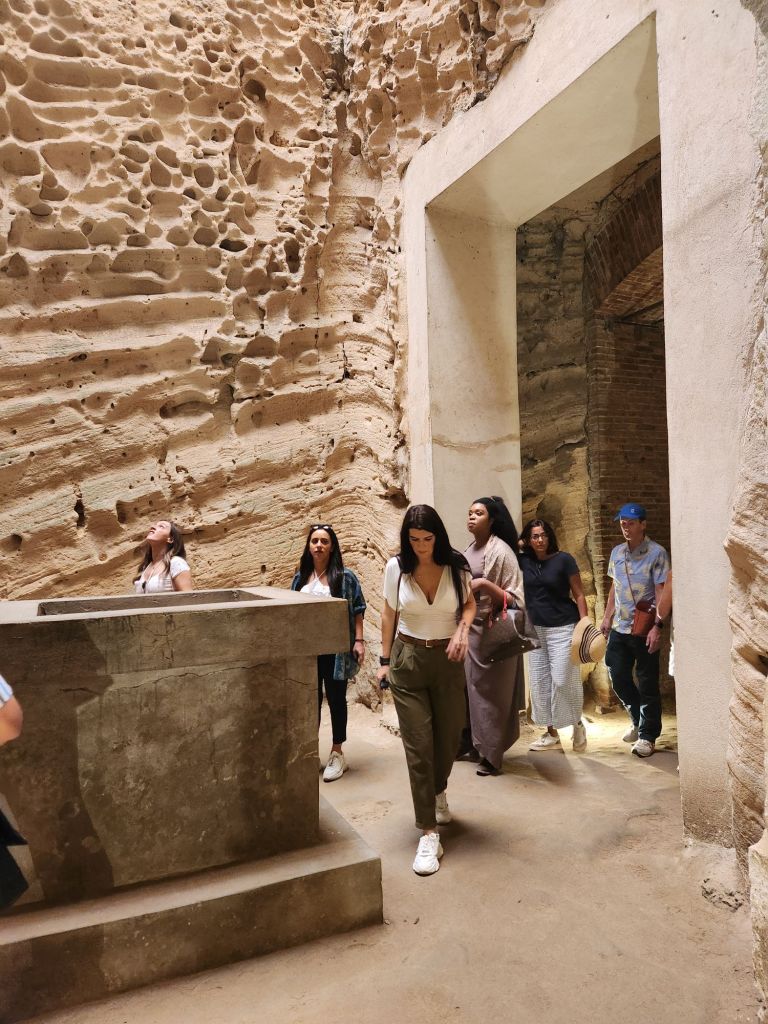
Rotunda next to shaft.
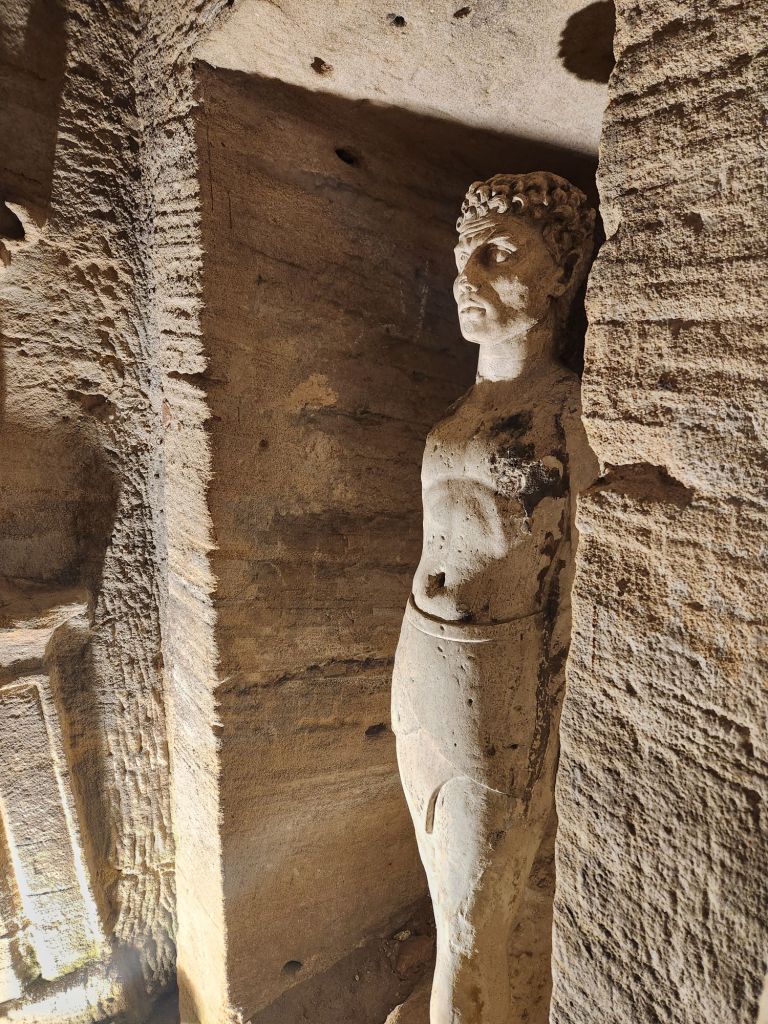
There were many impressive carvings, but I was drawn to this statue, perhaps carved in place, which is considered by some to be the original owner of the catacombs.
tucked away almost in a corner.
Of course, without a guide, many features were not clear to me, which is something I should be used to by now, but is still frustrating.
Perhaps a font for holy water? Did the Romans even do that?
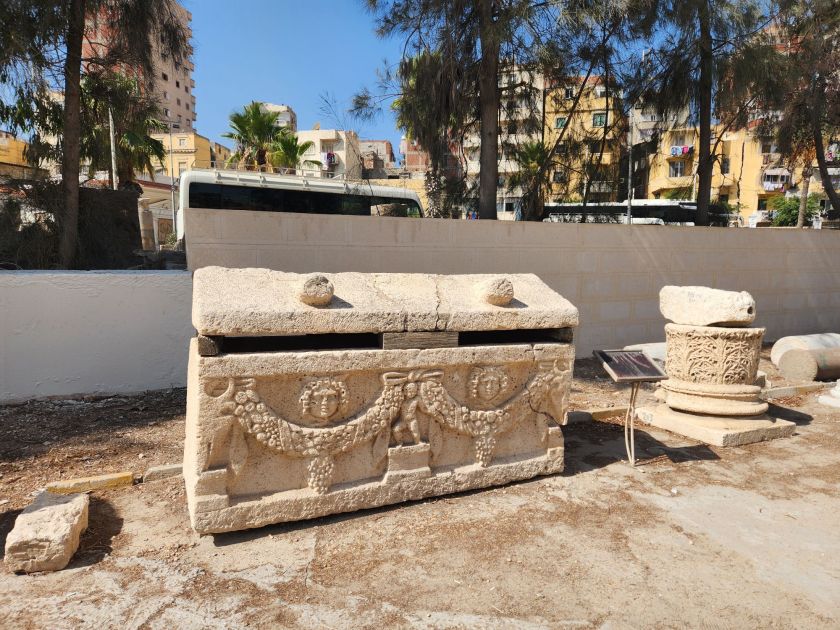
Once I was sick of bumping into my fellow tourists and trying to suppress the urge to hum the Indiana Jones theme, I made my way back to the surface, and took a few pics of the sarcophagi outside, and went for a walk.
The Great Library of Alexandria was one of the greatest centres of learning in antiquity, and scholars from every corner of the known world in the second and third centuries BCE made pilgrimages to study there. While history still lists some of the head librarians and some of the manuscripts that were held there, the actual site of the library is unknown. The importance and the contents of the library had been in decline for years before the supposed destruction by Julius Caesar in 48 BCE. Now, only the legend remains, which may be more interesting than the real history.
AI prompt was “Dusty library filled with scrolls with a creepy gnome wanking”
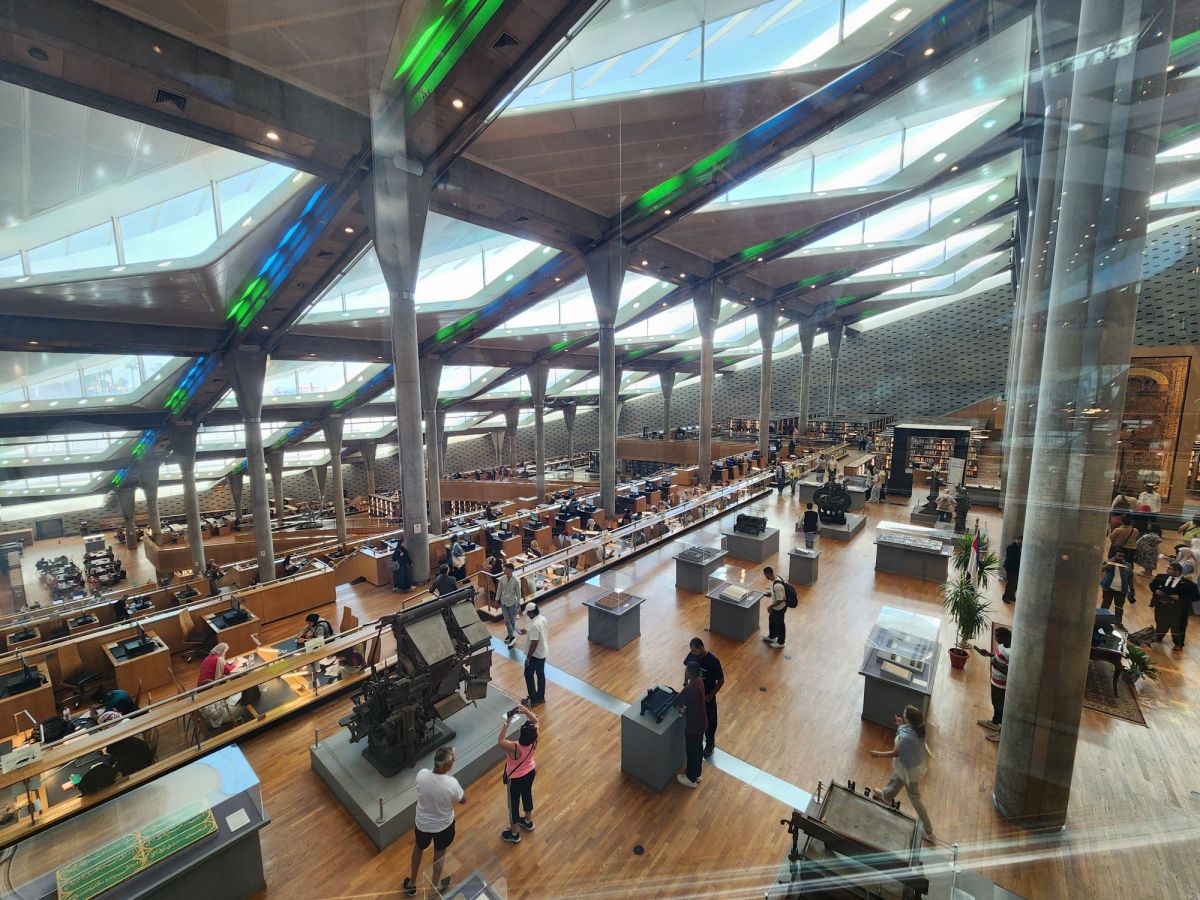
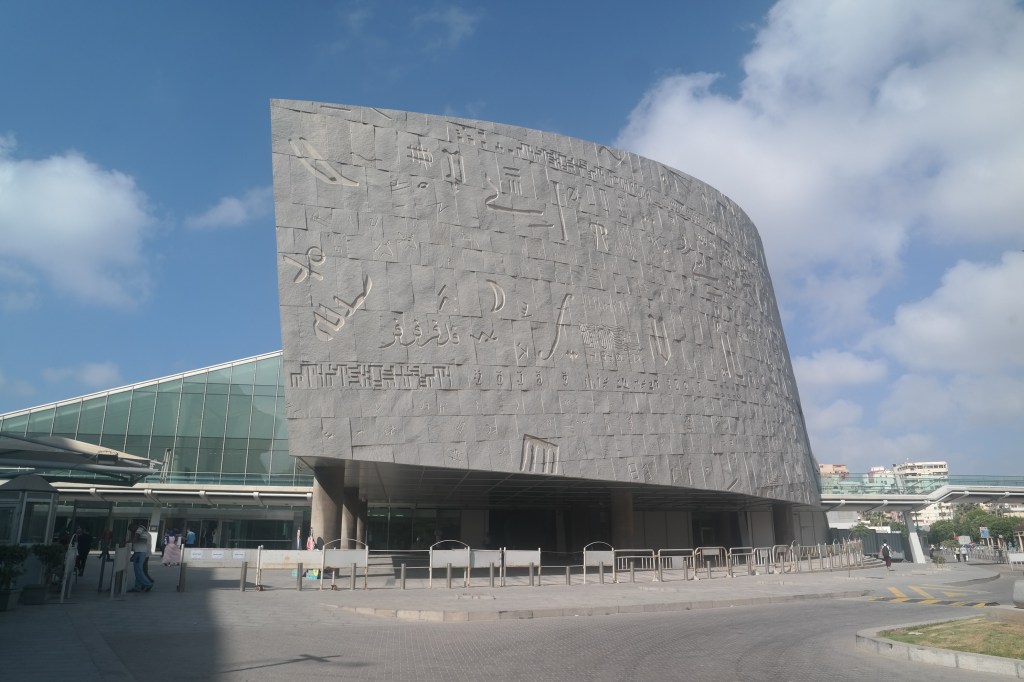
With the lack of concrete facts, and considering the remains of the Great Library of Alexandria could easily now have a Starbucks built on top of it (it’s a nice Starbucks, filled with pretty medical students when I visited), the Bibliotheca Alexandrina is much more a spiritual than a practical one, but it’s very impressive nonetheless.
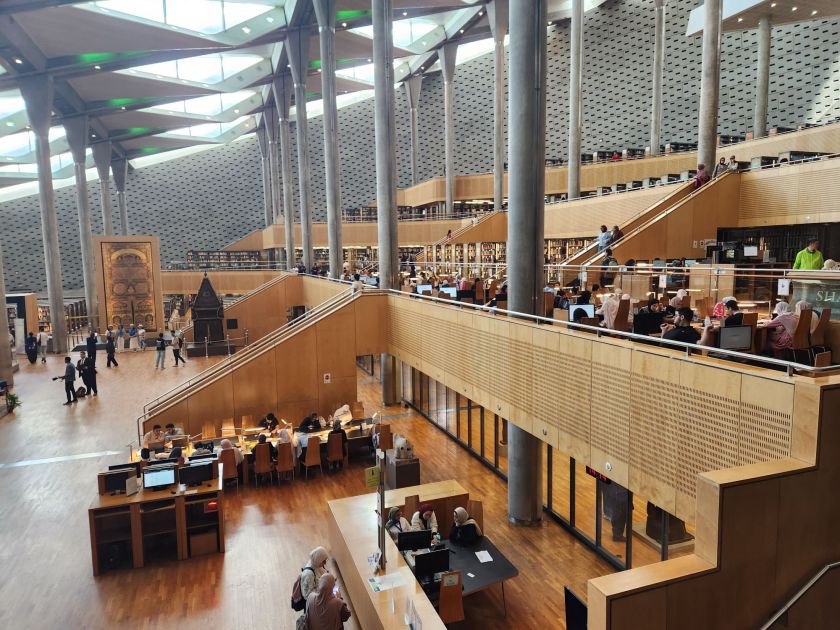
The library was officially opened in 2002, at a cost of two hundred million USD. Its main reading room sprawls over eleven levels and covers twenty thousand square metres.
Main reading room
In addition to its main library, it contains six specialised collections, including one specifically containing Braille books. Even forgetting about the books, the Bibliotecha is home to nineteen art galleries, a planetarium, a conference centre, two gift shops, two cafes, and a restaurant.
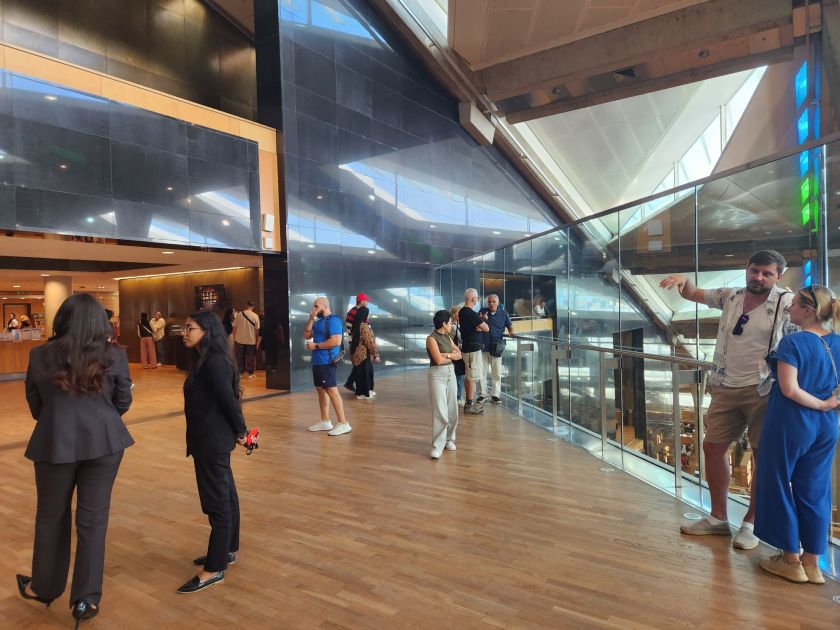
I accepted the offer of a free tour, where a stunning woman walked us through areas and explained that for a fee equivalent to two coffees, an Egyptian student can gain access to all this, in addition to internet access, catalog access, study space, and more. She explained the symbolic aspects of the architecture and answered our questions faultlessly. Her (I neglected to jot down here name) delivery was a masterclass in public speaking and interpretation, and I wished I had a tenth of her ability. I was also incredibly smitten.
Viewing platform.
I couldn’t help but think what a balancing act these incredible, smart, and beautiful women working here must perform. Trying to keep to an authentic and self-determined life, working in such a modern institute of learning, while living in a culture that insists on a tradition of women being dependent on the men in their lives. All I could do was thank her for the tour and walk away.
On the way out, numerous security types and police seemed to be milling around, waiting, and so I waited to see what would happen. Soon, a convoy of conference attendees exited the grounds in chauffeured Mercedes and BMWs, while police shut down traffic outside the library to allow them to stay together with their escorts.
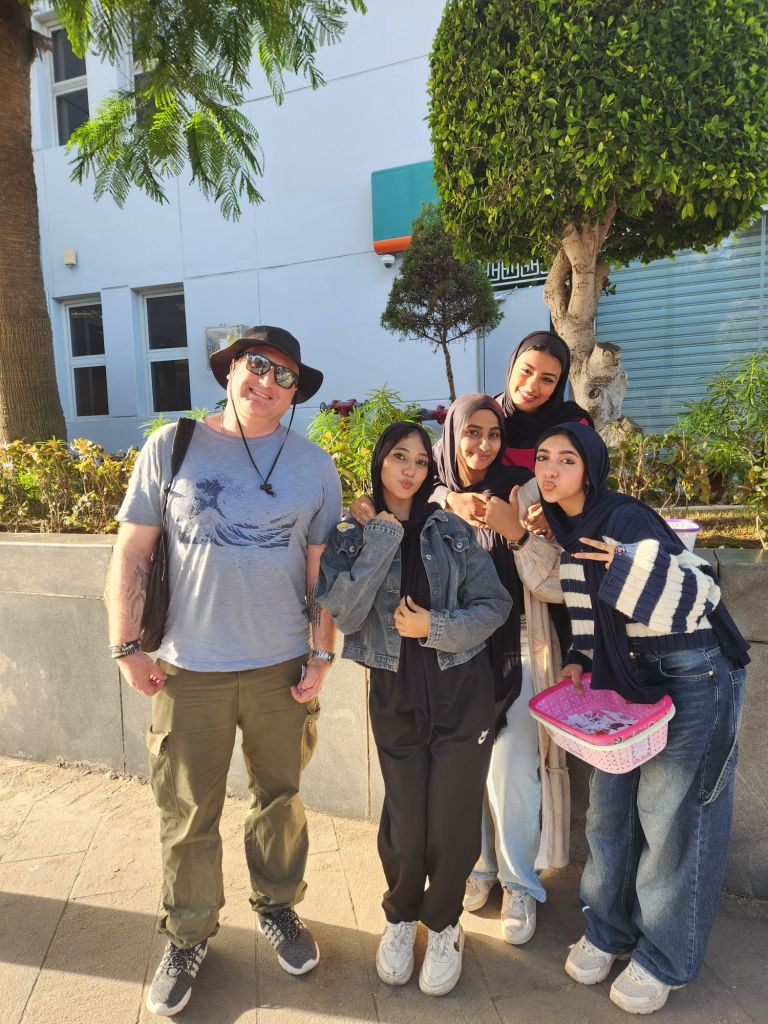
After a quick stop at a cafe for coffee and journalling, I discovered a small group of young ladies selling stickers. After walking past them I doubled back to buy some stickers and have a chat. 50 Egyptian pounds later, I asked if I could get a photo, which they were good-natured enough to consent to, with one of them offering to take the photo.
Hamming it up!
When I looked back at the photo, I said “Awwww, beautiful Egyptian ladies” which seemed to make them very happy as I said thank you and departed.
One day, when these amazing Egyptian women become a powerful force in Egyptian politics, Egypt will experience a rapid improvement for all its people.
The first thing I noticed on the Uber ride from the bus station to my hotel was the considerable number of medical supply shops. The next was the women. I had gotten used to 99% of Egyptian women wearing headscarves, and often the full hijab, with some covering even their eyes with black cloth, leading to them walking into the kind of people they wanted to be isolated from. Now, I was seeing at least half the women with fully exposed heads of perfect hair. If I were a poet, this would have caused me to write pages and pages of overwrought, terrible verses.
As it was, I almost gave myself whiplash. My tired brain finally put it all together after a quick Google search; Alexandria is host to numerous universities, including at least one exclusively for both medicine and dentistry. I suspect that very few women embarking on such studies were willing to submit to society and religious pressure. Later, while walking towards the ocean, I discovered the Egyptian version of punks in a small group of mixed sex youths (itself unusual), which also made me very happy.
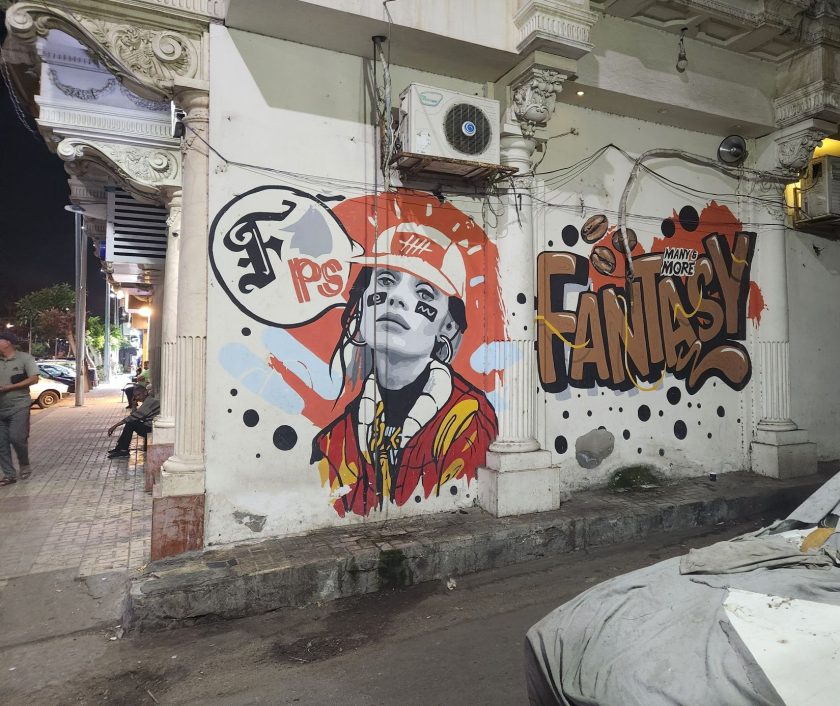
Street art near my hotel
Alexandria, founded by its namesake Alexander the Great in 331 BCE, is famous for two great structures- The Lighthouse of Alexandria and the Great Library of Alexandria. I was, of course, centuries too late to visit either of them. Screwed by my birthday again.
The Lighthouse of Alexandria was built in the third century BCE and was one of the Seven Wonders of the Ancient World. It was damaged by a series of earthquakes a thousand years ago, with much of the lighthouse ending up in the Mediterranean Sea.
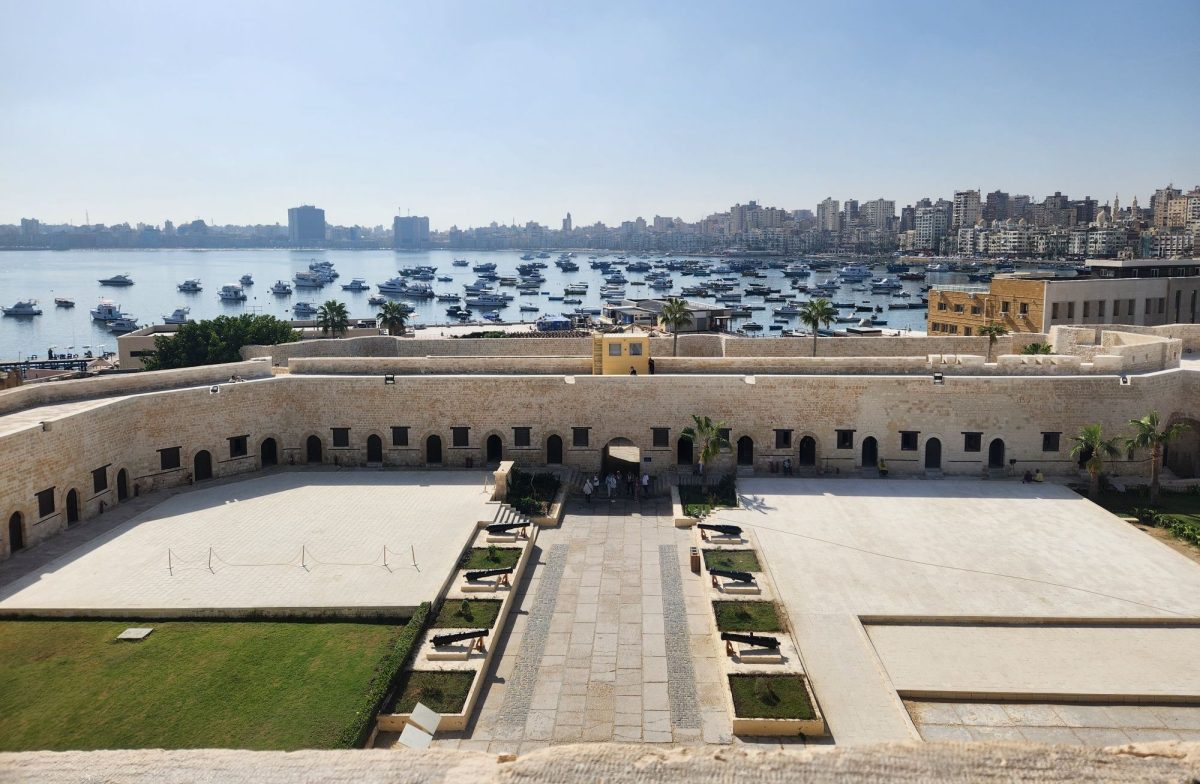
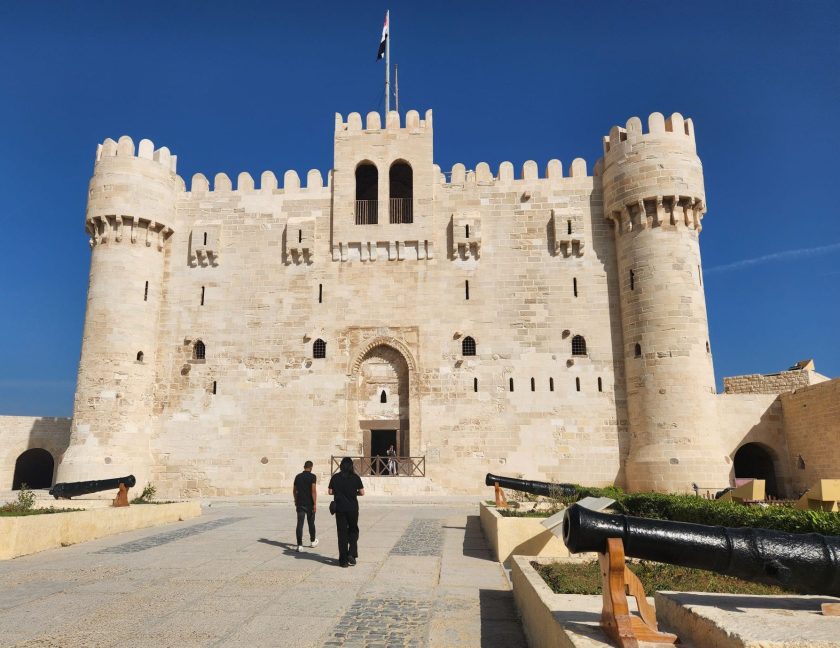
In 1480, the remainder of the lighthouse was used to build the Qaitbay Citadel, on the same site. Qaitbay Citadel was built by the Sultan of Egypt by the same name to defend the harbour of Alexandria, at the time having extreme military importance. It changed hands a number of times, and left in ruins after the British made a pointless and misguided attack.
The Citadel has been rebuilt, renovated and then restored, with 1984 being the restoration to its current state.
Qaitbay Citadel, from the main car park.
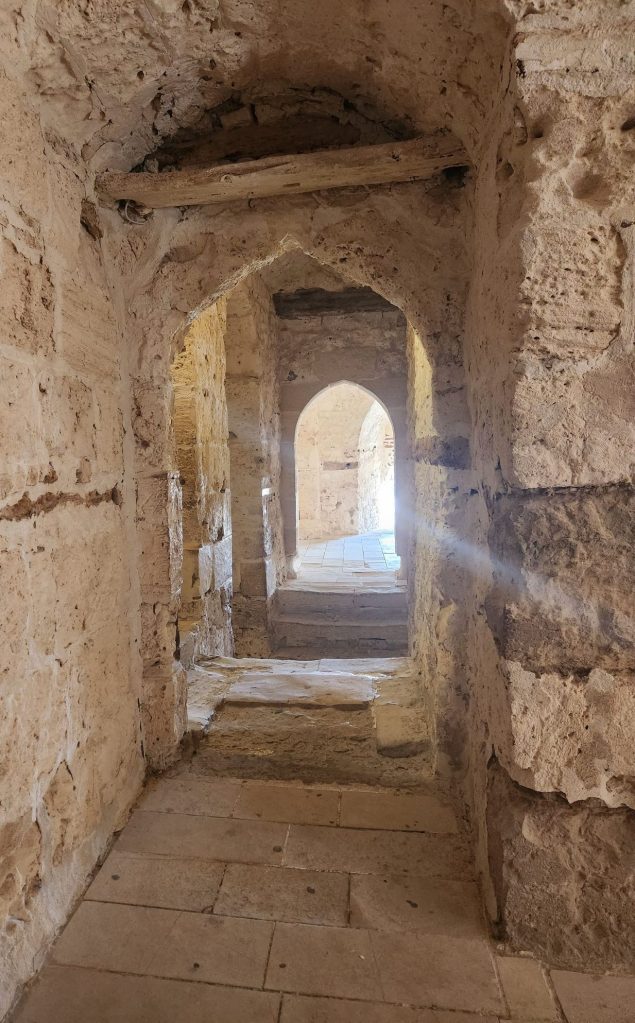
My camera took this oportunity to die entirely here, so all my photos here on in are from my phone. While I have no idea how historically accurate the restoration was, I was impressed how light and airy much of the fort was on the inside.
First floor
In one second floor corner, a monitor is set up playing footage about the Lighthouse of Alexandria, and efforts to document the remains.
Cleaning ladies pointed me towards good areas to take photos, in an effort to get baksheesh from me, which I have to say was successful as at least they were pleasant about it.
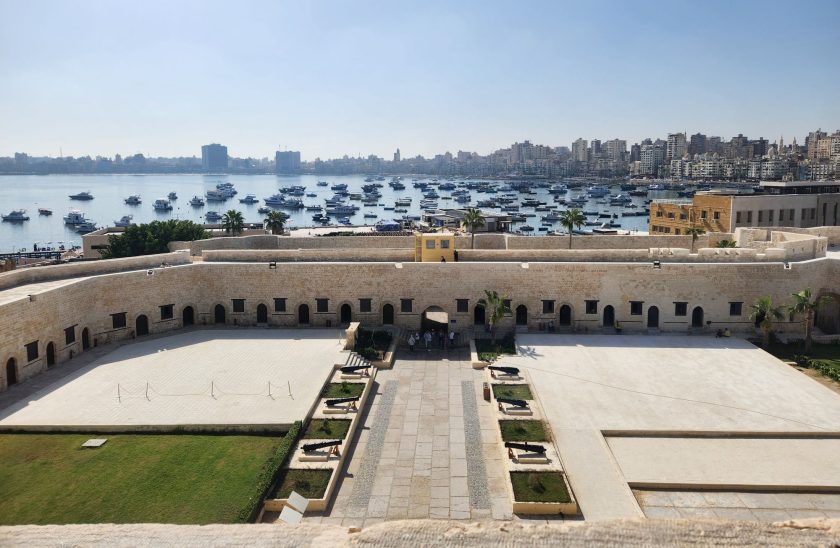
Still a busy harbour to this day.
From the highest points I could not help but try to imagine how incredible it would have been from the top of the Lighthouse, and the sheer majesty of such an endeavor. Now when we conduct public works they tend to feel sterile, replaceable and generic, instead of the stuff of legends.
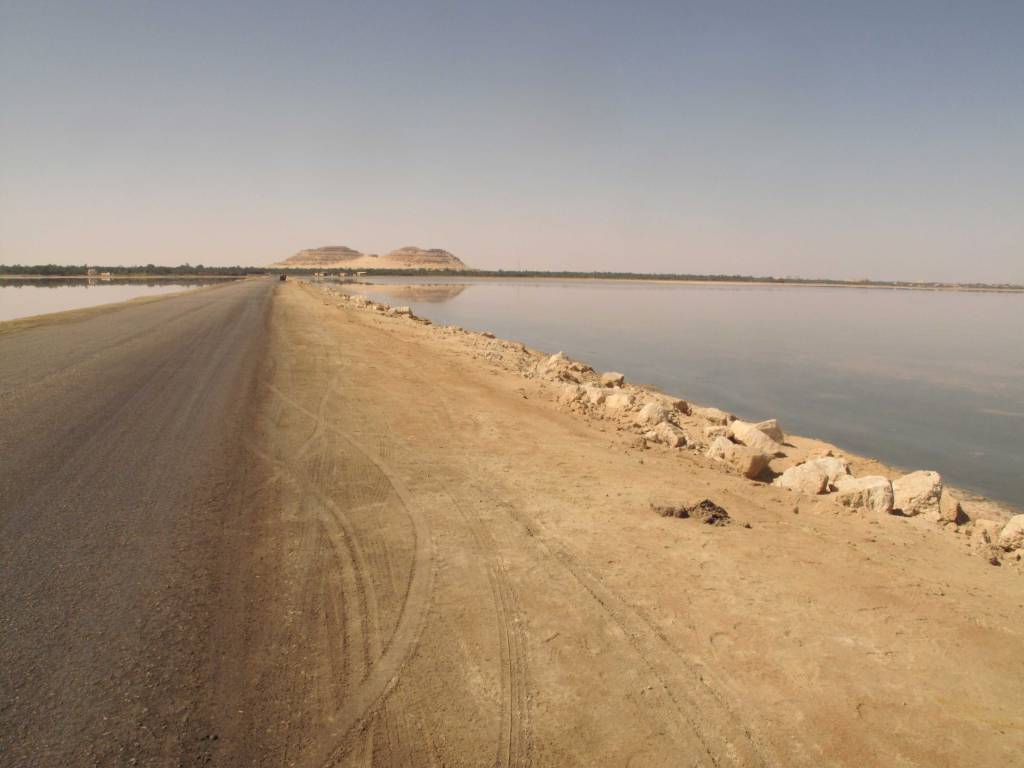
The next day, I made the mistake of spending ten minutes arguing with a tuk-tuk driver to take me to the actual oasis of Siwa. Note to self, never engage the services of anyone wearing Tommy Hilfiger, they have an excessively high opinion of the value of their services. The driver dropped me off near a closed cafe on a causeway through the oasis, and while the landscape had an undeniable desolate beauty, the oasis is huge, and any plan to walk around it was pointless.
I half expected to see human bones roadside.
There was no vegetation to offer shelter from the sun anywhere in sight, and very little of anything else. I suddenly felt very foolish as I took a few photos and started walking back towards town. Luckily ten minutes later, a couple in a late-model Toyota Land Cruiser pulled up, and I managed to bag a lift. I jumped in the backseat, and while the couple, several social and economic levels above anyone I had interacted with in Egypt so far, chatted to themselves in Arabic that seemed more melodic than the Egyptian dialect, I tried to look non-threatening and not sweat on their leather seats. They dropped me off in town near the mosque, and I didn’t insult them by offering payment, but did thank them profusely and shake hands with them before we went our separate ways.
After a few iced coffees and a light lunch at a nearby cafe, I realised there was only one thing I really needed to see in Siwa before moving on.
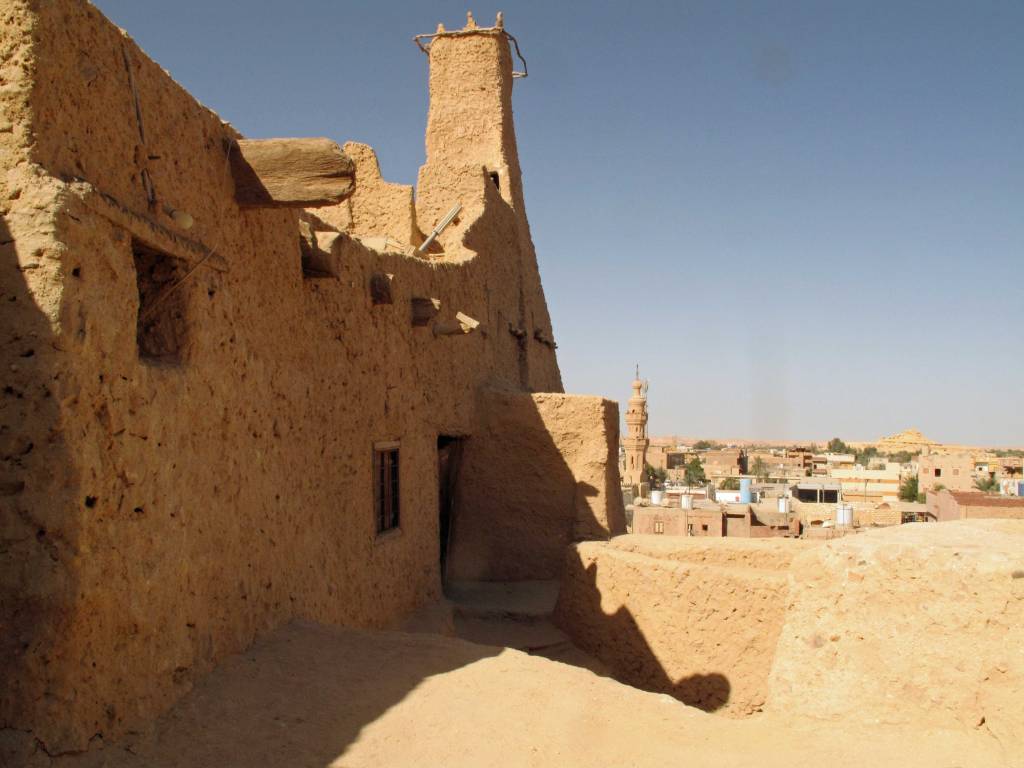
Shortly after I arrived at Siwa, I spotted a partially ruined fort on the hill overlooking the mosque, and I was immediately intrigued.
From where I started, Google Maps led me through a rubbish-strewn alley, along a loose wall of bricks, then advice from a traditionally-garbed man led me through an abandoned home and another alley. I squeezed past some parked motorbikes and unceremoniously dumped myself in an alleyway I was in on my first night in Siwa, which I could have simply walked to from where I had dinner the night before. Stairs hewn into the bedrock led me uphill, and to the ancient mosque, the only part of the fort still in official use.
Ancient Mosque
While I didn’t see anyone around, it didn’t seem like the kind of place people would have liked me poking around, especially considering my complete lack of Arabic, so I continued uphill.
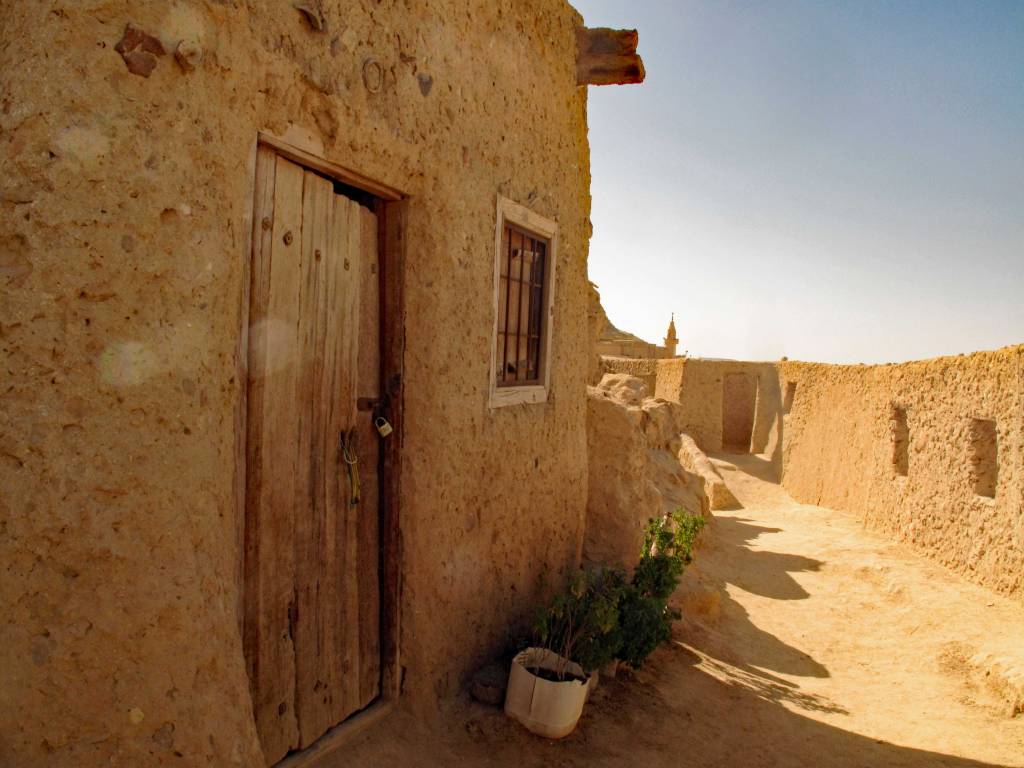
Amongst the ruins, I spotted walled sections that seemed to feature either toilets or small wells, along with a small handful of buildings that were either very small homes or storage rooms, which showed signs of use and upkeep.
But who would bother with plants in a place they were using for storage?
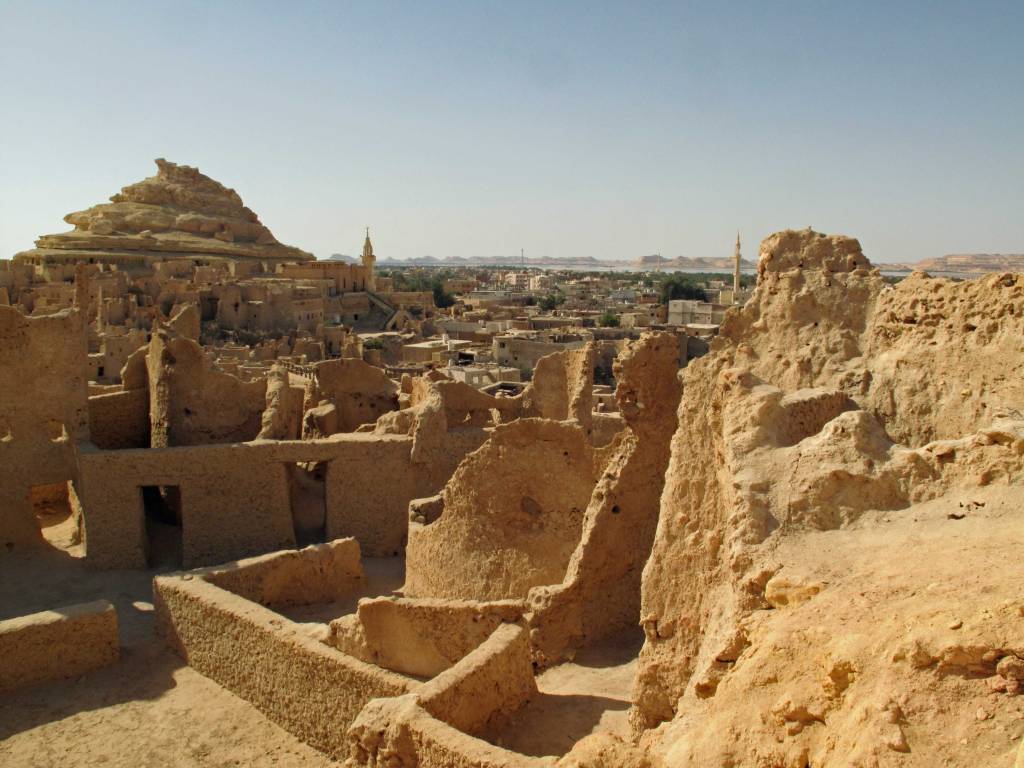
Finally, after scrabbling up worn steps and avoiding an incredibly attractive couple making out while taking selfies, I reached the top.
Shali Fortress
Shali Fortress was built in the twelfth century by Siwi Berbers to defend against the Bedouins. It was constructed from kercheif, a mixture of rock salt and clay. The walls survived many attacks and the passage of time until three days of rain in 1926 caused considerable damage. In 2018, locals, many of the descendants of the original Berbers, partially rebuilt the fortress.
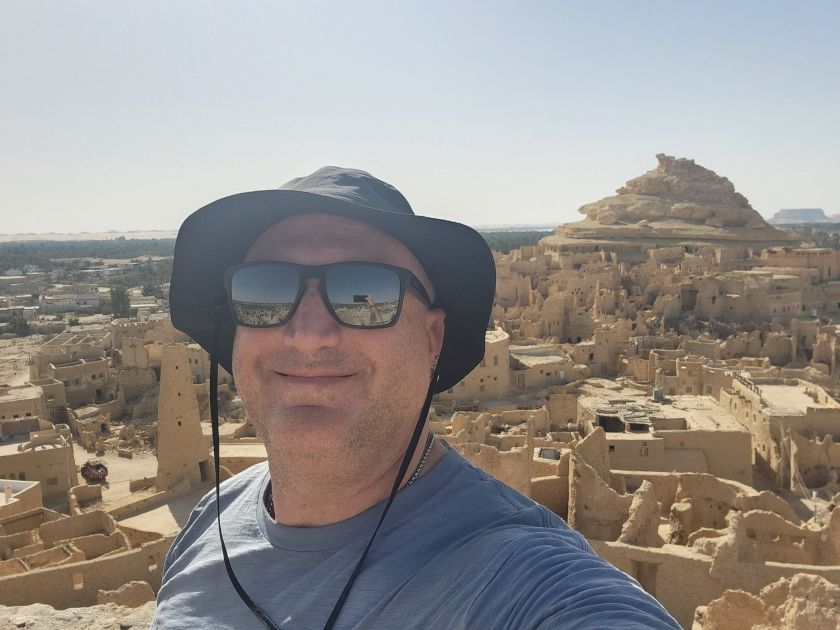
Happy as a pig in shit.
By the time I reached the top, my camera was starting to have issues, so I only have a few phone pics to show for my trouble. I could not help but think about how many people lived and died defending this fort. I suspect I only scratched the surface of the history of this place, and would dearly love to find some books written on the subject. Sadly, I struggled to find a path down to what I thought of as the town square of the fort. I could have done with a guide.




 Adrian's Got The Moose
