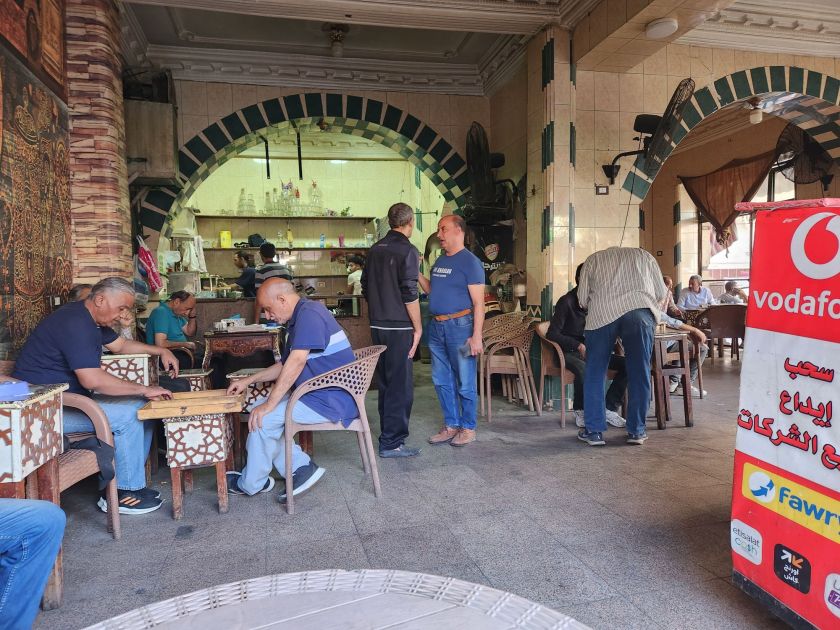
After the congestion of the catacombs, I decided I would simply walk the streets for a while. I stopped ten minutes later at a coffee shop. The place clearly didn’t see many tourists, but the lovely staff member knew enough English to understand coffee, little sugar, and I enjoyed myself, watching the other customers play backgammon and pass the time.
“What’s that creepy white dude doing here? “Never mind that, it’s your turn”
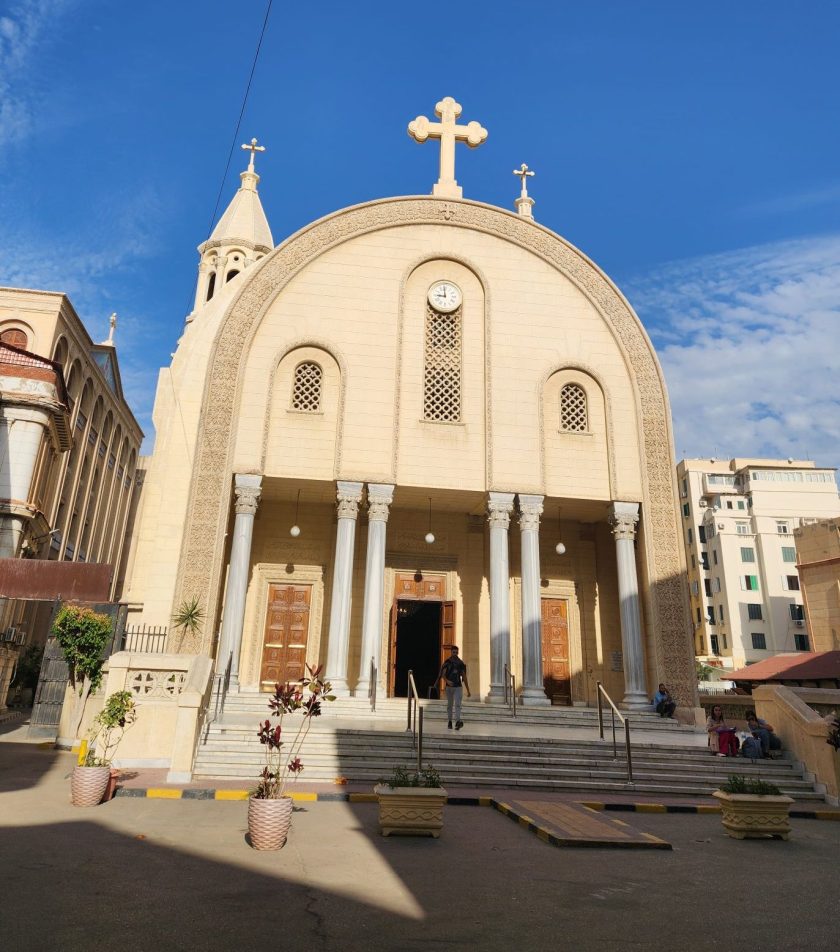
After a few chapters of Ian Fleming, I continued to walk, with the vague aid of Google Maps, towards the Mediterranean Sea. Purely by accident, Google sent me to Saint Mark’s Cathedral, and I decided to have a look. I went through a metal detector, and then was approached by a policeman who asked for my passport. After a cursory check (Australian? Yes) I was informed I could collect my passport when I left. Nervously- never like having my passport out of sight or not locked away- I continued on through another metal detector in case I managed to acquire a weapon in the last fifteen seconds, and entered the secure compound.
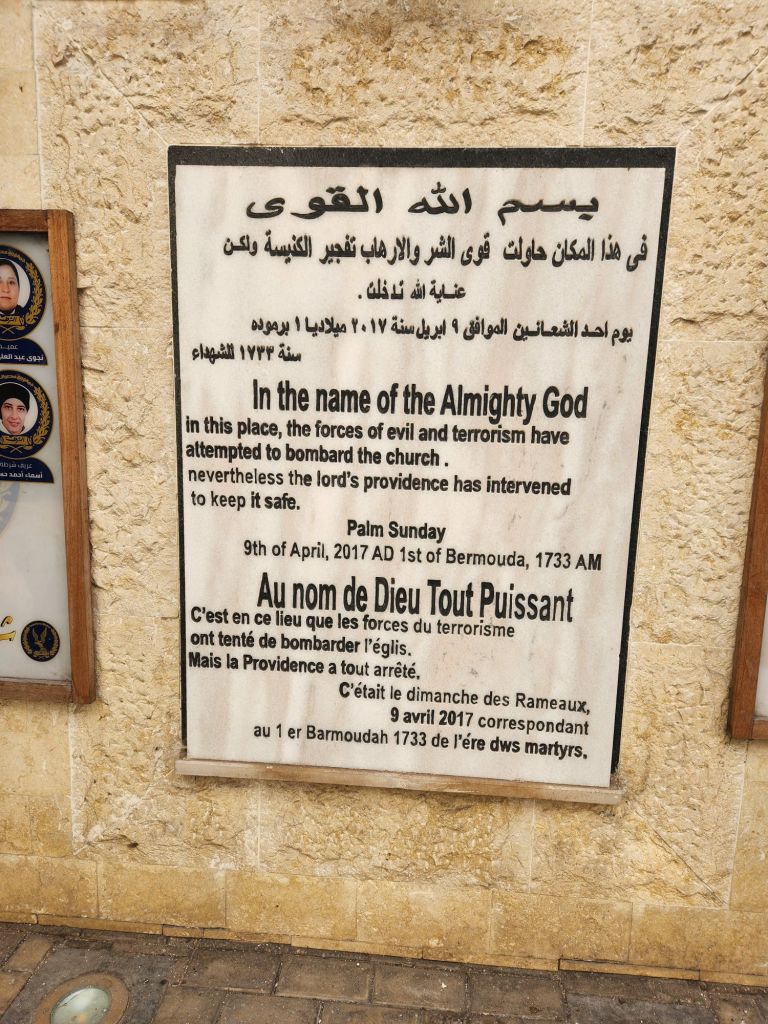
A nearby wall explained all the security. 9th of April 2017, an ISIS suicide bomber fufilled his title at the cathedral- the seat of the Pope of Alexandria, head of the Coptic Orthodox Church- killing seventeen and wounding forty-eight, as part of the Palm Sunday Church Bombings.
Largely understated explanation compared to the security presence.
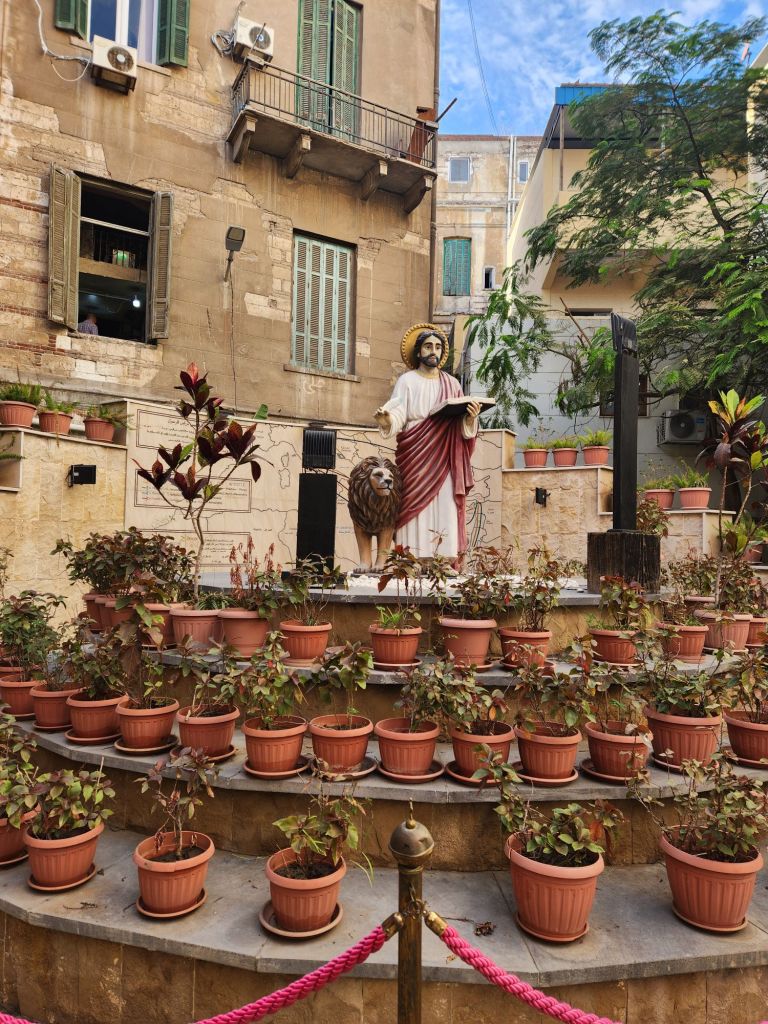
A pretty alleyway featured a display explaining the pilgrimages of Saint Mark, and I took delight in knowing I had been to some of these places in my own travels. Considering that Saint Mark was born in what is now Libya, travelling to places such as the Holy Land, modern Jordan, and Turkiye would have been a considerable undertaking.
I think they are apartments above.
I had a quick look in the cathedral, which like most modern churches, I didn’t find particularly interesting. But I did put the US dollars the police officer foisted on me in their collection box, thinking that the Copts would have solid arrangements to take advantage of international currencies.
Modern churches tend to all look the same to me.
On the way out and collecting my passport, I had a good chat with the police officer about the bombings and the security. I shook his hand and told him I hope he always gets home safe. It was a nice moment of sincerity.
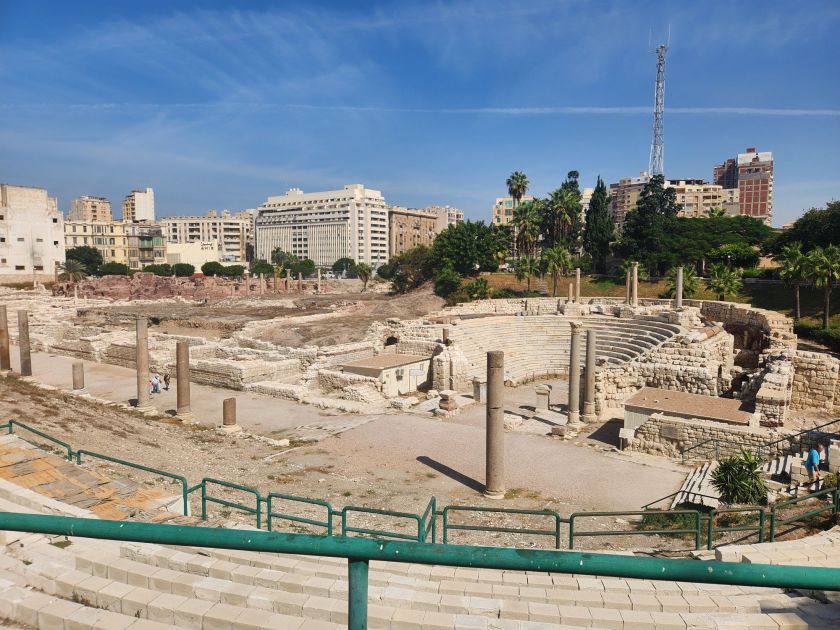
The next day I embarked to visit some of Alexandria’s lesser known sites. The first being Kom El Deka, more commonly called the Ancient Roman Theatre. The area was an upper-class residential area in the first to third century CE, by the fourth to seventh century it was much changed, and featured numerous public facilities, such as the theatre and a bathhouse.
Ancient Roman Theatre, modern neighbourhood in the background.
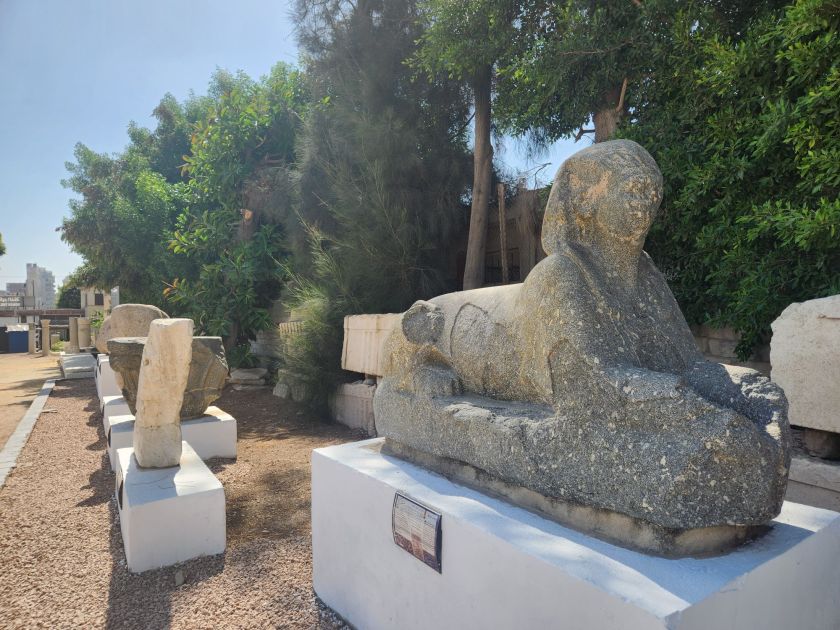
Oddly, I soon discovered statues and blocks of stone that appeared to be have been part of the lighthouse, and transported from the ocean floor to here.
Including this Sphinx
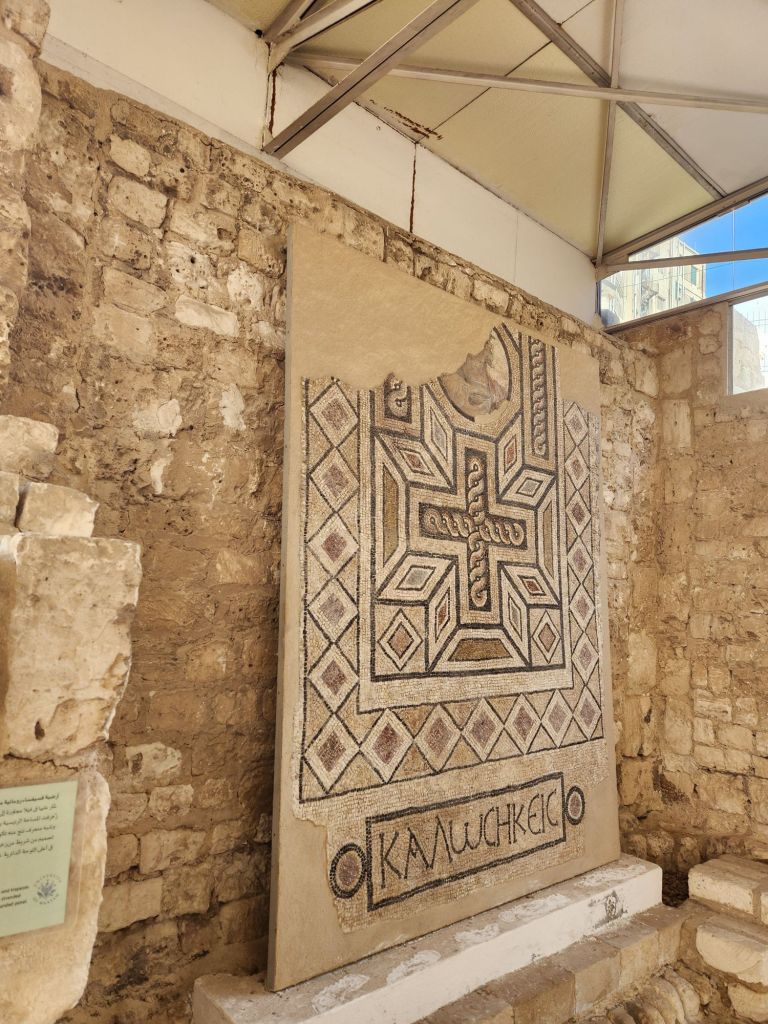
Tucked into the corner of the site was a partially restored villa, which contained several amazing mosaics and decorations.
Villa of the Birds
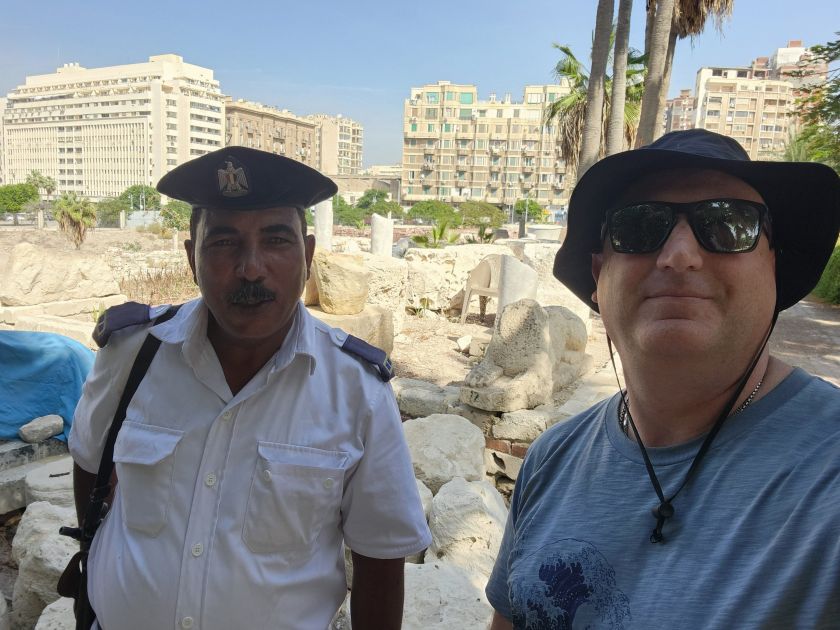
After a lap around, there was nothing further to keep me here, and I was about to leave when a machine-gun-wielding policeman offered me a cup of tea, that I accepted. We had a nice chat, and while he declined payment for the tea, he immediately hit me up to exchange some USD for Egyptian Pounds. Caught, I complied and made a mental note to be more careful about this in the future.
I kept my promise of not posting this on Facebook.
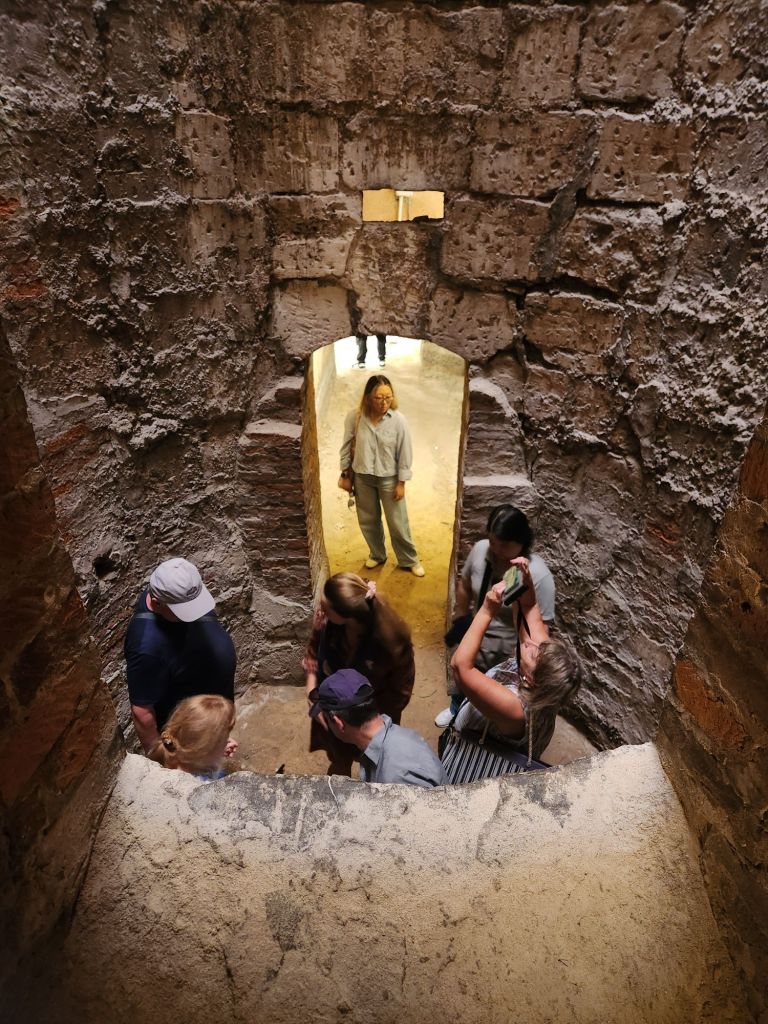
Next I visited the Catacombs of Kom El Shoqufa. Believed to have been created in the second century CE for a single family, it was expanded greatly for unknown reasons. It was rediscovered in 1900 when a donkey fell through a shaft-perhaps considering the way animals are treated, it was a deliberate act of protest. The catacombs consist of three levels, multiple chambers, and two large circular shafts that may have been used to lower the deceased into the catacombs.
shaft with a staircase wrapping around it
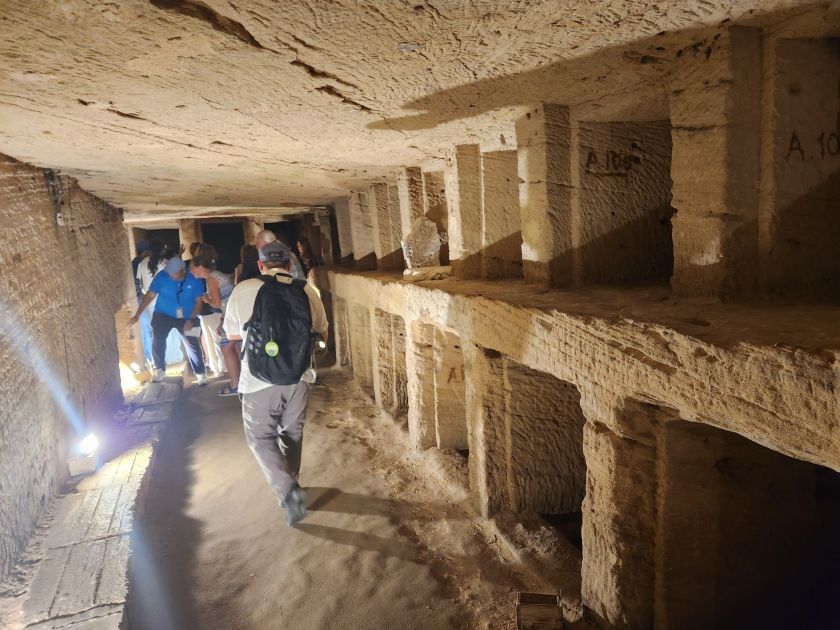
Many of the corridors and chambers feature simple stone ledges for a body to be laid to rest.
Niches
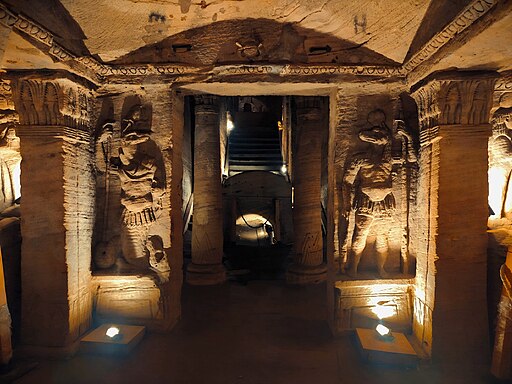
The main drawcard here is an elaborate chamber, perhaps the original families, featuring ornate carvings, and a blend of Roman, Ancient Egyptian and Greek art styles. Between the hordes of tourists and the limited ability of my phone, I struggled to document this chamber, so I will include this one from Wikipedia.
Bilal Detailz, CC BY-SA 4.0
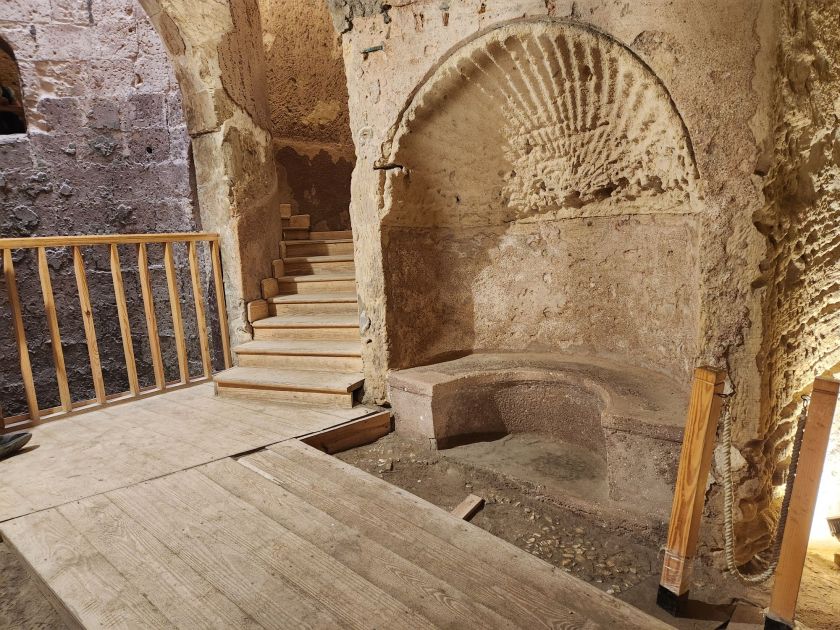
The catacombs also featured benches where mourners could sit and rest, and perhaps even eat meals close to their deceased loved ones, something that would seem very odd to modern Western eyes, but I suspect was very normal in the ancient world.
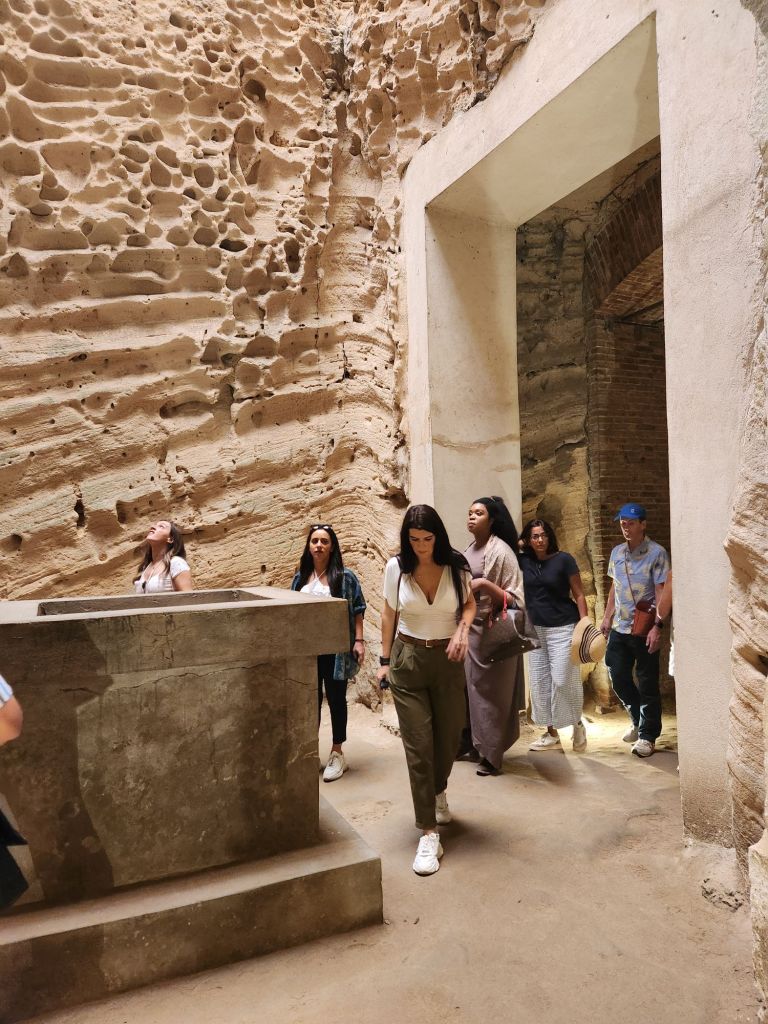
Rotunda next to shaft.
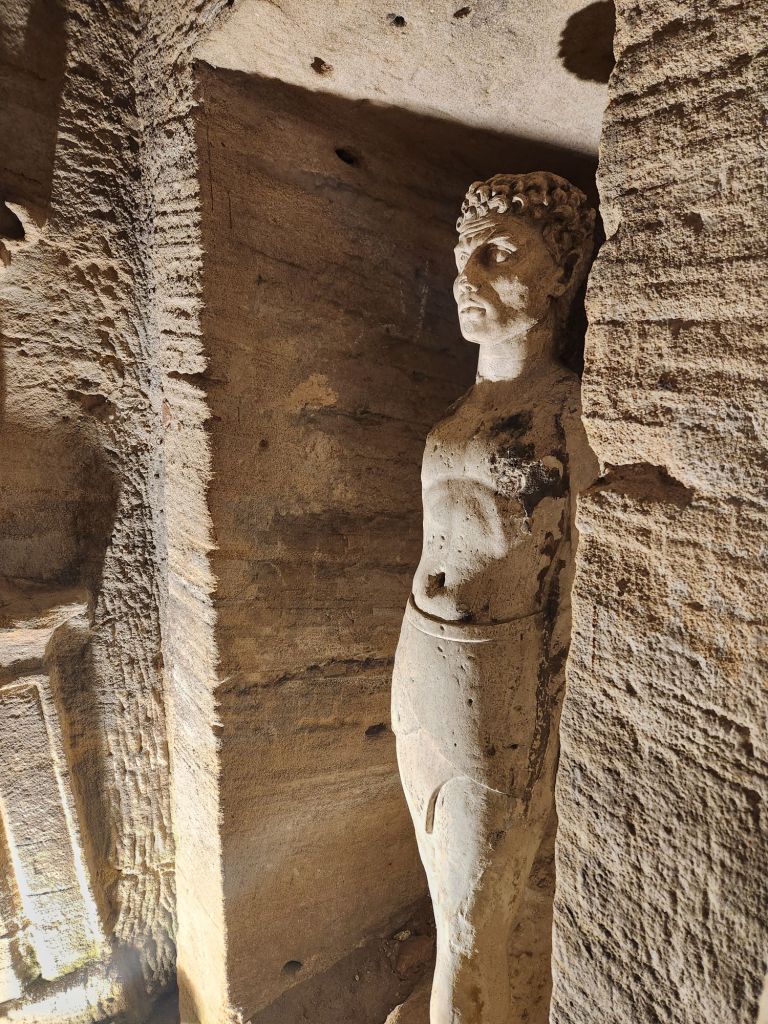
There were many impressive carvings, but I was drawn to this statue, perhaps carved in place, which is considered by some to be the original owner of the catacombs.
tucked away almost in a corner.
Of course, without a guide, many features were not clear to me, which is something I should be used to by now, but is still frustrating.
Perhaps a font for holy water? Did the Romans even do that?
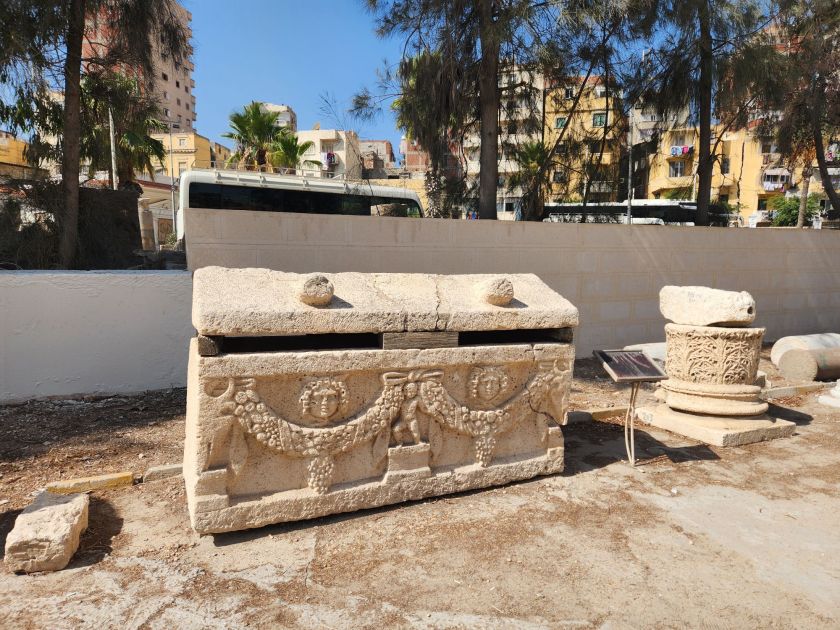
Once I was sick of bumping into my fellow tourists and trying to suppress the urge to hum the Indiana Jones theme, I made my way back to the surface, and took a few pics of the sarcophagi outside, and went for a walk.
The Great Library of Alexandria was one of the greatest centres of learning in antiquity, and scholars from every corner of the known world in the second and third centuries BCE made pilgrimages to study there. While history still lists some of the head librarians and some of the manuscripts that were held there, the actual site of the library is unknown. The importance and the contents of the library had been in decline for years before the supposed destruction by Julius Caesar in 48 BCE. Now, only the legend remains, which may be more interesting than the real history.
AI prompt was “Dusty library filled with scrolls with a creepy gnome wanking”
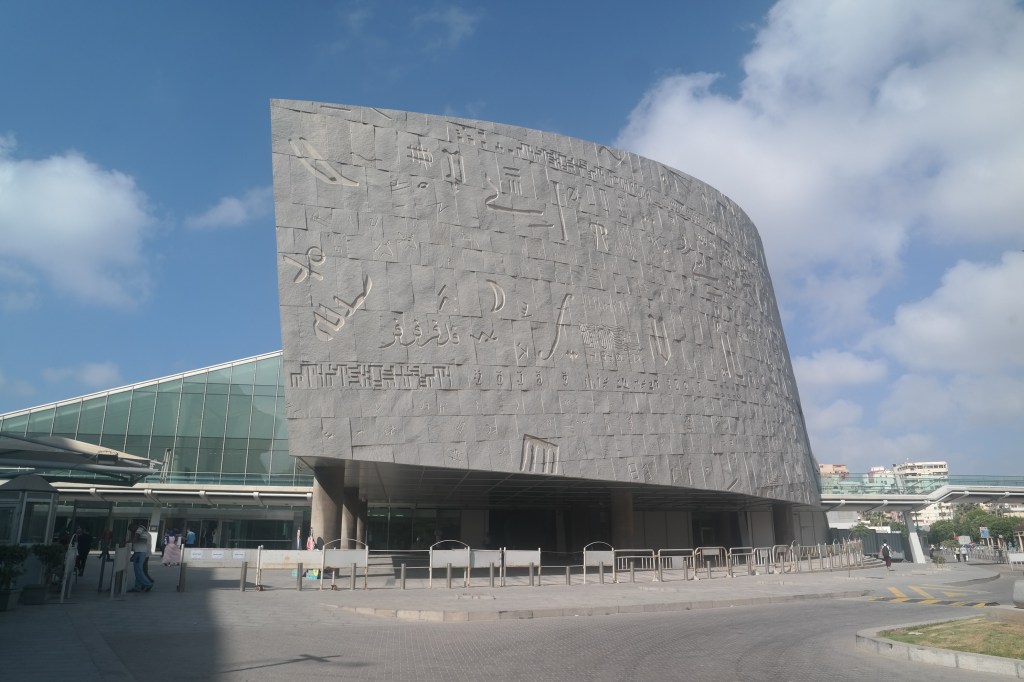
With the lack of concrete facts, and considering the remains of the Great Library of Alexandria could easily now have a Starbucks built on top of it (it’s a nice Starbucks, filled with pretty medical students when I visited), the Bibliotheca Alexandrina is much more a spiritual than a practical one, but it’s very impressive nonetheless.
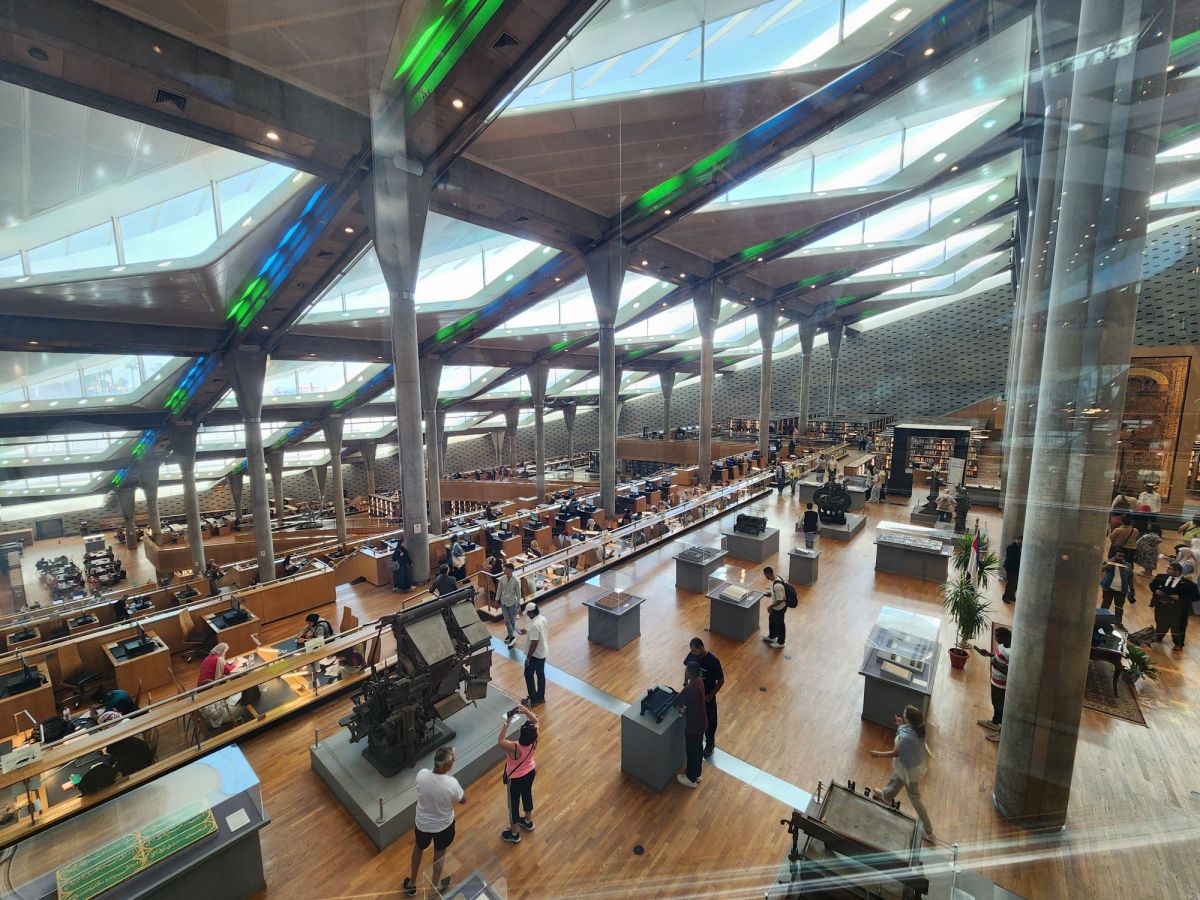
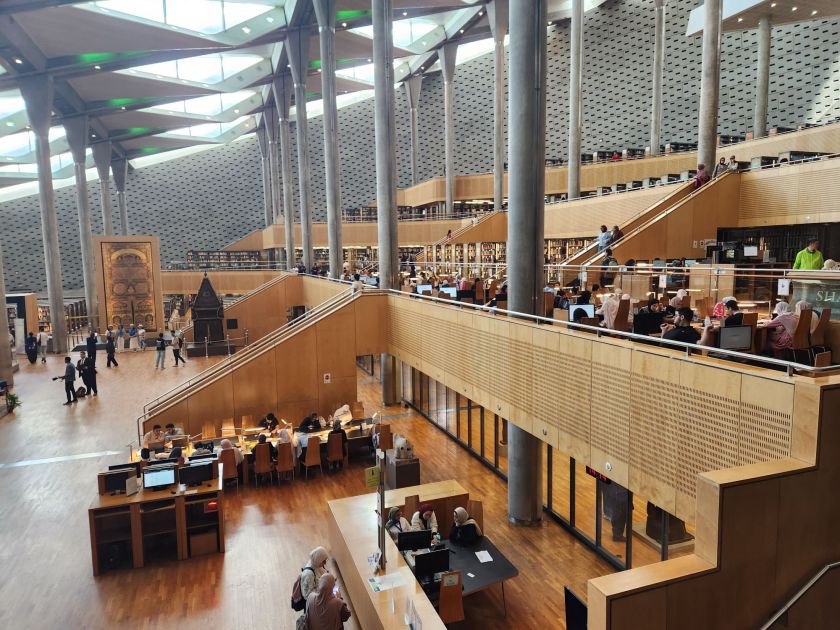
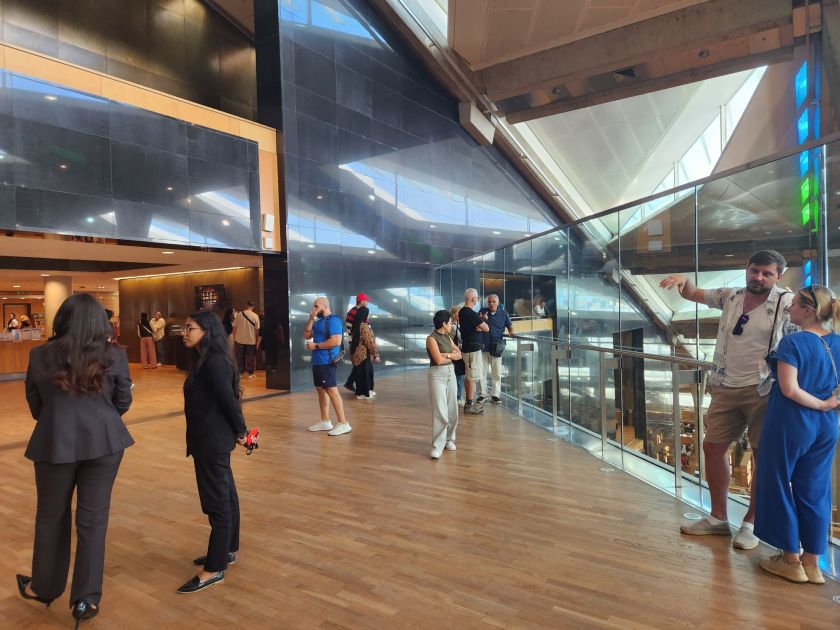
The library was officially opened in 2002, at a cost of two hundred million USD. Its main reading room sprawls over eleven levels and covers twenty thousand square metres.
Main reading room
In addition to its main library, it contains six specialised collections, including one specifically containing Braille books. Even forgetting about the books, the Bibliotecha is home to nineteen art galleries, a planetarium, a conference centre, two gift shops, two cafes, and a restaurant.
I accepted the offer of a free tour, where a stunning woman walked us through areas and explained that for a fee equivalent to two coffees, an Egyptian student can gain access to all this, in addition to internet access, catalog access, study space, and more. She explained the symbolic aspects of the architecture and answered our questions faultlessly. Her (I neglected to jot down here name) delivery was a masterclass in public speaking and interpretation, and I wished I had a tenth of her ability. I was also incredibly smitten.
Viewing platform.
I couldn’t help but think what a balancing act these incredible, smart, and beautiful women working here must perform. Trying to keep to an authentic and self-determined life, working in such a modern institute of learning, while living in a culture that insists on a tradition of women being dependent on the men in their lives. All I could do was thank her for the tour and walk away.
On the way out, numerous security types and police seemed to be milling around, waiting, and so I waited to see what would happen. Soon, a convoy of conference attendees exited the grounds in chauffeured Mercedes and BMWs, while police shut down traffic outside the library to allow them to stay together with their escorts.
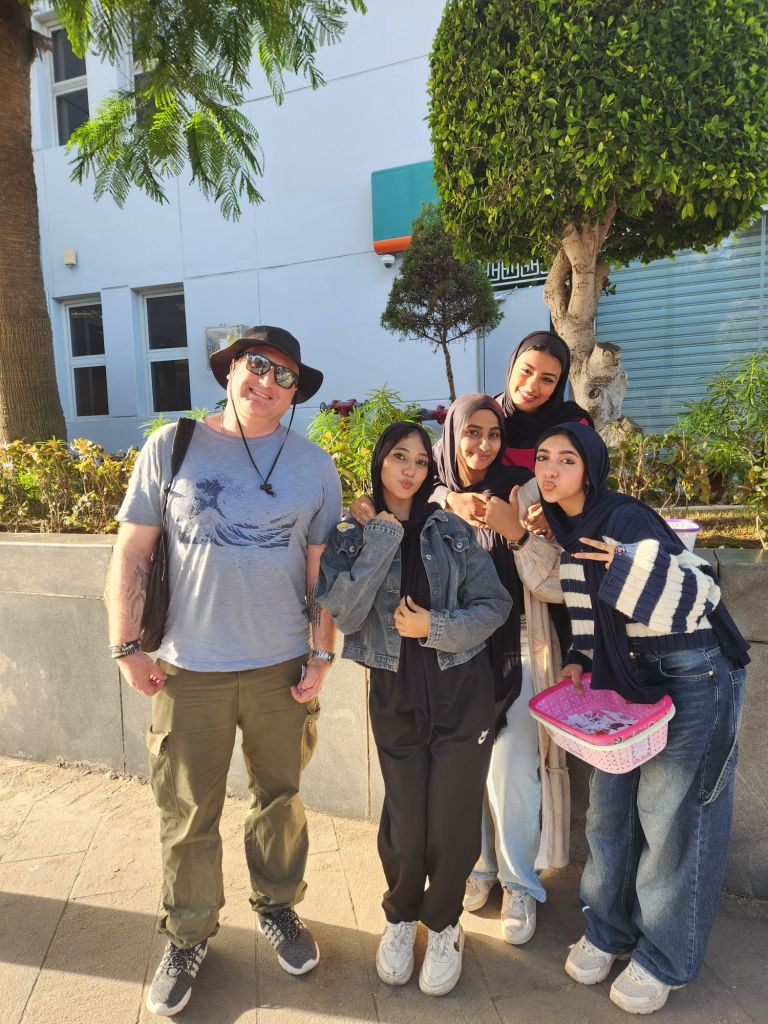
After a quick stop at a cafe for coffee and journalling, I discovered a small group of young ladies selling stickers. After walking past them I doubled back to buy some stickers and have a chat. 50 Egyptian pounds later, I asked if I could get a photo, which they were good-natured enough to consent to, with one of them offering to take the photo.
Hamming it up!
When I looked back at the photo, I said “Awwww, beautiful Egyptian ladies” which seemed to make them very happy as I said thank you and departed.
One day, when these amazing Egyptian women become a powerful force in Egyptian politics, Egypt will experience a rapid improvement for all its people.
The first thing I noticed on the Uber ride from the bus station to my hotel was the considerable number of medical supply shops. The next was the women. I had gotten used to 99% of Egyptian women wearing headscarves, and often the full hijab, with some covering even their eyes with black cloth, leading to them walking into the kind of people they wanted to be isolated from. Now, I was seeing at least half the women with fully exposed heads of perfect hair. If I were a poet, this would have caused me to write pages and pages of overwrought, terrible verses.
As it was, I almost gave myself whiplash. My tired brain finally put it all together after a quick Google search; Alexandria is host to numerous universities, including at least one exclusively for both medicine and dentistry. I suspect that very few women embarking on such studies were willing to submit to society and religious pressure. Later, while walking towards the ocean, I discovered the Egyptian version of punks in a small group of mixed sex youths (itself unusual), which also made me very happy.
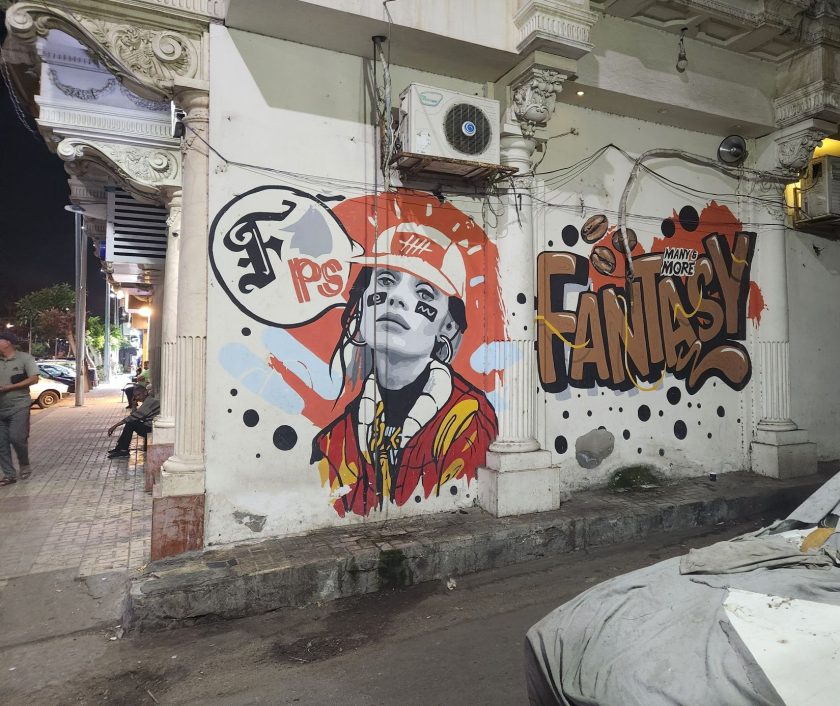
Street art near my hotel
Alexandria, founded by its namesake Alexander the Great in 331 BCE, is famous for two great structures- The Lighthouse of Alexandria and the Great Library of Alexandria. I was, of course, centuries too late to visit either of them. Screwed by my birthday again.
The Lighthouse of Alexandria was built in the third century BCE and was one of the Seven Wonders of the Ancient World. It was damaged by a series of earthquakes a thousand years ago, with much of the lighthouse ending up in the Mediterranean Sea.
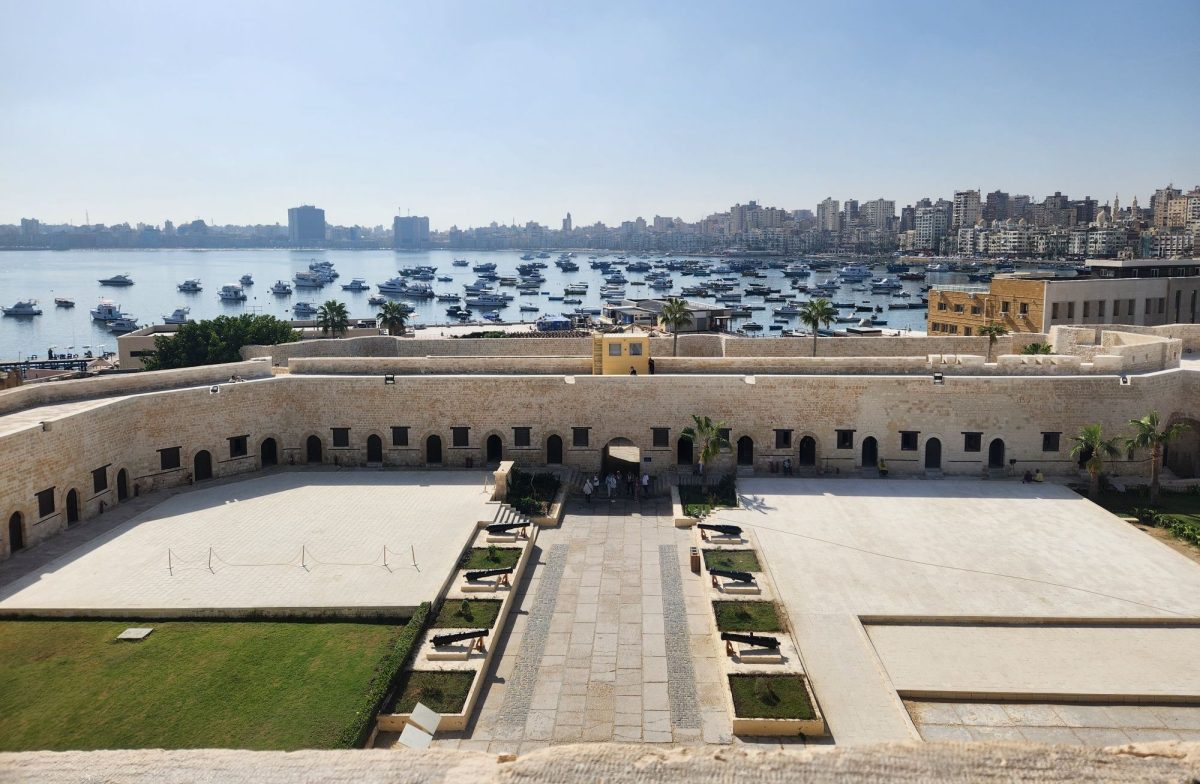
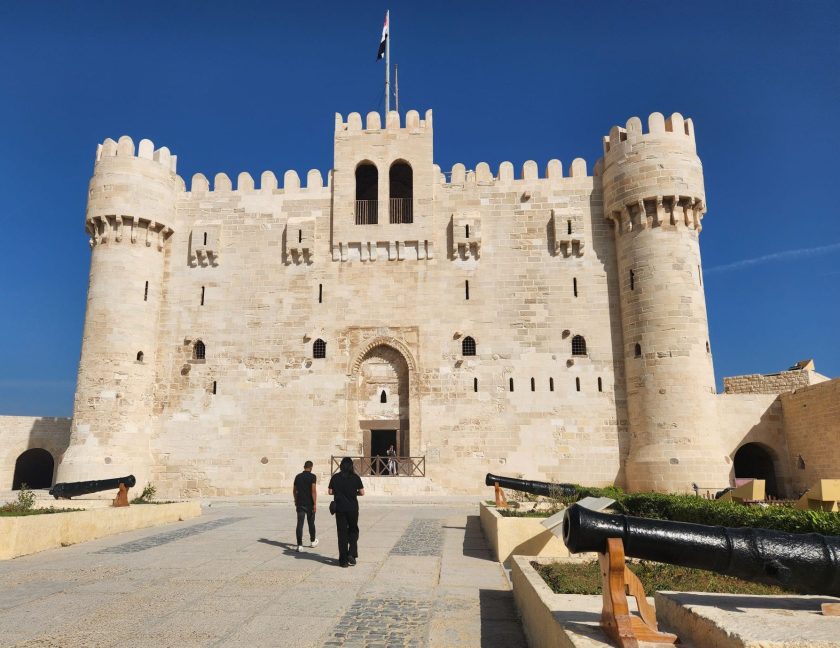
In 1480, the remainder of the lighthouse was used to build the Qaitbay Citadel, on the same site. Qaitbay Citadel was built by the Sultan of Egypt by the same name to defend the harbour of Alexandria, at the time having extreme military importance. It changed hands a number of times, and left in ruins after the British made a pointless and misguided attack.
The Citadel has been rebuilt, renovated and then restored, with 1984 being the restoration to its current state.
Qaitbay Citadel, from the main car park.
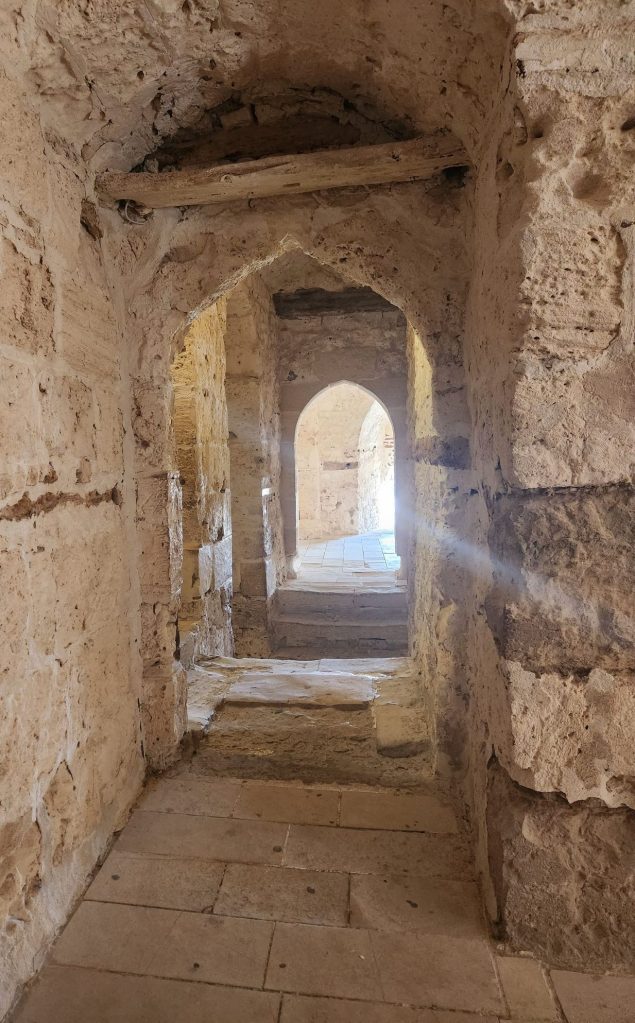
My camera took this oportunity to die entirely here, so all my photos here on in are from my phone. While I have no idea how historically accurate the restoration was, I was impressed how light and airy much of the fort was on the inside.
First floor
In one second floor corner, a monitor is set up playing footage about the Lighthouse of Alexandria, and efforts to document the remains.
Cleaning ladies pointed me towards good areas to take photos, in an effort to get baksheesh from me, which I have to say was successful as at least they were pleasant about it.
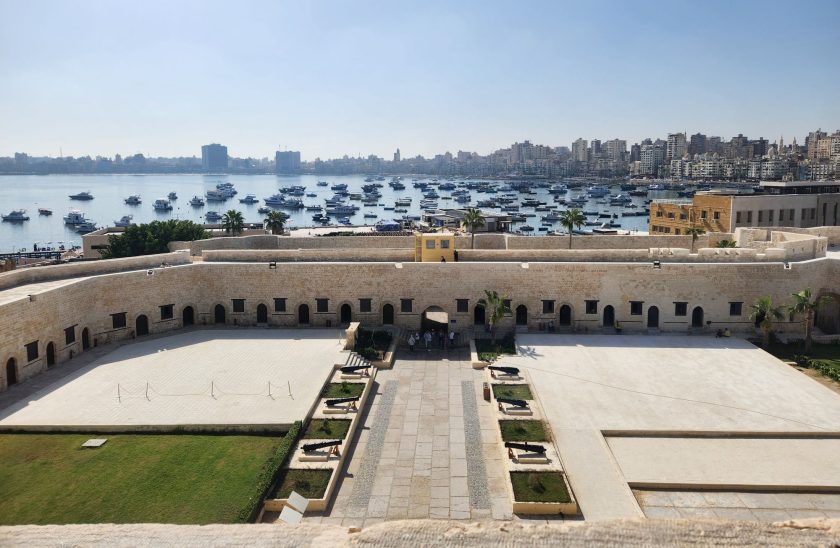
Still a busy harbour to this day.
From the highest points I could not help but try to imagine how incredible it would have been from the top of the Lighthouse, and the sheer majesty of such an endeavor. Now when we conduct public works they tend to feel sterile, replaceable and generic, instead of the stuff of legends.
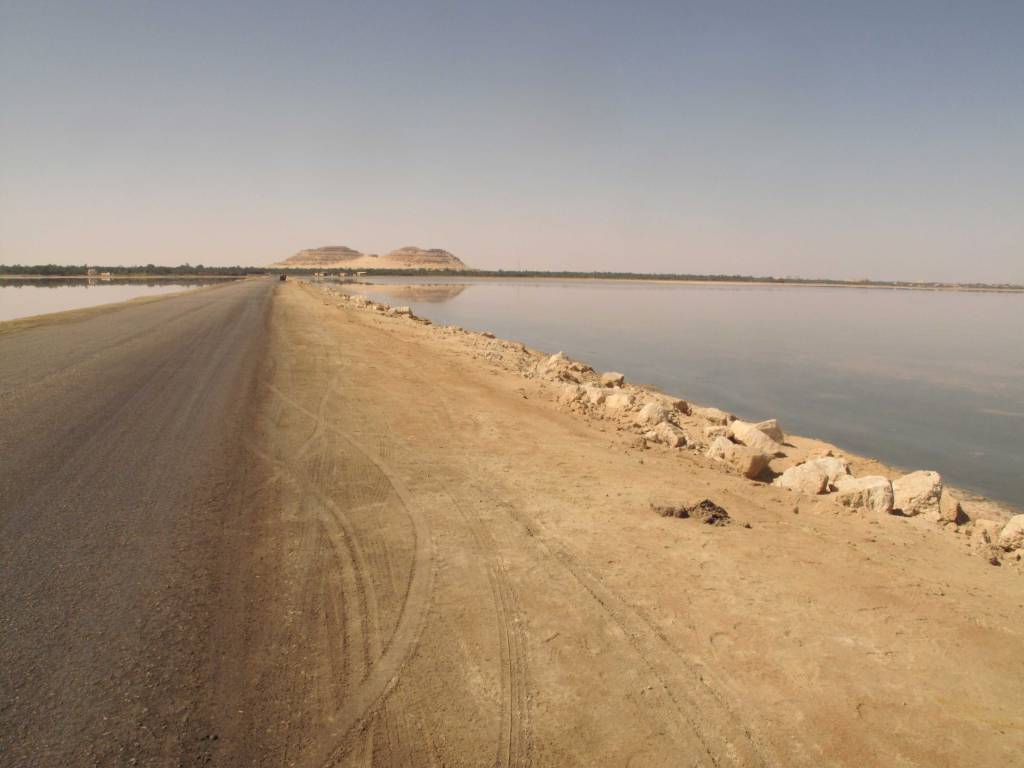
The next day, I made the mistake of spending ten minutes arguing with a tuk-tuk driver to take me to the actual oasis of Siwa. Note to self, never engage the services of anyone wearing Tommy Hilfiger, they have an excessively high opinion of the value of their services. The driver dropped me off near a closed cafe on a causeway through the oasis, and while the landscape had an undeniable desolate beauty, the oasis is huge, and any plan to walk around it was pointless.
I half expected to see human bones roadside.
There was no vegetation to offer shelter from the sun anywhere in sight, and very little of anything else. I suddenly felt very foolish as I took a few photos and started walking back towards town. Luckily ten minutes later, a couple in a late-model Toyota Land Cruiser pulled up, and I managed to bag a lift. I jumped in the backseat, and while the couple, several social and economic levels above anyone I had interacted with in Egypt so far, chatted to themselves in Arabic that seemed more melodic than the Egyptian dialect, I tried to look non-threatening and not sweat on their leather seats. They dropped me off in town near the mosque, and I didn’t insult them by offering payment, but did thank them profusely and shake hands with them before we went our separate ways.
After a few iced coffees and a light lunch at a nearby cafe, I realised there was only one thing I really needed to see in Siwa before moving on.
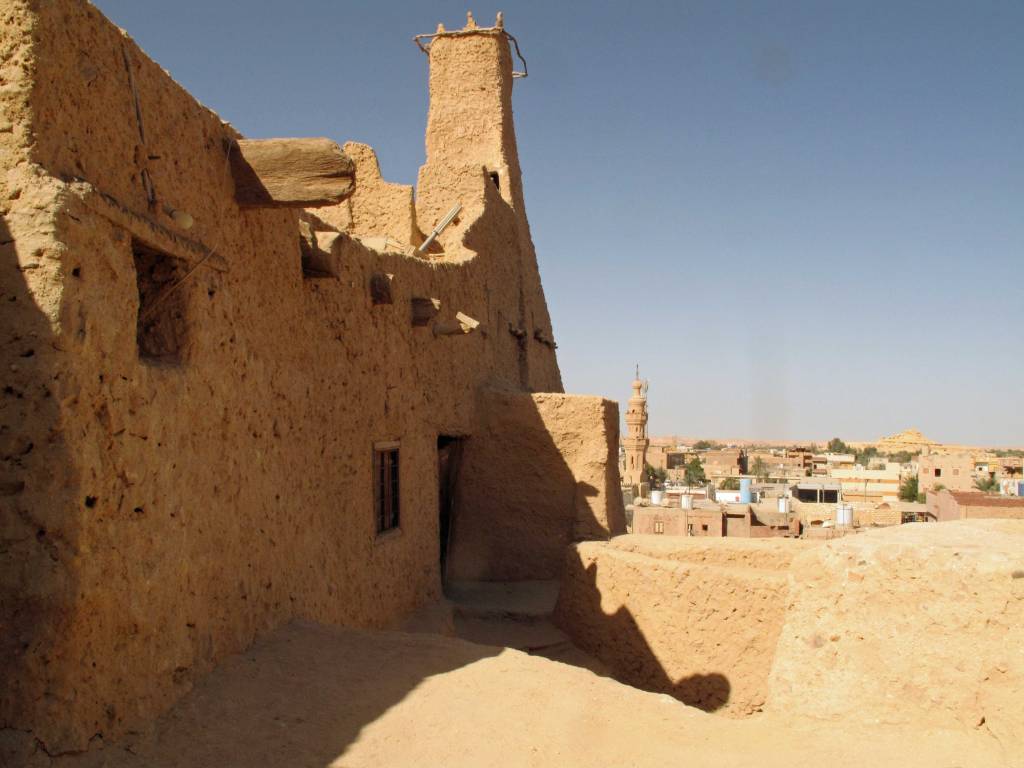
Shortly after I arrived at Siwa, I spotted a partially ruined fort on the hill overlooking the mosque, and I was immediately intrigued.
From where I started, Google Maps led me through a rubbish-strewn alley, along a loose wall of bricks, then advice from a traditionally-garbed man led me through an abandoned home and another alley. I squeezed past some parked motorbikes and unceremoniously dumped myself in an alleyway I was in on my first night in Siwa, which I could have simply walked to from where I had dinner the night before. Stairs hewn into the bedrock led me uphill, and to the ancient mosque, the only part of the fort still in official use.
Ancient Mosque
While I didn’t see anyone around, it didn’t seem like the kind of place people would have liked me poking around, especially considering my complete lack of Arabic, so I continued uphill.
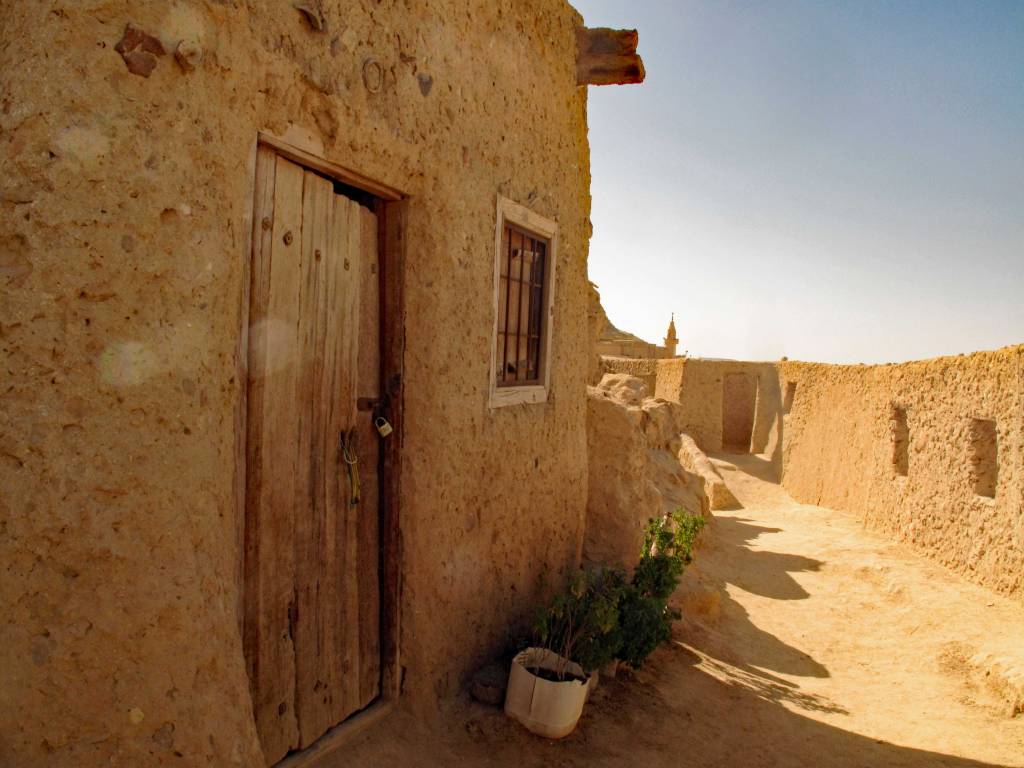
Amongst the ruins, I spotted walled sections that seemed to feature either toilets or small wells, along with a small handful of buildings that were either very small homes or storage rooms, which showed signs of use and upkeep.
But who would bother with plants in a place they were using for storage?
Finally, after scrabbling up worn steps and avoiding an incredibly attractive couple making out while taking selfies, I reached the top.
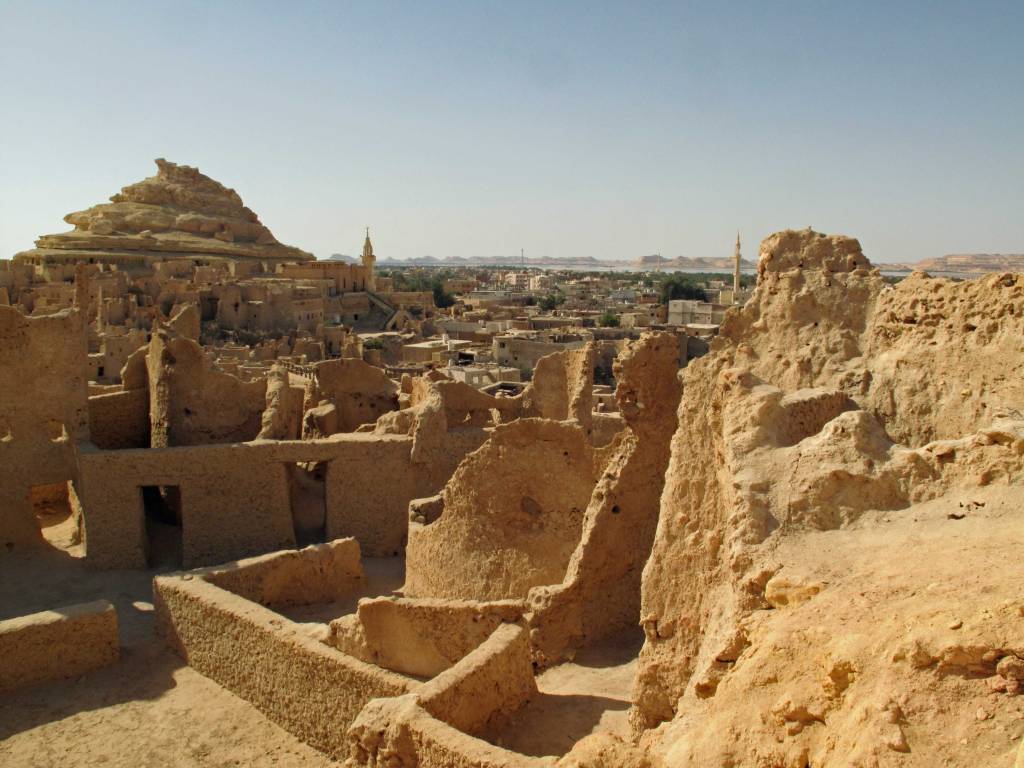
Shali Fortress
Shali Fortress was built in the twelfth century by Siwi Berbers to defend against the Bedouins. It was constructed from kercheif, a mixture of rock salt and clay. The walls survived many attacks and the passage of time until three days of rain in 1926 caused considerable damage. In 2018, locals, many of the descendants of the original Berbers, partially rebuilt the fortress.
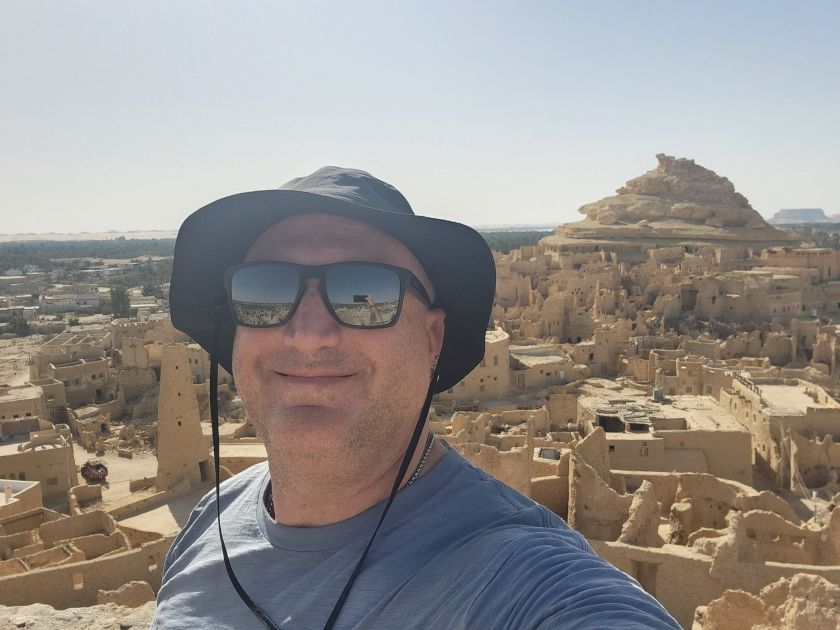
Happy as a pig in shit.
By the time I reached the top, my camera was starting to have issues, so I only have a few phone pics to show for my trouble. I could not help but think about how many people lived and died defending this fort. I suspect I only scratched the surface of the history of this place, and would dearly love to find some books written on the subject. Sadly, I struggled to find a path down to what I thought of as the town square of the fort. I could have done with a guide.
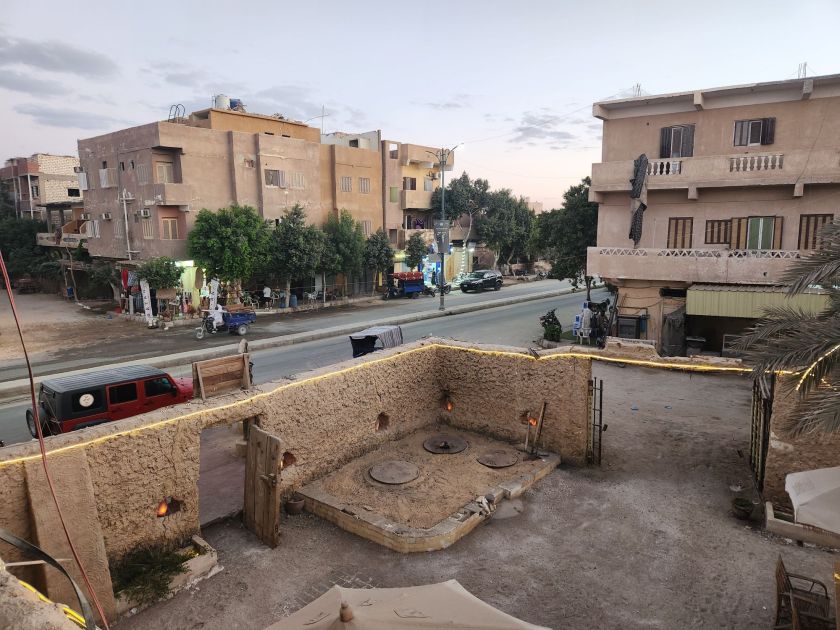
After a short stay in the seaside town of Marsa Maturah, notable only by a dip in the Red Sea at a rather ordinary beach, I headed to Siwa, near the Liberian border. I booked three nights in a place simply known as Forrest Camp, five minutes’ walk from the main street. My “tent” was a small limestone hut, a ten-second walk from the shared bathroom.
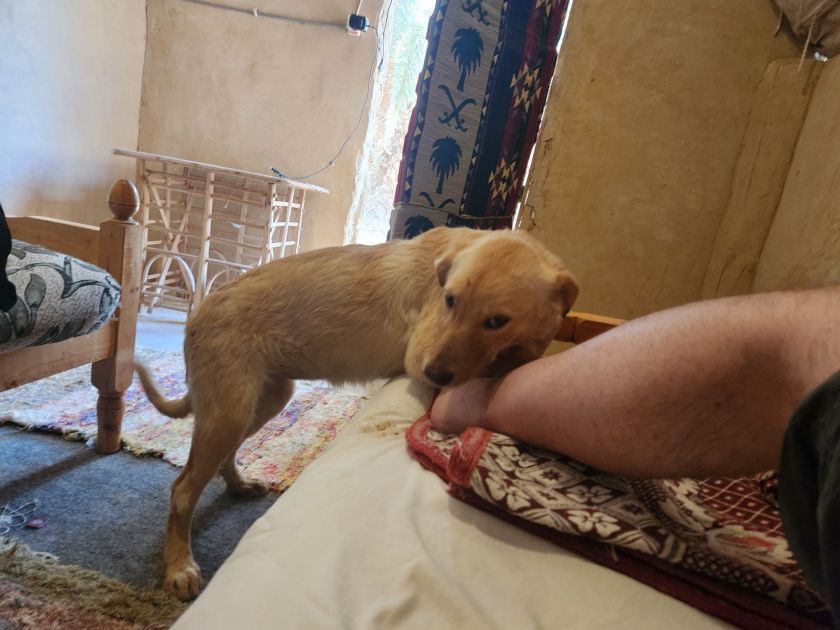
Hey pup!
It was comfortable enough, but I was disappointed that the pool featured in the listing had not been functional for months. I also had to choose between plugging in my phone or the fan, which seemed incredibly unfair.
Another view, handy having an extra bed to keep your stuff on.
However, all things considered, after spending so much time in crumbling high-rises, the natural and low-lying surroundings were welcome. That night my pay hit my account, and I decided to live it up with a fancy dinner. I walked to the main street and to one of the highest rated resturants in town that was not in a hotel.
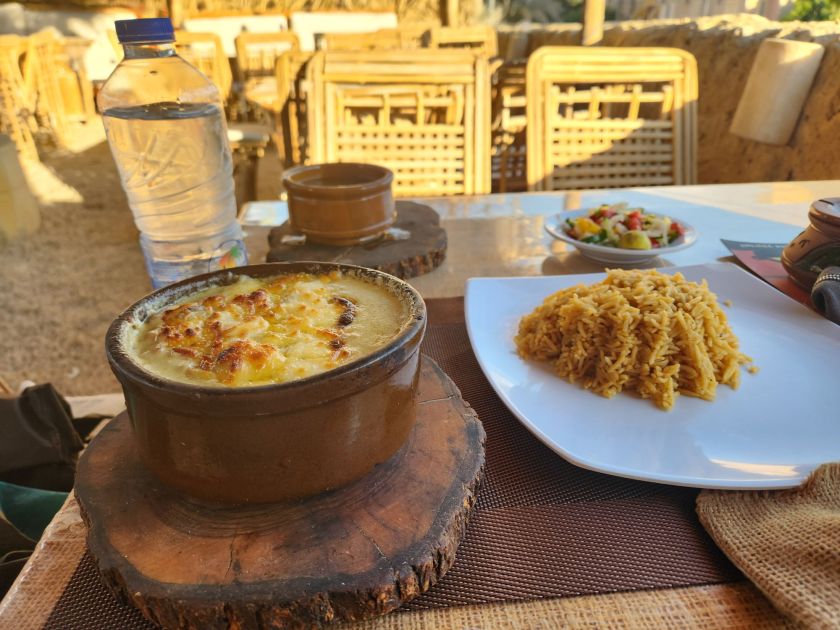
Tekeyet Elamir Restaurant & Café
I ordered Tagine el Amir, a vegetable stew topped with cheese, and it came with rice, lentil soup, and a small salad, and was delicious.
Get in my belly!
With two mango smoothies, coffee, and water, the bill was less than I would pay in Australia for an upgraded KFC meal, and I happily tipped the very attentive wait staff.
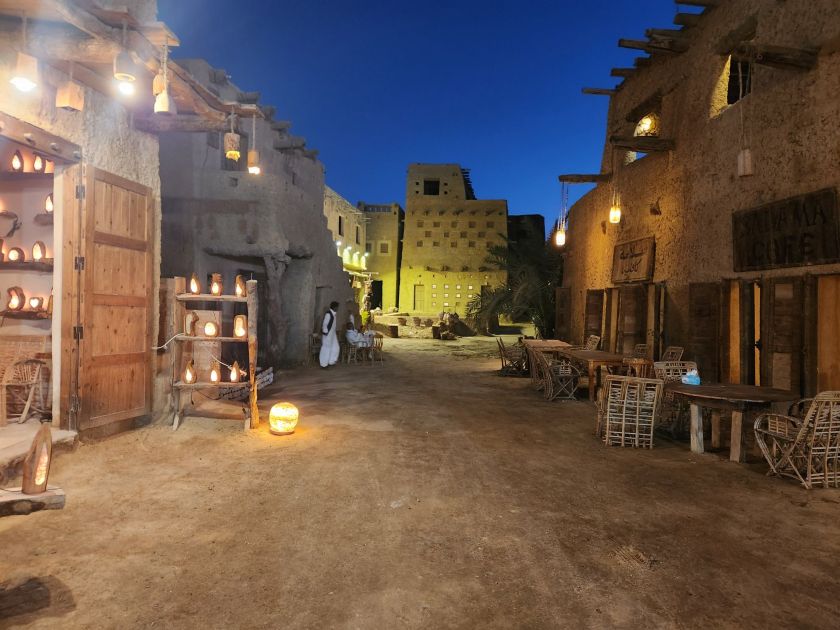
I walked into what I thought of as the downtown area after dinner, and ended up in an alley focused on selling handicrafts, which was more picturesque than tempting.
Lamps I think?
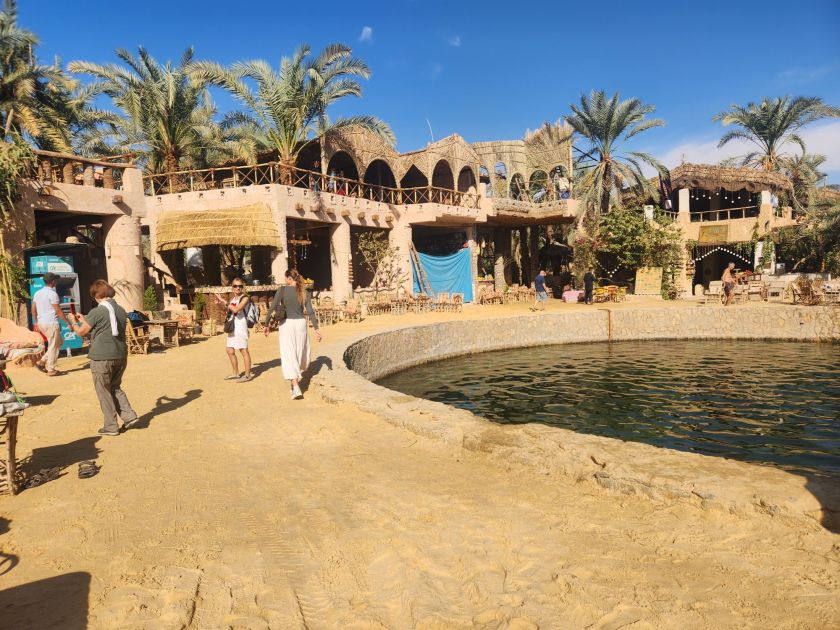
The next morning, after a coffee that was supposedly the best in Siwa, I flagged down a Tuk-tuk and, after a long and complicated negotiation, I headed to Cleopatra’s Pool. A hot spring feeds a man-made circular pool, with a constant temperature of 29°C. It’s definitely a tourist trap, surrounded by cafes and souvenir shops, and it cost me 100 EGP before I even got my toes wet.
Cleopatra’s Pool
According to legend, Cleopatra once swam here, and locals believe the water has beautifying effects. Interestingly, the most attractive person around was a long-skirted European woman, who stared at the pool longingly but never got in. Perhaps she was concerned that increasing her already considerable beauty would be more trouble than it was worth. I, however, had no such issues and quickly stripped and spent a quarter of an hour paddling around, dodging the Spanish. Drying off and enjoying my second coffee for the day, I did feel more beautiful than before, but I am unsure if that was simply the power of suggestion. After declining offers of ice cream, tours, and transport, I exited the enclosure around the pool, walked a hundred metres before realising I was going in the wrong direction, and walked back through the pool towards the Temple of Unn Ubayd.
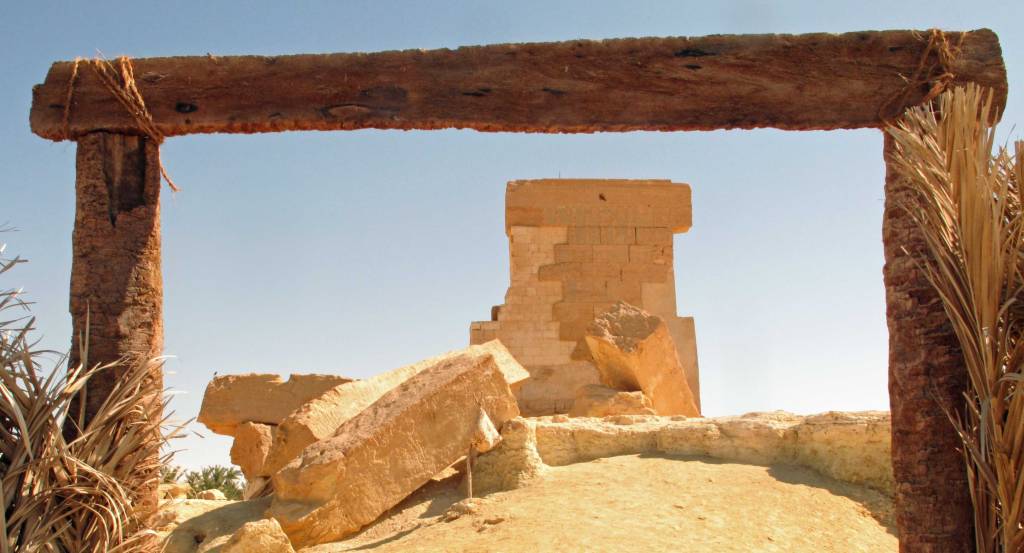
Temple of Unn Ubayd.
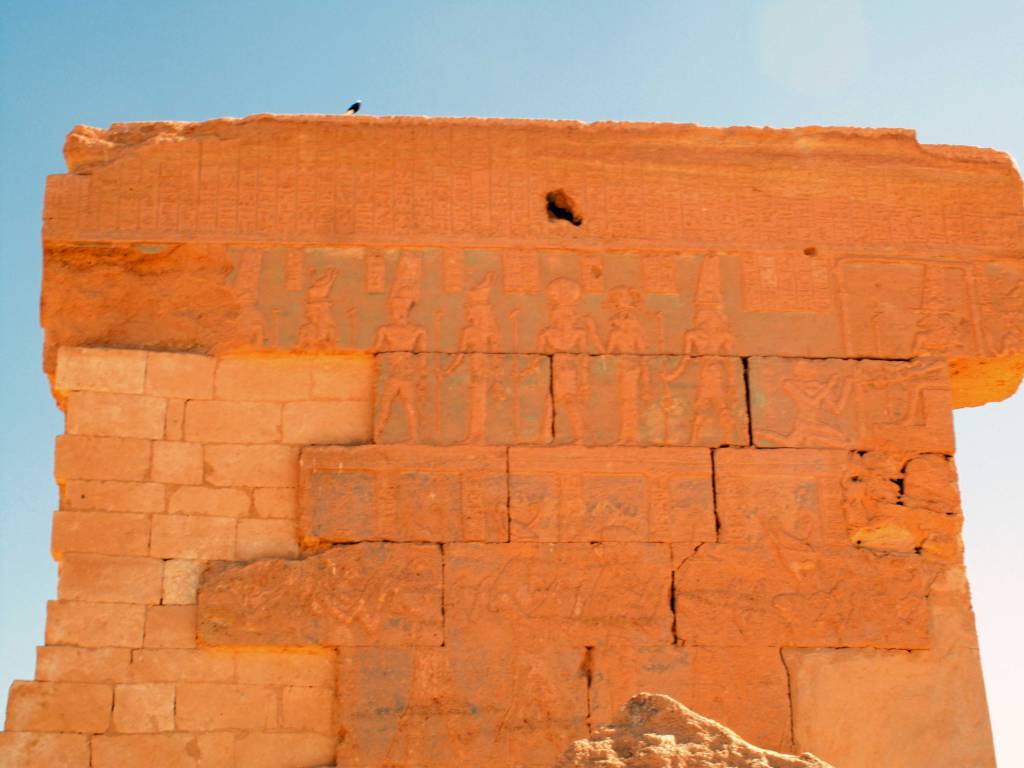
Built for the worship of Amun around 340BCE, it’s now one restored wall and a lot of rubble. It was also blessedly free of other humans. On closer examination, the restored wall features carvings typical of Ancient Egypt.
Wall detail.
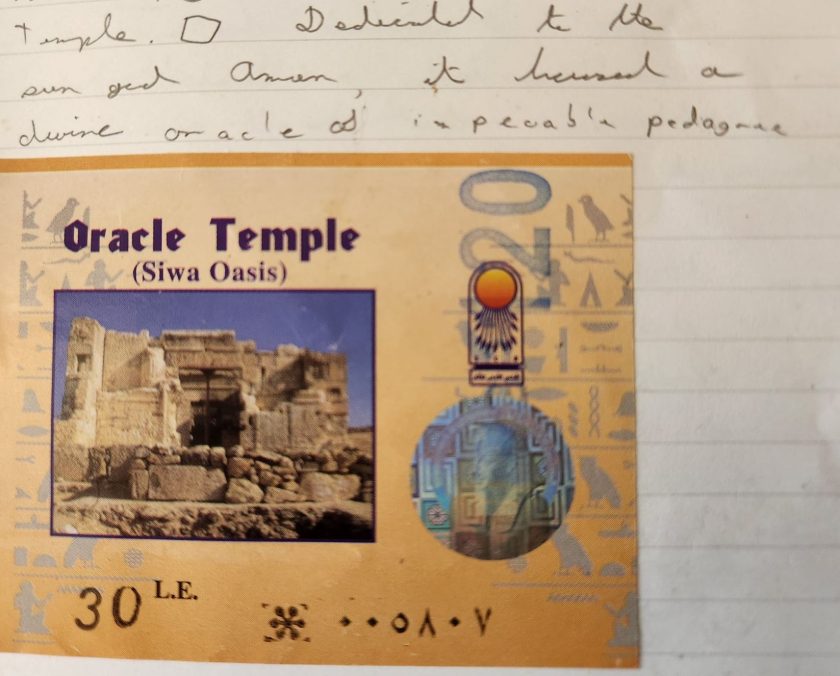
From the road, I could see on a nearby hill the main purpose of this walk in the desert sun, another temple of Amun, but more commonly known as the Oracle Temple. Now I put my phone away and relied on my somewhat dubious sense of direction. This caused me to walk through what I suspect was backyards, luckily the owners were too busy elsewhere to complain about this casual trespassing, and I made my way to the trail leading up to the temple, where small children tried to sell me toys, but also pointed me towards the ticket office, where a sleepy man hit me up for 120 EGP.
Also, scrapbooking my tickets.
Dedicated to the sun god, the temple housed a divine oracle of impeccable pedigree. The most famous of its supplicants was Alexander the Great. What the great man was told here is now lost. Whatever the truth, its importance is undeniable, and it’s impressive in its semi-restored state.
Oracle Temple
It’s also worth noting that the site is very understated compared to many historical sites in Egypt, with no surrounding tourist trap infrastructure, not counting the persistent but good-natured children. It seemed people were getting here via tour groups or hire cars, rather than walking in the sun like idiots. I couldn’t find any tuk-tuks, and, giving up, I flagged down a man on a motorbike and trailer carting dates, and managed to convince him to take me into town. Back in the main street, I handed him 100 EGP, the same amount I paid the tuk tuk driver to get to Cleopatra’s Pool, which made him very happy, making me wonder how long it would take him to earn that transporting dates around.
I left my home during a solar eclipse. I crossed forests and rivers, mountain passes and glaciers. I shared meals with princes and beggars, shared fires with soldiers and priestesses. When I reached a great desert, I drank tea with a Bedouin and traded my watch for his camel. He had no need to know the time, but he liked the way it caught the desert sun on his wrist.
I named the camel Daisy and rode him for countless days, until he expired on the edge of an oasis. I buried him and drank my fill, then continued on for countless more days.
When I knew I could walk no more, I looked up and saw the Sphinx, and fell to my knees.
“Oh Great Sphinx, which way should I go?” I asked, my voice barely above a whisper, cracking with thirst.
The Sphinx yawned, stretched his great paws, and looked down at me balefully and spoke.”Where do you want to go?” His voice was like granite boulders rolling down a mountain, in no particular hurry.
“I don’t know,” I said, knowing I would be crying if I had the water to spare.
“Then it doesn’t matter.” The Sphinx replied.
Confused, I asked, “Wait, didn’t you steal that straight from Alice in Wonderland? “
The Sphinx yawned again and stated, “You try being original for five millennia, then we can talk about plagiarism.” The Sphinx closed his eyes and began gently snoring.
“You were a big help,” I muttered darkly. I stood up, swaying in the desert wind, turned around, and started for home.
There are three things I need you to understand about the Pyramids of Giza.
It doesn’t matter how many photos, videos, blog posts, articles, and documentaries you have consumed about this place; nothing will prepare you for just how impressive they are in person.
Every bit of statue, carving, every sarcophagus, every column, every obelisk that can be dragged away and taken to a museum or private collection has been. This leads to visiting the Pyramids to be a stark experience, devoid of context.
You cannot escape the overwhelming miasma of horse and camel shit.
After managing to avoid my Uber driver’s efforts to have a tour through his brother-in-law’s, fighting my way through the touts, and paying the exorbitant entry fee, I passed through the security as if I was some dubious English lord looking for a nice piece to hang over his mantle, and was let loose inside the Giza Necropolis.
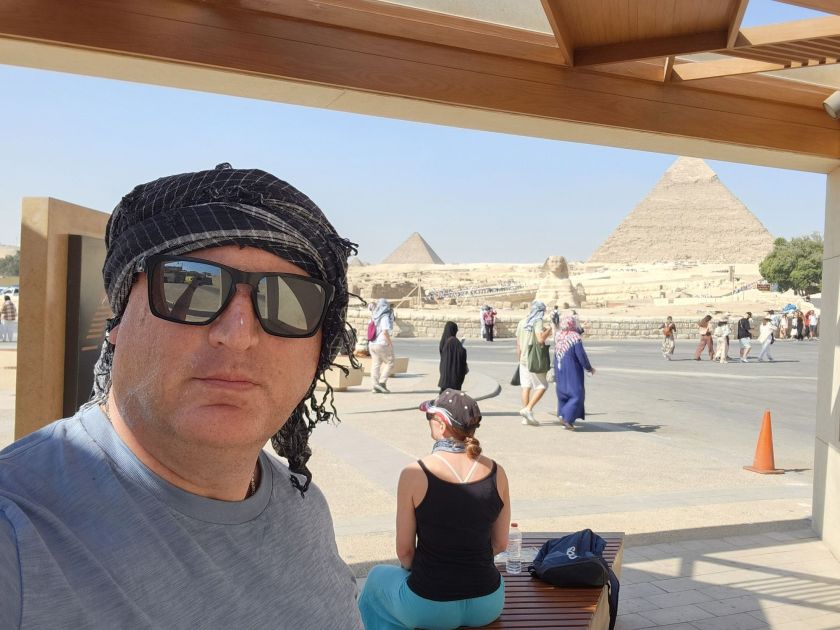
Just past the gate was a modest pavilion, and I stopped there to apply sunscreen to my delicate skin. This is where I saw my first glimpse of the Sphinx.
You kind of have to squint to see it, unlike the sunscreen on my nose.
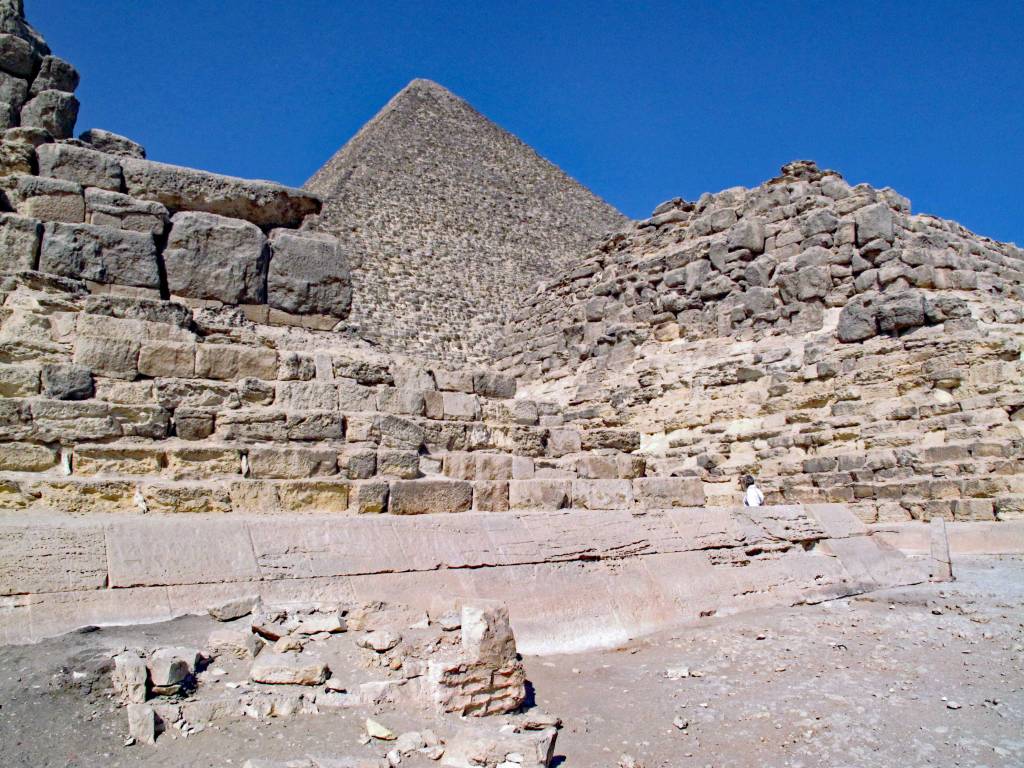
The way to the Sphinx was unclear, which I suspect was on purpose, so I walked uphill to the tomb of Meresankh III, Queen and wife of Khafre.
Tomb of Maresankh III
It was a comparatively modest structure that I enjoyed exploring despite various touts yelling at me at all times.
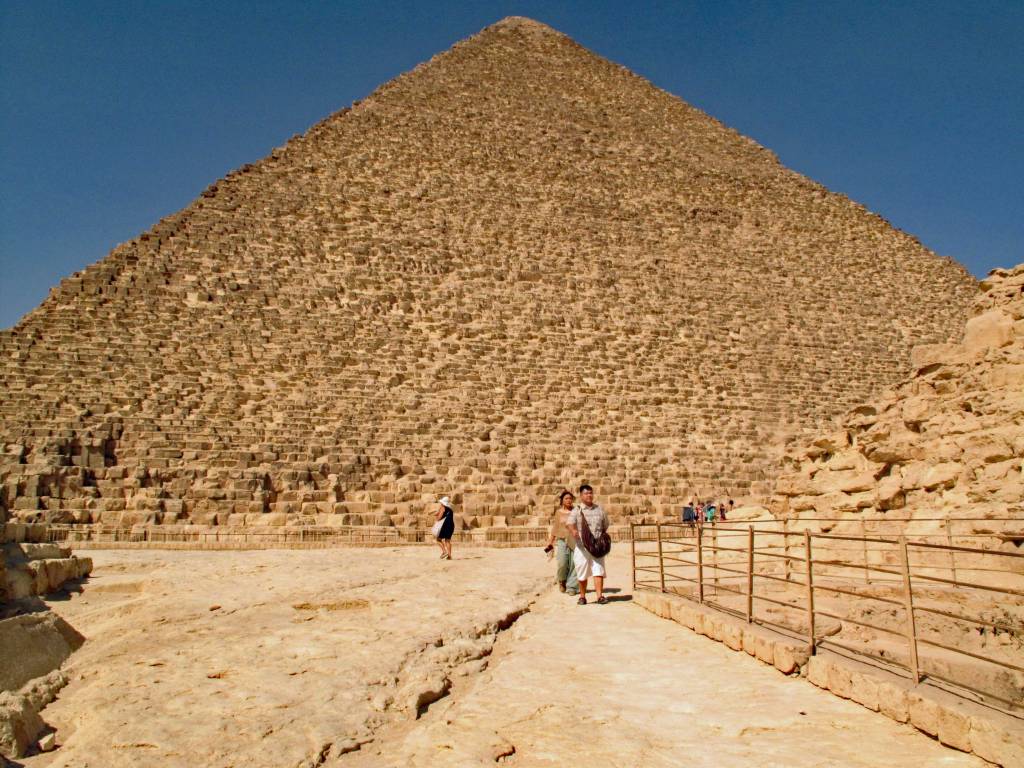
I moved on to the Great Pyramid of Giza.
Great Pyramid of Giza
Correctly known as the Pyramid of Khufu, it has lost eight metres of its height due to the pillaging of its limestone shell, but the one hundred and thirty-eight metres left was still enough to leave me dumbfounded. This colossal structure was the largest man-made building for three and a half millennia. Even with access to modern trucks, cranes, loaders, and diamond-tipped saws, the logistics to recreate it today would be staggering. It’s also the only one of the Seven Wonders of the Ancient World still standing to this day. After walking around the pyramid and taking in its majesty, I moved on to the Pyramid of Khafre.
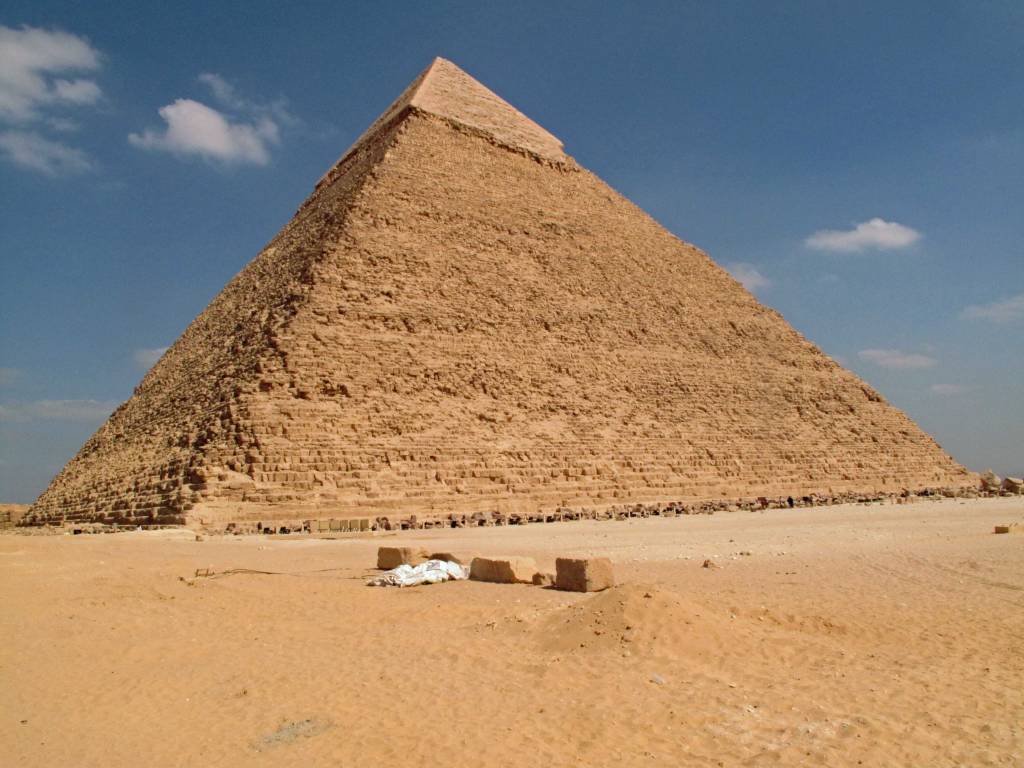
Tried removing that white thing 😦
The middle-sized of the Great Pyramids, it’s perhaps the most striking of the three due to the limestone cap that still remains to this day. Here I could have paid extra to go inside, but my claustrophobia and early-trip cheapness prevented me from taking advantage of this.
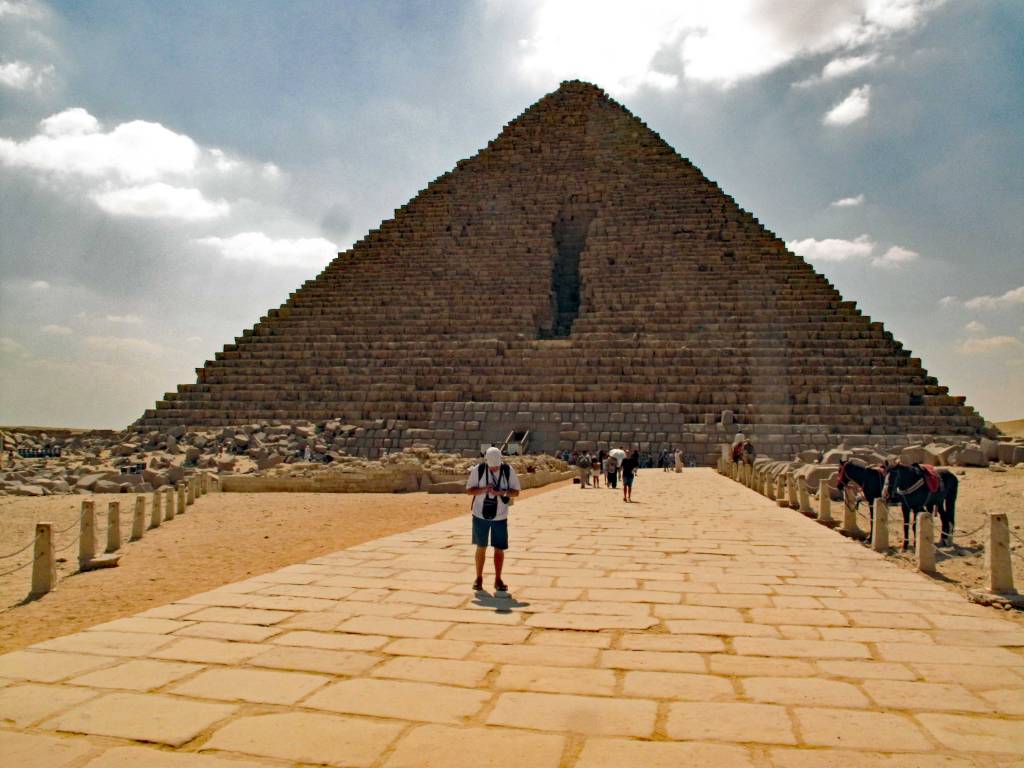
The third of the Great Pyramids is the very much reduced Pyramid of Menkaure.
Pyramid of Menkaure
It stands at sixty-one metres high today. The large vertical gash is the result of the Sultan of Egypt’s efforts to demolish it; luckily, after eight months, this act of vandalism was abandoned.
By now, I was getting worn out and baked in the sun, and I followed a group of tourists who seemed to be walking with confidence, hoping they would lead me to the Sphinx.
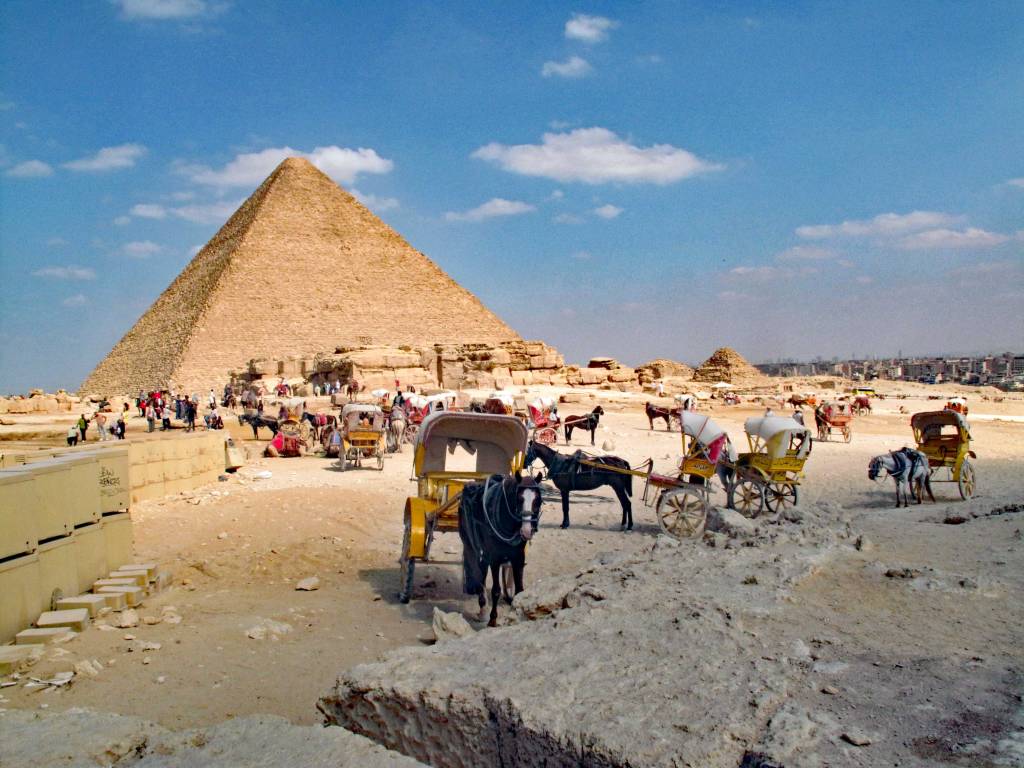
Too many horses, not enough people willing to ignore their condition.
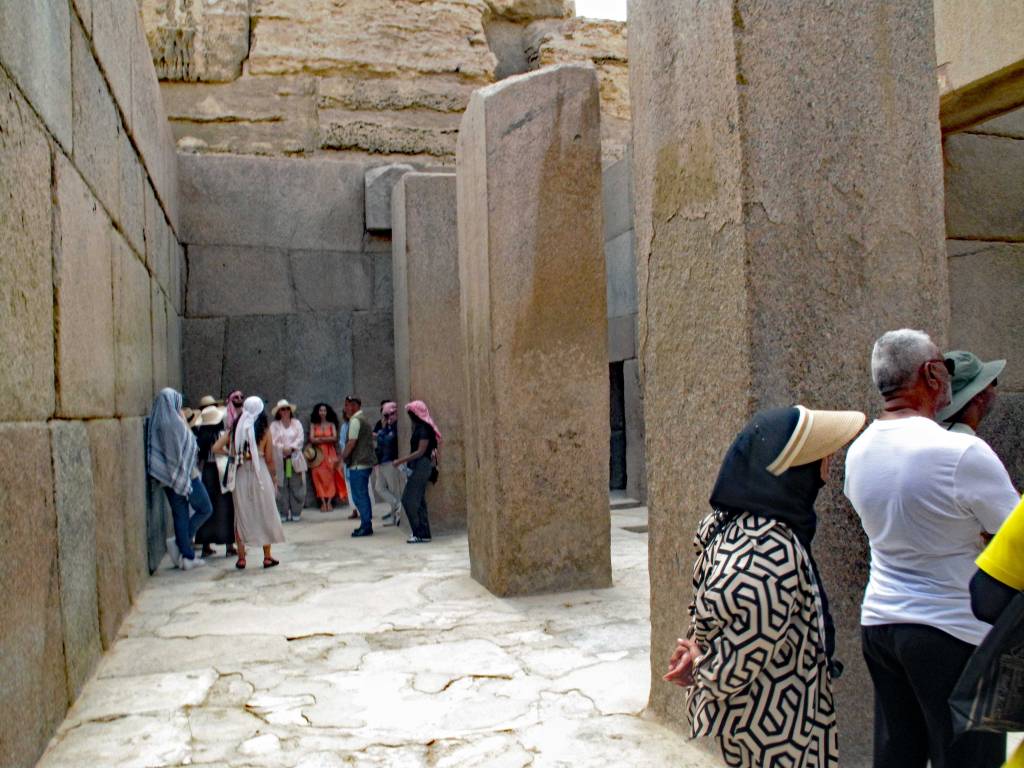
This area seemed to be where the freelance horse carriage operators congregate, away from the Great Pyramid scammer bros. I managed to find the entrance to the Sphinx, which was through the Valley Temple of Khafre, who was also one of the suspected builders of the Sphinx.
Partly restored.
Once I made my way through the temple, I climbed a causeway with a view of the Sphinx, which is the closest one can get without bribing a guard or jumping a fence.
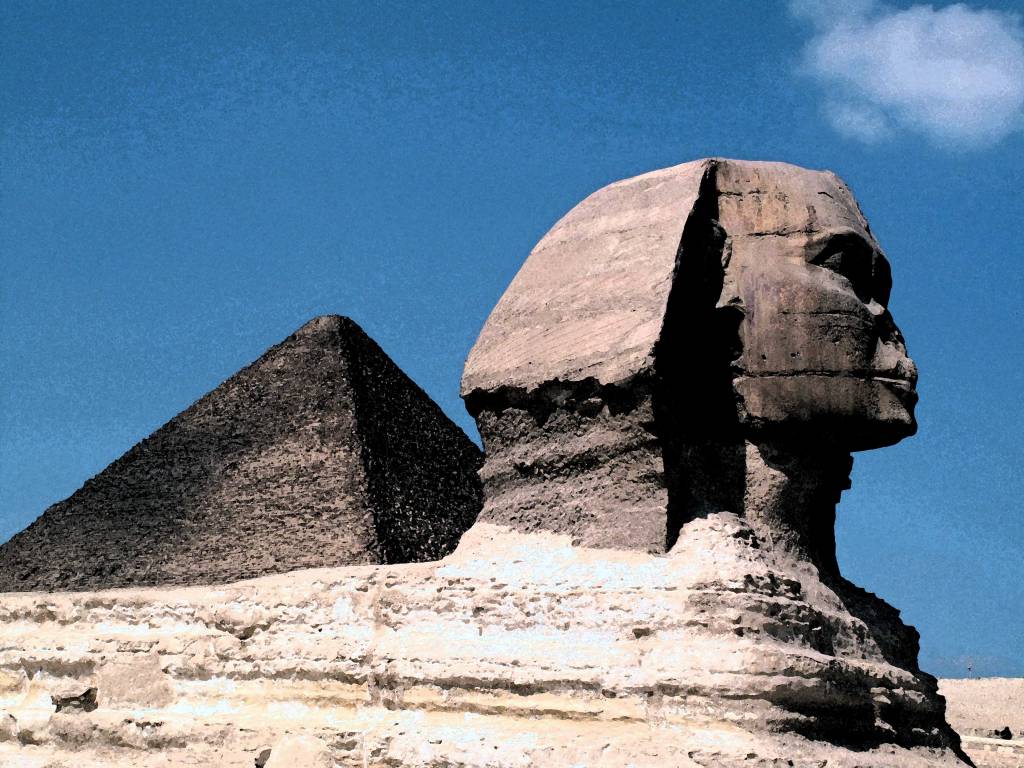
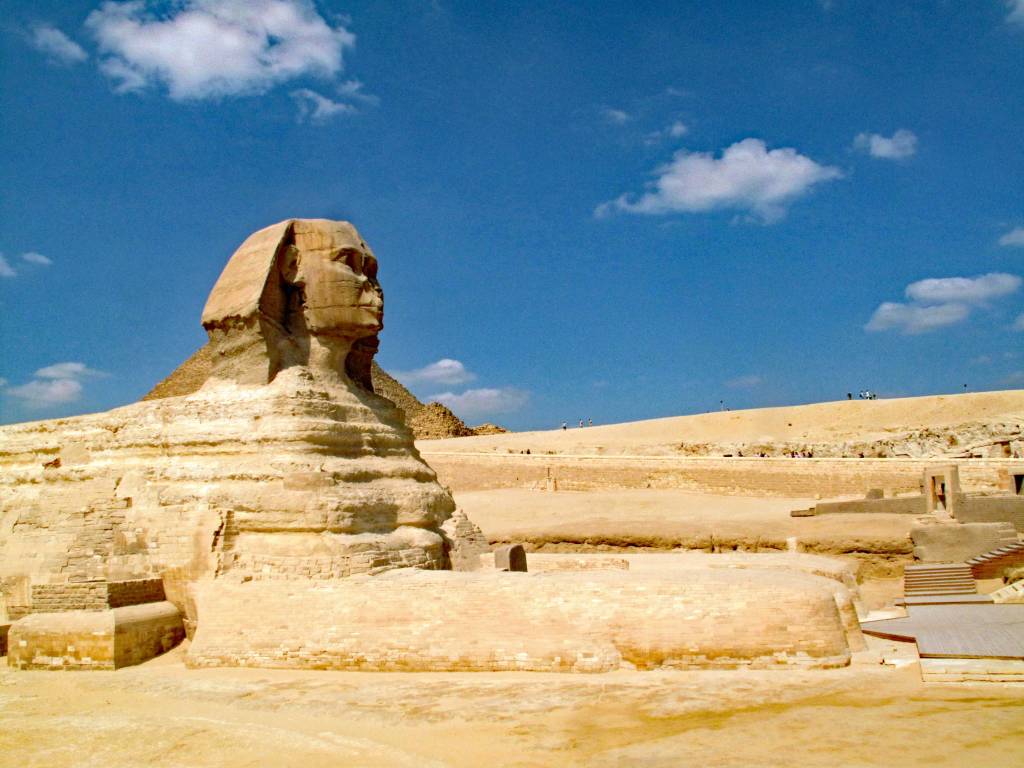
Great Sphinx of Giza.
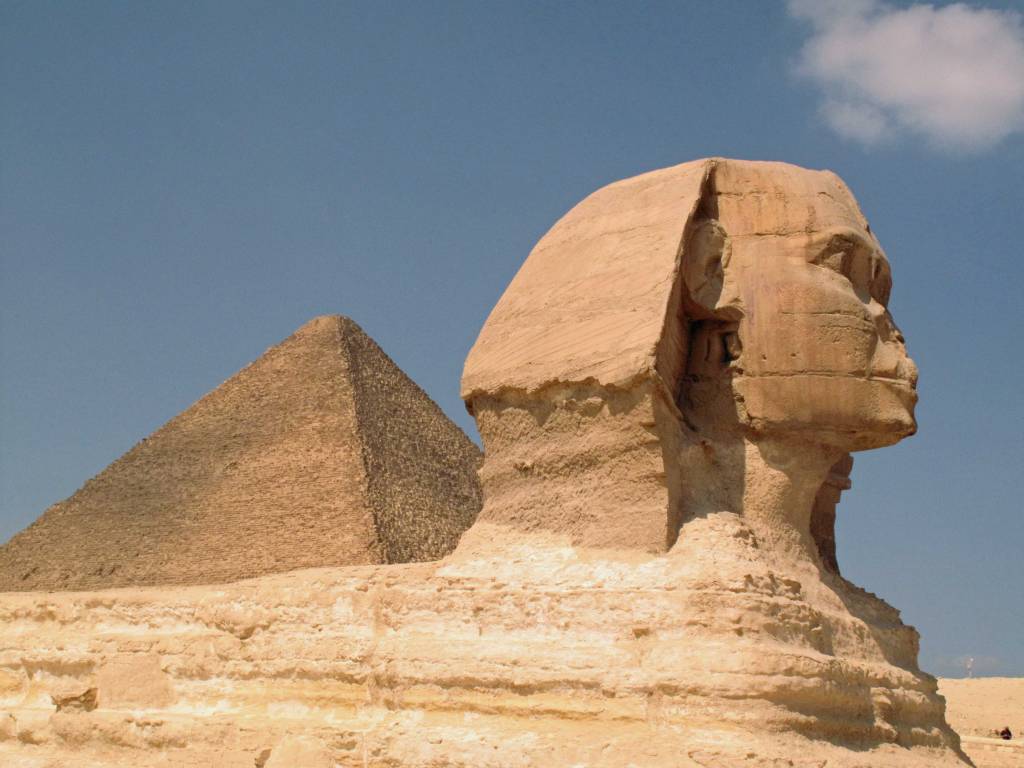
Standing taller than the nearby Pyramid of Menkaure, the Great Sphinx of Giza (It’s certainly not the only one; it’s a common motif) has been the stuff of legends since it was carved from the bedrock over four thousand years ago. I grew up reading fairy tales featuring this enigmatic statue. Including ones where the statue is alive and poses riddles to weary supplicants.
I managed to hold off on taking a selfie snogging this ancient monument, which at least placed me in the minority of the crowd on that day. He or she deserves more respect than that. I sat on the stone wall lining the causeway for a few minutes, simply soaking up the view as much as I could while tourists milled around me, taking photos from every available angle.
Great Spinx of Giza, with the Great Pyramid of Giza in the background.
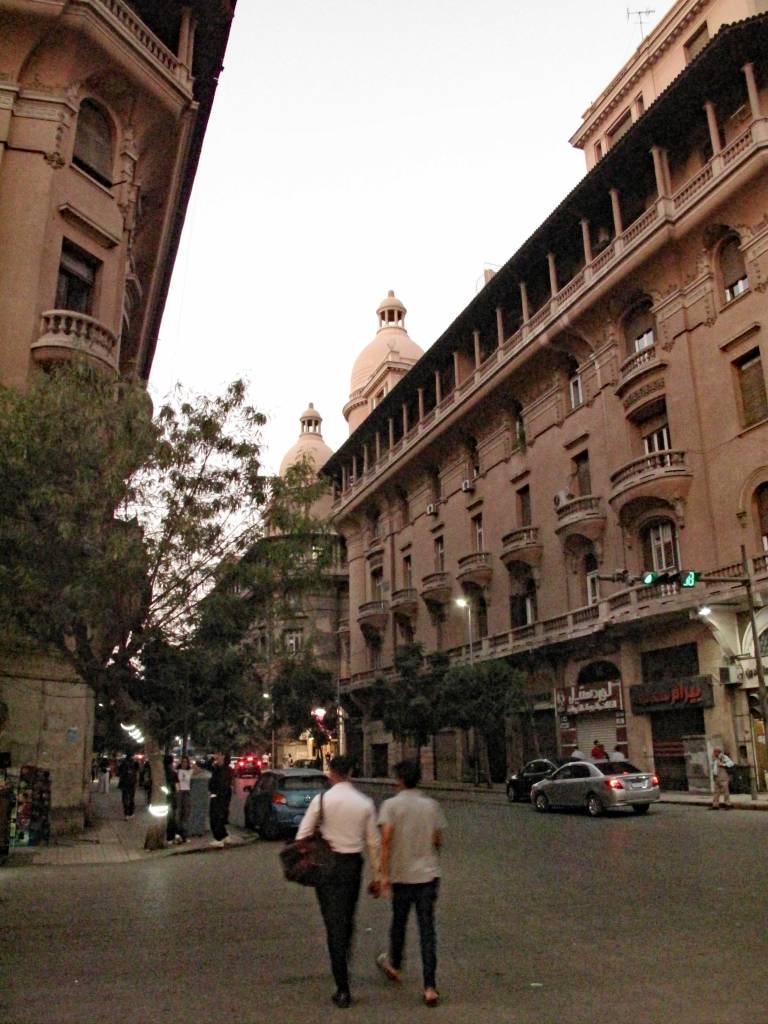
Walking along Talaat Harb Street, heading towards what I hoped was the closest bar, a young girl, perhaps no more than five, dressed more in dirt than rags, ran up to me, pointing at her bare feet. I shook my head and kept walking. She was not taking no for an answer; she kept pace, then grabbed me on the arm and started kissing me just above the elbow. I tried pulling my arm away, but she was stronger than she looked. She kept saying “Yub You” as she continued with these unwanted kisses. I finally managed to pull away from her, almost twisting my ankle as I stumbled down a curb, only for her to grab hold of my day pack, almost pulling it off me. I finally stepped into traffic and got away from her. Strangely, this seemed to all be happening as the street transitioned from the crumbling area near my hotel to the more upmarket area closer to Tahrir Square.
Skaken, I gave up on the idea of a beer and entered a small food court filled with Western fast food options, and made myself sick eating donuts and iced coffee. On the way back, I dreaded seeing her again, but she had moved on. I bought some tissues from a young girl studying on the sidewalk, and gave her my last donut. I walked back to my hotel, trying not to vomit.
After Tokyo, Cairo was a shock. No matter how crowded the train, street or shop, there was a certain minimal elegance to the behaviour of the crowd. If someone had to step on your toes, there would at least be an apologetic shrug. In Cairo, it was a much more dog-eat-dog attitude. An Egyptian will think nothing of stopping in the middle of the street to chat to a friend who is already half blocking all the pedestrian traffic. Foot traffic is often already being made harder by street vendors setting out their goods on the ground. A four-lane road will often be reduced to a single lane due to people parking on the road, usually blocking other cars in. Queuing for a toilet or to be served at a corner store, I would have people step right in front of me as if I had suddenly been rendered invisible. I made the mistake of visiting the largest and most famous market in Cairo, Khan el Khalili, and was almost injured numerous times as large motorbikes rode down tiny lanes as fast as possible. After walking around like that for an hour, I never even came close to starting to buy anything, which seemed to be a common theme. Silence is entirely unknown here, with constant car horns, constant yelling, and constant loud music. At some point, I gave up buying goods from corner stores, as the prices for my goods seemed to be twice or three times what they should be.
This is not to say I didn’t have pleasant moments. A perfume seller on the street gave me excellent directions to my hotel when I first landed. A head-scarved lady with startling blue eyes offered me some confectionery while she waited for her friend buying some costume jewellery from a street vendor. A dark-skinned lady told me I “said no beautifully” when I declined her offer of a henna tattoo before continuing on her way.
At least they are not selling sushi, which I did not trust.